
Explore the RHS Facebook Archives, a rich repository of local history written by Carol Flynn. For two decades, Carol brought a deeply dedicated voice to public education at RHS. Her role as Facebook administrator through mid-2025 naturally extended her prolific research into meticulously detailed articles, most notably her multi-part historical series posts. Today, Carol continues her local history writing for The Beverly Review and other outlets.
All Posts
The Ridge Historical Society
The Early Days of Morgan Park – Part 5: More Founders of Morgan Park
By Carol Flynn
In previous posts, we looked at two of the prominent Chicago businessmen who developed Morgan Park, Frederick H. Winston and John F. Tracy. Both were executives with the Chicago, Rock Island, and Pacific Railroad (CRI&P) and both were founders of the Blue Island Land and Building Company (BILBCo).
Other men important to Chicago’s history were also part of the BILBCo.
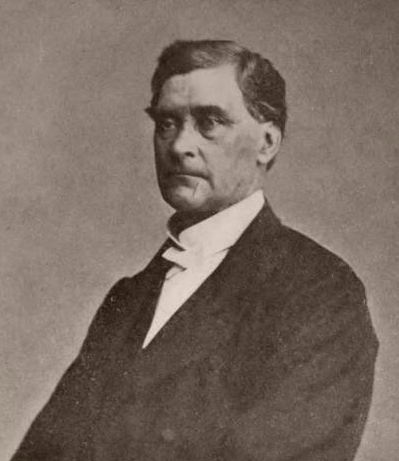
CHARLES VOLNEY DYER (1808-1878) was a physician who came from Vermont to Chicago in 1835, where he served as Surgeon for the garrison at Fort Dearborn, and later went into private practice.
Dyer made the wise decision to invest in real estate, and he was able to retire in 1858. Presumably, his investment in the BILBCo paid off favorably.
He and his wife Louisa had three children and an adopted daughter who lived to adulthood.
Dyer is best known for being an ardent abolitionist. As early as 1837, he held a protest meeting in reaction to the murder of Elijah Lovejoy by a pro-slavery mob in Alton, Illinois. Lovejoy was the owner of a newspaper that advocated for ending slavery. The Lovejoys were good friends of Abraham Lincoln, and their nephew Austin Wiswall lived in Morgan Park and was a member of the Village Board of Trustees in the 1890s.
Dyer actively fought against slavery. He became a stationmaster on the Underground Railroad, hosting many escaped slaves, some brought to him by Owen Lovejoy, Elijah’s brother.
In a famous incident, a young escaped slave staying with Dyer was re-captured by slave traders and held at a hotel. Dyer burst into the room and cut the ropes to free the youngster and told him to flee through the window. One of the slave traders attacked Dyer with a knife and Dyer beat him unconscious with his walking stick.
A later connection between Dyer and Beverly/Morgan Park was the Loring School for Girls. Dyer’s daughter Stella Dyer Loring established this private school in 1876. From 1935 until the school’s closing in 1962, it was located in the England J. Barker House at 107th Street and Longwood Drive.
Dyer's photo is attached to this post.
CHARLES W. WESTON (1833-1880) was born in Massachusetts and had a career in manufacturing and merchandising. He came to Chicago in 1866 and made a new career in real estate investment. He also invested in elevated railways, or streetcars, and was named as Treasurer of the West Chicago Elevated Railway in 1879.
Weston died of consumption (tuberculosis) at the age of 48. He was living at the Palmer House at the time with his wife Mary and their ten-year old son. A special funeral train brought his coffin and mourners to Mount Greenwood Cemetery.
JOHN BACON LYON (1829-1904) was born in New York in 1829 and came to Chicago as a grain merchant in 1857. He joined the Board of Trade and became one of the longest-standing members. It was reported that he was involved in more deals than any other grain trader in the west.
Lyon was also involved in real estate, and had interests in the timber, turpentine, oyster, and sugar industries. He was known for his insightful investments, and keen judgment, making him one of the most successful businessmen in Chicago. He was also a founding member of the Chicago Historical Society.
He, his wife Emily, and their five children lived at 262 Michigan Avenue.
The next post will look at some of the BILBCo men who lived in and developed sections of Beverly.
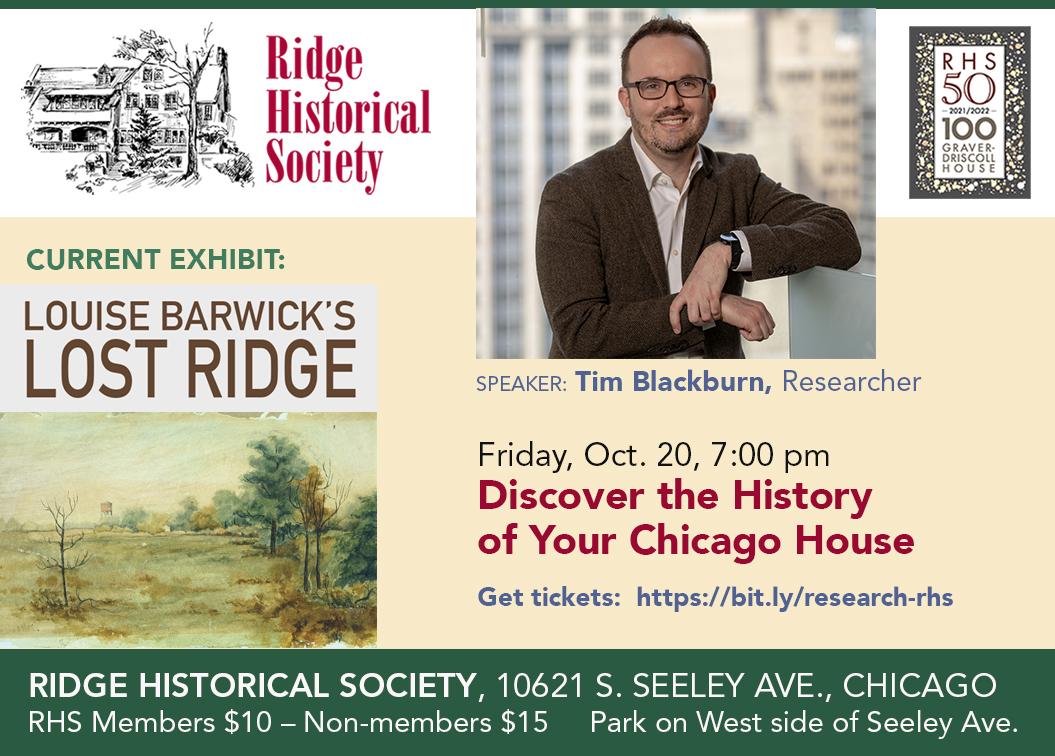
Friday, Oct. 20, 7:00 pm
“Discover the History of Your Chicago House” – Tim Blackburn, Researcher
You will learn how to research the history of your Chicago home, including the architecture, construction, inhabitants, and owners. You’ll develop research methods that will help you gain a new understanding and appreciation for your home’s history. The research methods covered will be useful for anyone researching a building older than 1955 in Chicago. You’ll learn about building permits, local history, Chicago street renumbering, Sanborn maps, and more.
Join us to find out more!
Tickets: Members: $10.00 Non-Members: $15.00 buy tickets online here:
https://bit.ly/research-rhs
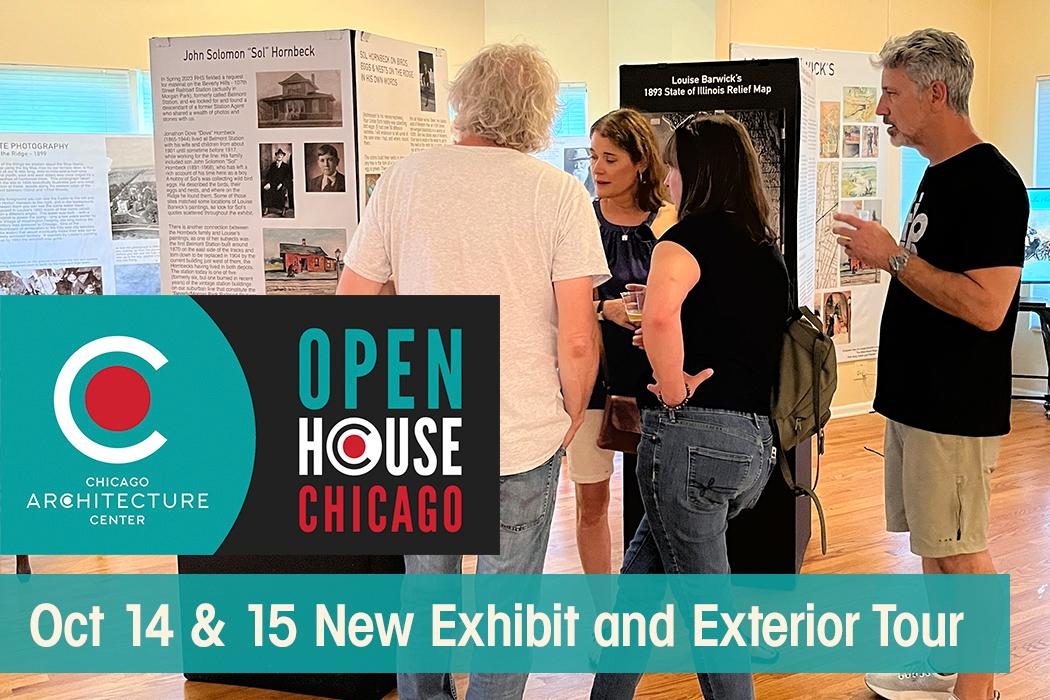
This week-end! Open House Chicago at the Ridge Historical Society.
Saturday and Sunday, October 14 and 15, 11 a.m. to 5 p.m. 10621 S. Seeley Avenue, Chicago.
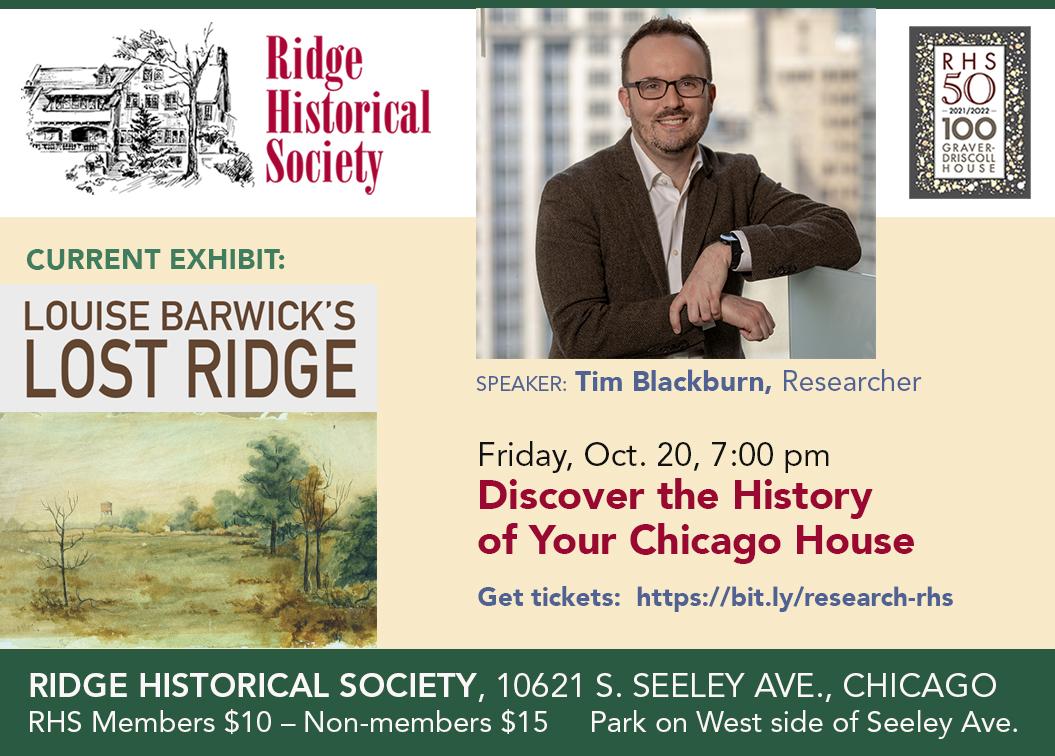
Friday, Oct. 20, 7:00 pm
“Discover the History of Your Chicago House” – Tim Blackburn, Researcher
You will learn how to research the history of your Chicago home, including the architecture, construction, inhabitants, and owners. You’ll develop research methods that will help you gain a new understanding and appreciation for your home’s history. The research methods covered will be useful for anyone researching a building older than 1955 in Chicago. You’ll learn about building permits, local history, Chicago street renumbering, Sanborn maps, and more.
Join us to find out more!
Tickets: Members: $10.00 Non-Members: $15.00 buy tickets online here:
https://bit.ly/research-rhs
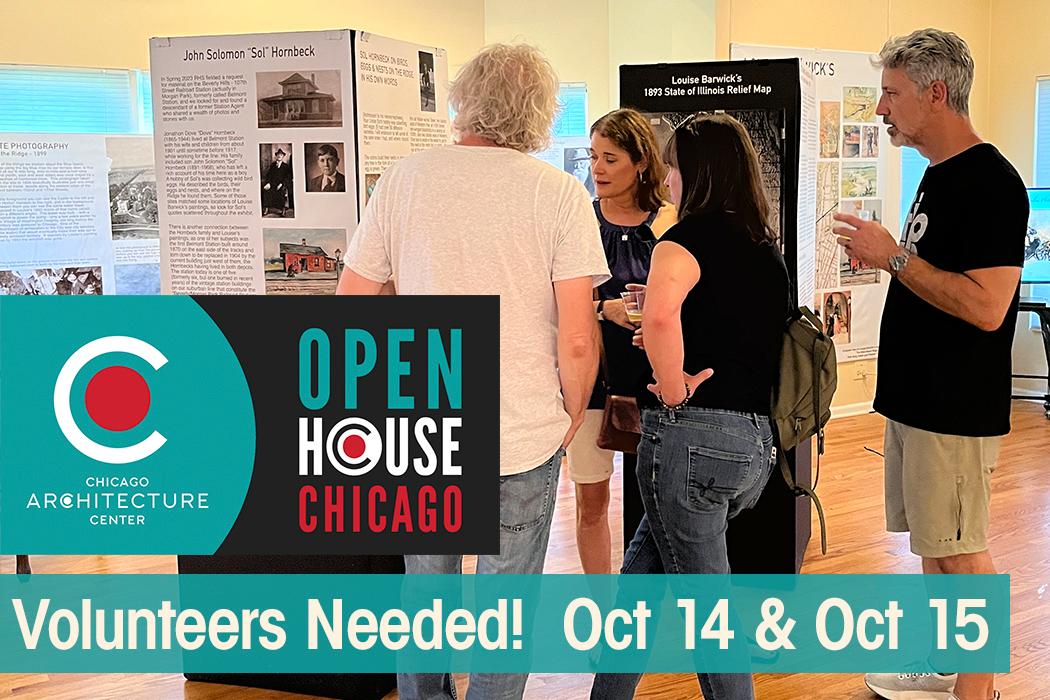
OPEN HOUSE CHICAGO is next week-end, October 14 and 15. The Ridge Historical Society will be one of the venues open for touring.
Volunteers are needed to staff RHS at the Graver-Driscoll House, 10621 S. Seeley Avenue, Chicago, on both of those days from 10 a.m. to 5 p.m. to greet and assist visitors. This is an excellent opportunity for those who would like to learn more about RHS.
Any new volunteers will be paired with a Board member, and the exhibit curators will be there to explain the exhibit (Louise Barwick's Lost Ridge).
If you are interested in volunteering, please send a message to ridgehistory@hotmail.com.
The Ridge Historical Society
Breweries on the Ridge – Part 1
By Carol Flynn
History was made on September 23 of this year when Horse Thief Hollow Brewing Company (HTH), the first brewery ever established in “North Blue Island,” that is, Beverly, Chicago, won the top-honors gold award at the Great American Beer Festival in Denver for its international-style pilsner beer, Little Wing.
In May, Little Wing won the top gold medal at the World Beer Cup competition in Nashville.
Both awards are sponsored by the Brewers Association, a not-for-profit organization that promotes and protects American craft brewers. These are the most prestigious awards that a craft beer can win in the industry, in the U.S., and possibly in the world. The awards are decided by peer-review by judges from around the world, based on a number of factors and standards set by the industry.
That HTH won both awards, and for an international pilsner, the most widespread style of beer in the world, by beating out over one hundred competitors, is truly laudable, and definitely one for the history records.
Neil Byers, the founder of HTH, and his “brewing team” members Jacob Nelson and Andrian Morrison have the goal to turn Little Wing into “Chicago’s pilsner,” that is, have it associated with the city as are the Magnificent Mile, Al Capone, and Chicago-style hot dogs.
As a start, Little Wing can be known as “Beverly’s beer” and be associated with the community, joining the Givins Beverly Castle and Rainbow Cone.
It’s ironic that the best beer in the country is being made in Beverly, a community historically known for being an exclusive residential area and a leader in the temperance, Prohibition, and post-Prohibition “dry” movements.
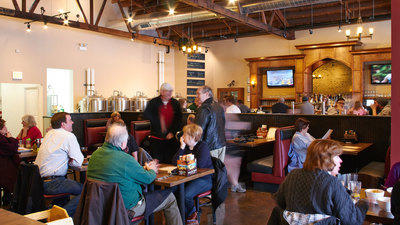
There are now three craft breweries on the Ridge, one in each of the three historically distinct communities. HTH opened in Beverly in 2013. The Blue Island Beer Company opened in 2015 in the City of Blue Island at the southern tip of the Ridge, and in the middle in Morgan Park is Open Outcry Brewing Company which opened in 2017.
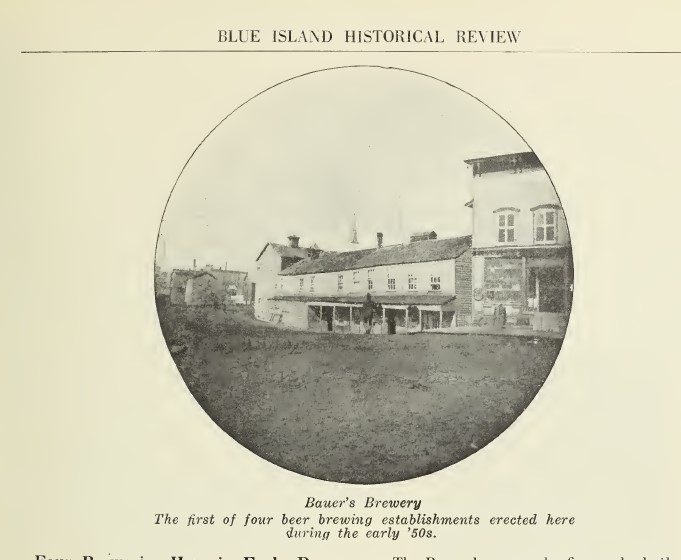
These are the first breweries on the Blue Island in ninety years. Before Prohibition, the city of Blue Island was famous for its breweries. The next post will look at the early breweries in Blue Island and the coming of Prohibition.
The Ridge Historical Society
Bessie Sutherland
By Carol Flynn
Happy Belated Birthday to Bessie Sutherland, the namesake of the Elizabeth H. Sutherland Elementary School at 10015 S. Leavitt Street in Beverly, Chicago.
Bessie was born as Elizabeth Bingle Huntington in Blue Island on September 27, 1851. Her father, Samuel D. Huntington, farmed and raised livestock, was involved in the railroads, and was Constable and Sheriff for a number of years.
Her mother, Maria Robinson Huntington, was possibly the first schoolteacher on the Ridge. In 1842, at the age of 14, Maria was making $1 per week to teach school. No record of any school earlier than that has been found.
Bessie graduated from the Cook County Normal School in 1869. “Normal” schools trained teachers in the “norms” of education standards of the day. That school evolved into Chicago State University.
She taught in Blue Island, Hyde Park, and Washington Heights. She took additional coursework at the University of Chicago. Along the way, she moved north on the Ridge to 107th Street and Prospect Avenue.
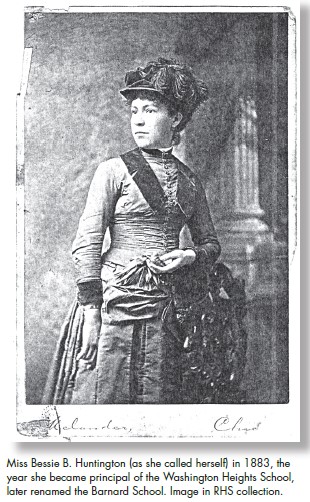
In 1883, she was named Principal of the Washington Heights School. This was before Washington Heights was annexed to the City of Chicago in 1890. She was the first woman to be named principal of a Cook County school. The school was renamed the Alice L. Barnard School in the 1890s in honor of another pioneering Ridge educator. Alice was the one of the first women to be named a principal of a Chicago public school.
Bessie was a Progressive Era educator and a suffragist. That period was marked by great reforms in all areas. Education saw a major shift from learning by lecture and memorization to learning by doing and experimentation.
One example of Bessie as an educator illustrated the new thinking. When she learned that a camel had escaped from a traveling show and was roaming freely in the local woods, she rounded up the entire school body and took them on an impromptu field trip to observe the animal in a natural setting.
Back then, women teachers were not allowed to marry and keep their jobs. Bessie put off marriage to her “intended,” David Sutherland, until her 43rd birthday in 1894. David, seventeen years her senior, was in real estate with considerable holdings on the south and west sides of Chicago.
David died in 1904, and Bessie continued with Barnard School until she retired in 1923. She died in 1924 and was buried in Mount Greenwood Cemetery. In 1925, the new school built at 100th and Leavitt Streets was named in Bessie’s honor.
RHS Historian Linda Lamberty is related to Bessie Sutherland. In 1974, a 96-year-old mutual cousin of Linda’s and Bessie’s told Linda that Bessie was “a truly wonderful person.” This cousin had known Bessie personally. According to Linda, Bessie was “one of the rare stalwart women” who forged paths for other women.
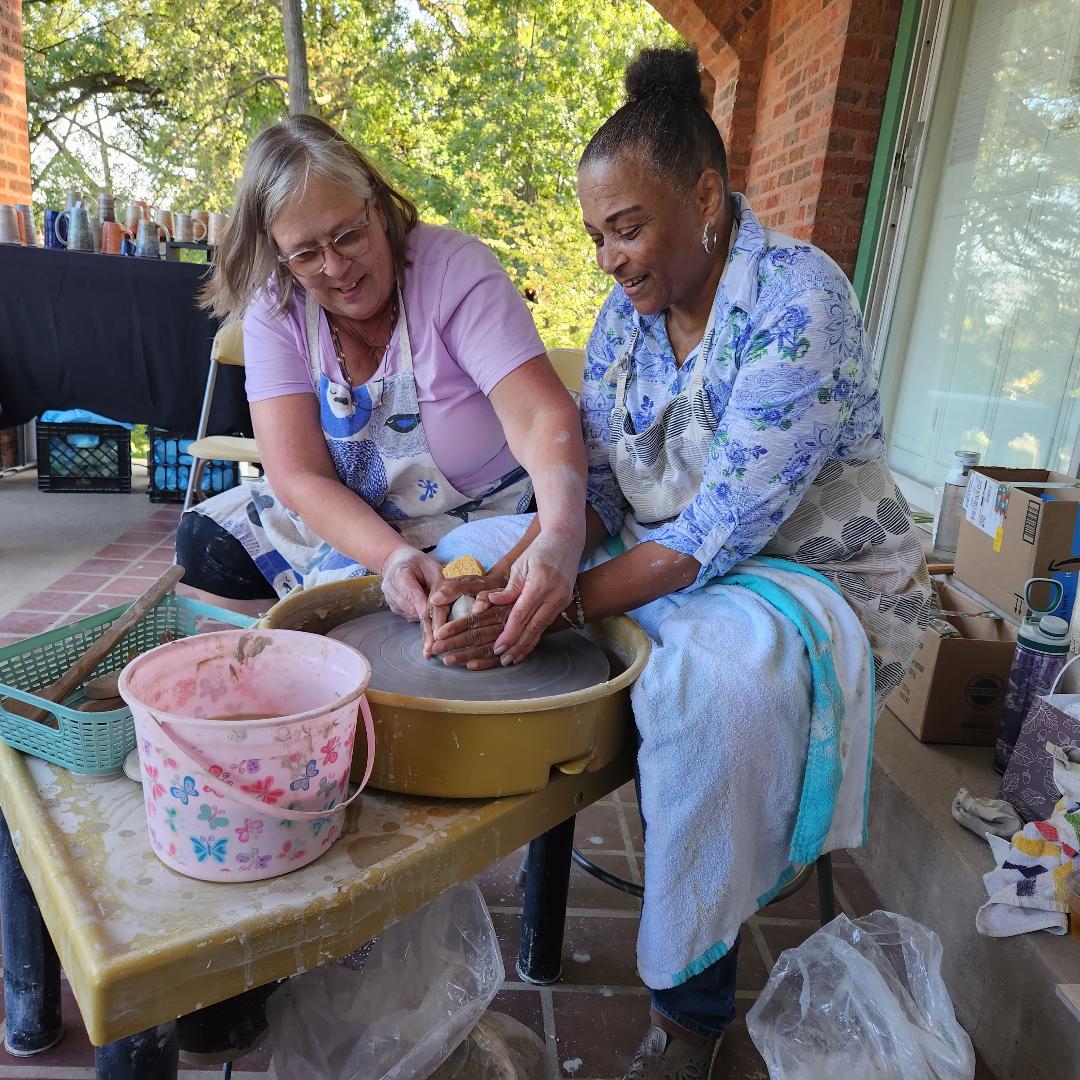
The Ridge Historical Society congratulates and thanks the Beverly Area Arts Alliance for another successful Beverly Art Walk. It was a great day; RHS had many new visitors.
Special thanks to Robin Power for her pottery demonstrations. She did this for five hours and people really enjoyed it.
Photo by C. Flynn: Robin Power (left) helps visitor Audrey Moore learn how to use a pottery wheel. It was Audrey's first try ever, and she left very happy with a nice pot she made herself. Now she is going to look into pottery classes!
BEVERLY ART WALK today at the Ridge Historical Society
10621 S. Seeley Avenue, 12 noon to 5:00 p.m.
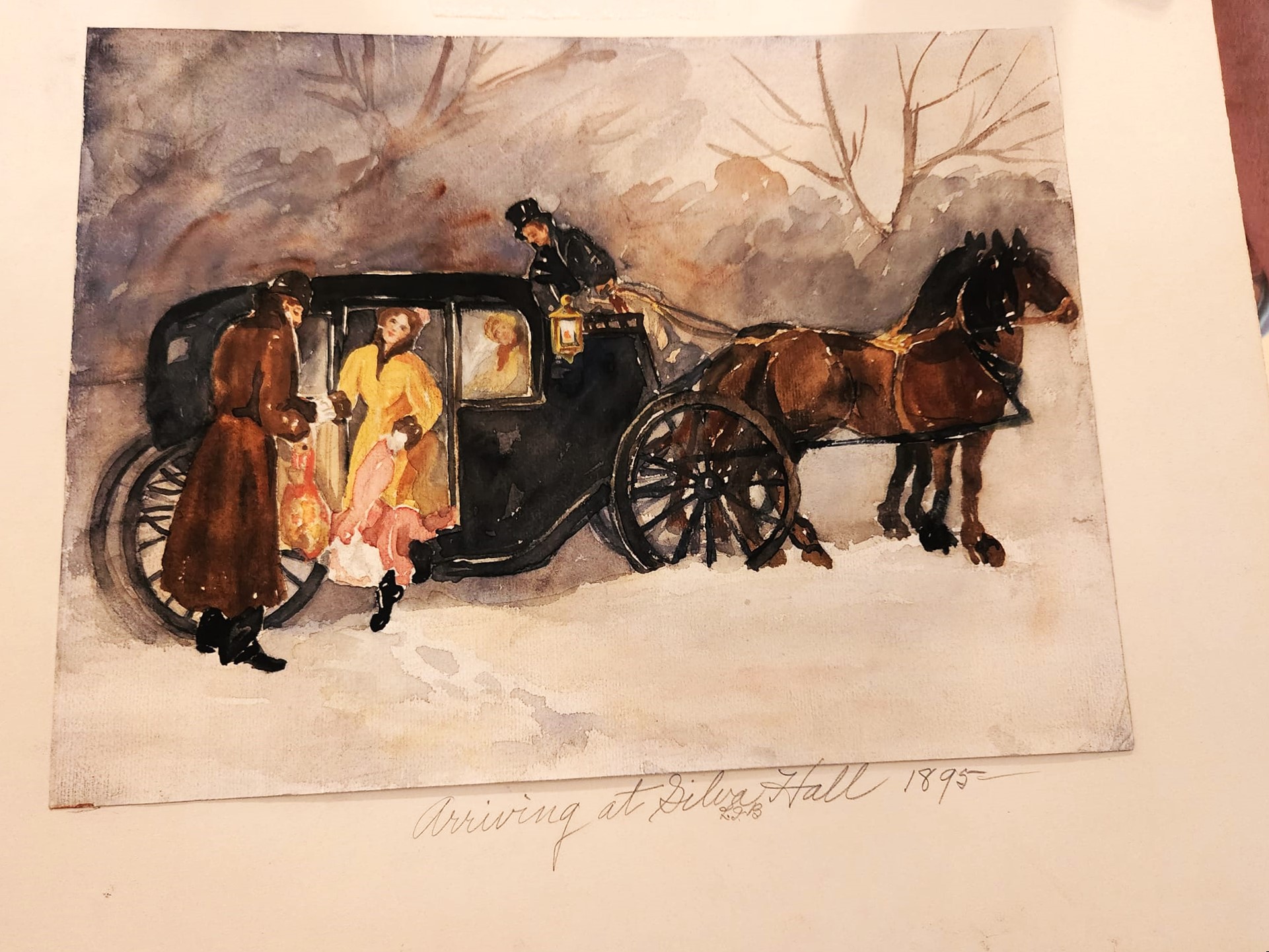
Louise Barwick’s name should be on the list of Beverly artists participating in today’s Art Walk. Her works will be shown at RHS.
Miss Barwick lived from 1871 to 1957. She was an artist and an educator. Her watercolor paintings of local scenes from the late 1800s – early 1900s give the community an amazing insight into what life was like here in the past. RHS has over a dozen of her paintings in the collection.
Fields of daisies. Horse-drawn coaches delivering young ladies to dances. Bridges over long-gone streams. Lamp lighters lighting gas streetlamps. All of these scenes are part of “Louise Barwick’s Lost Ridge.”
The watercolors are just part of Miss Barwick’s story. She has an amazing history – she was a woman ahead of her time. She was famous for her three-dimensional map-modeling skills and was featured for that at the 1893 World’s Fair in Chicago.
Visit RHS today to see this new exhibit, and to observe artist Robin Power’s demonstrations of pottery-making and the dancers from Weber Irish Dance.
BEVERLY ART WALK ALERT!!
There is plenty of entertainment as part of the Beverly Art Walk.
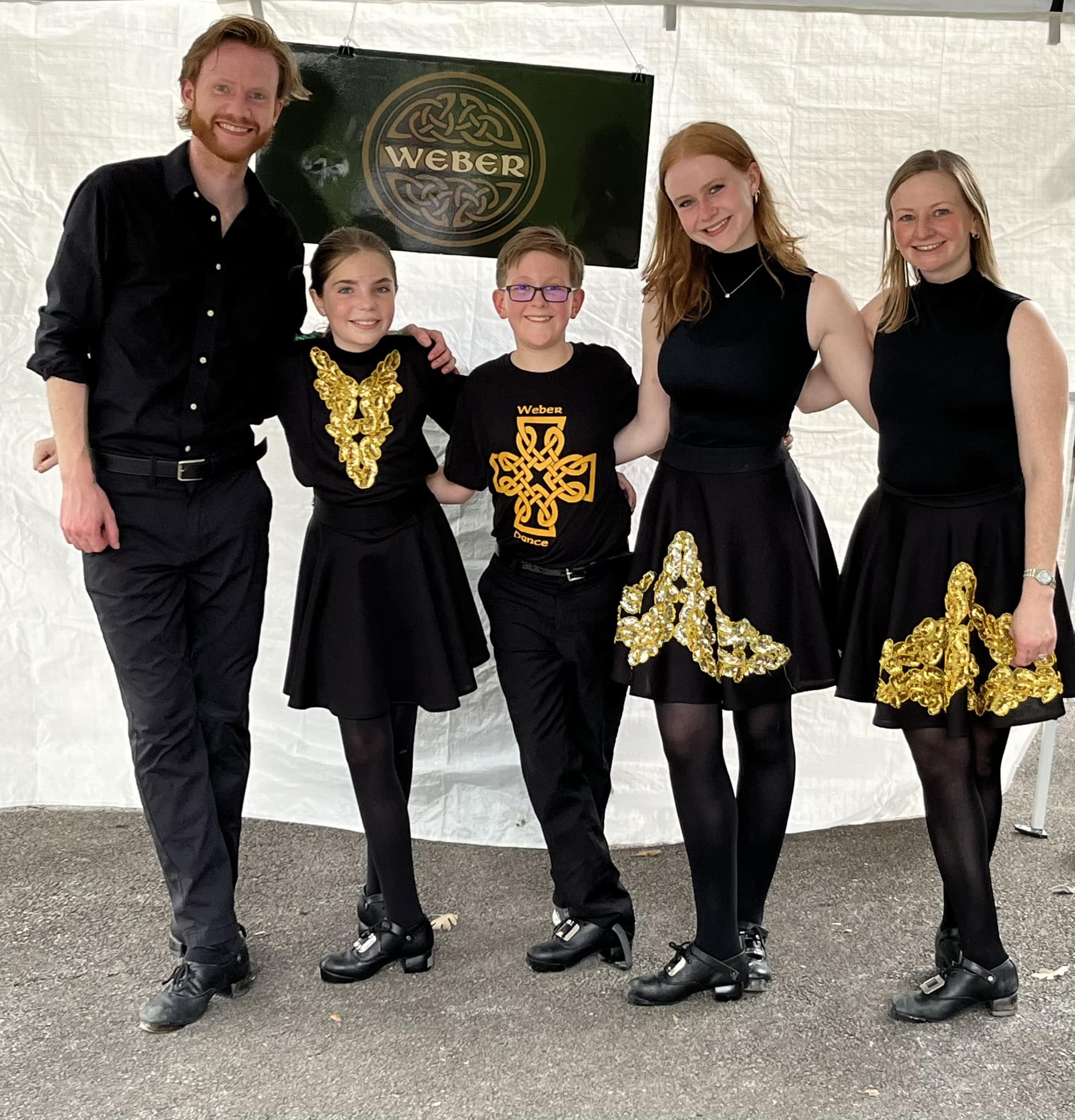
The only place you'll be able to see Irish dancers, though, will be at the Ridge Historical Society.
Dancers from Weber Irish Dance will perform at RHS at 1:30 p.m. and 3:00 p.m.
Irish dance is a significant part of Irish culture, history, identity, and of course, the performance arts. It doesn't have to be St. Patrick's Day to enjoy a good Irish jig!
Traditional Irish dancing was taught by traveling dance masters across Ireland in the 1600s and 1700s, and regional and local variations developed.
Modern Irish dancing developed from traditional Irish dancing, with some influence from later country dancing and possibly even quadrilles as Irish dancing spread with the migrating Irish people and became popular world-wide in the 1800s.
RHS is located at 10621 S. Seeley Avenue, Chicago. Park on Seeley Avenue and walk down the driveway to the house. RHS will be open from 12 noon to 5:00 p.m. for the Art Walk with many activities.