
Explore the RHS Facebook Archives, a rich repository of local history written by Carol Flynn. For two decades, Carol brought a deeply dedicated voice to public education at RHS. Her role as Facebook administrator through mid-2025 naturally extended her prolific research into meticulously detailed articles, most notably her multi-part historical series posts. Today, Carol continues her local history writing for The Beverly Review and other outlets.
All Posts
The Ridge Historical Society
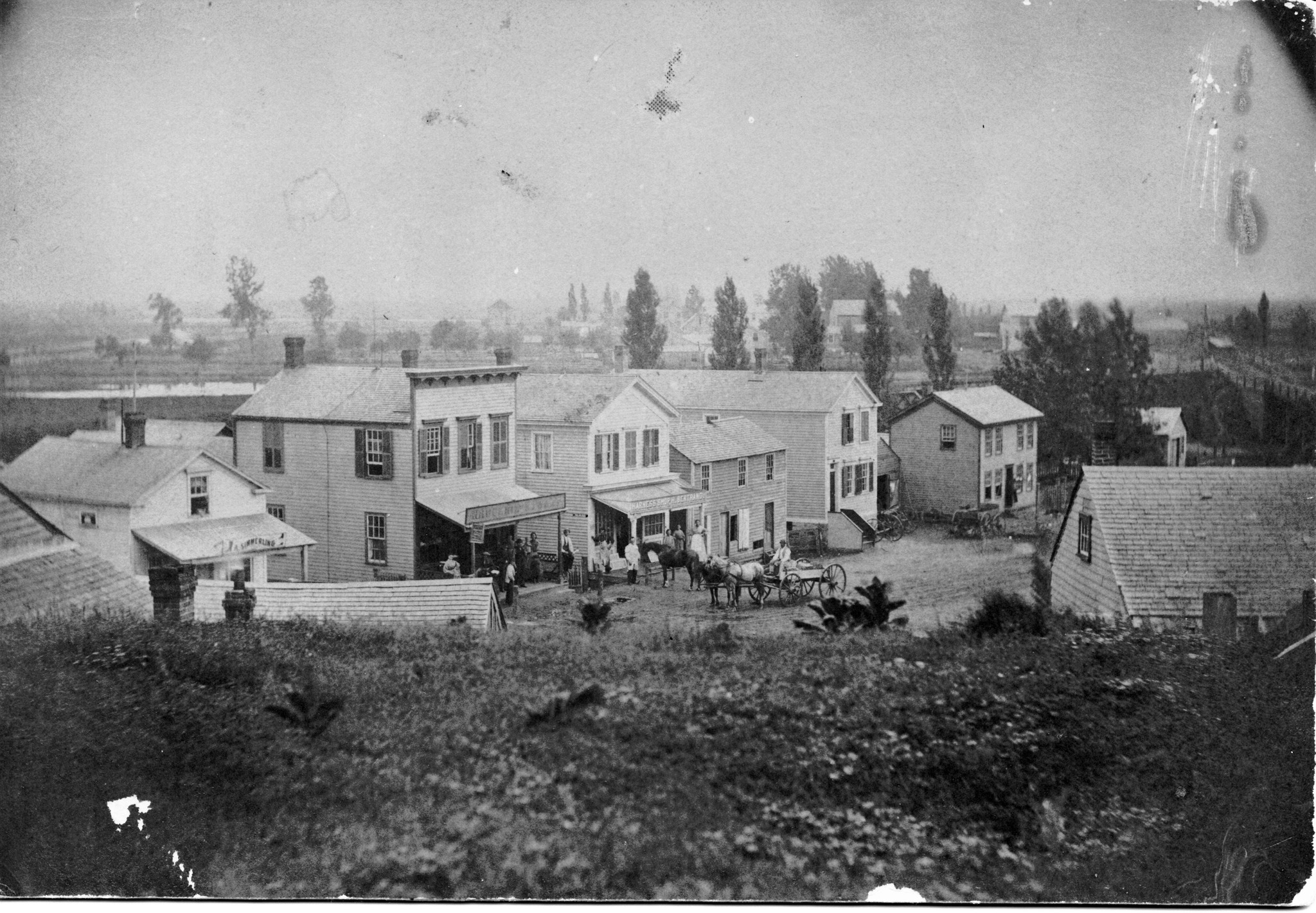
The Early Days of Morgan Park – Part 1
By Carol Flynn
Selecting a date to recognize the “beginning” of Morgan Park is arbitrary.
Indigenous people lived in the area for thousands of years before the European settlers came, so habitation is not really the measure.
What is really being decided is a date to mark the transition from Natives to non-natives as the predominant inhabitants of the Ridge.
The identity of the first non-native to step foot on the Ridge, and when that person came, will never be known with certainty. The first written records of explorers in the Chicago area date to the 1600s. Jean Baptiste Point du Sable of African descent is recognized as the first non-native to take up residence in the downtown area around 1790.
Fort Dearborn was established in 1804 and survey teams operated from there. They could see the Blue Island rising from the prairie twelve miles to the southwest.
In 1972, a group of Beverly/Morgan Park residents proposed that the community recognize the year as the sesquicentennial of the founding of Beverly/Morgan Park. This was based on the arrival of French-Canadian fur trader Joseph Bailly in 1822 at Porter, Indiana, on the Calumet River, where he established a homestead. Bailly was from a well-known family that ran trading posts from Michigan to Chicago. He interacted with the local Native Americans, predominantly the Potawatomi, and travelled their paths and waterways.
It was surmised that Bailly knew well the local Natives, and the Vincennes Trail that ran through the Ridge, and that he “opened up” the Blue Island Ridge to the fur trade. Therefore, they believed this was the start of current history, at the time 150 years in the past. There was a year’s worth of celebrations in 1972 to mark this anniversary.
A decade after Bailly, in 1832, DeWitt Lane built a cabin at what today is about 102nd Street and Seeley Avenue. He didn’t own the land; the U.S. government had not yet put it up for public sale.
The Native Americans gave up ownership of the land with the Treaty of Chicago in 1833, and began to leave the area.
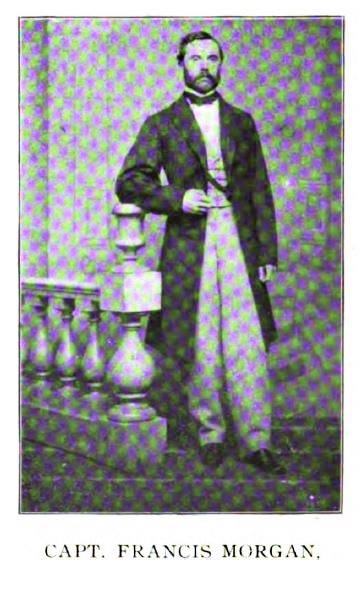
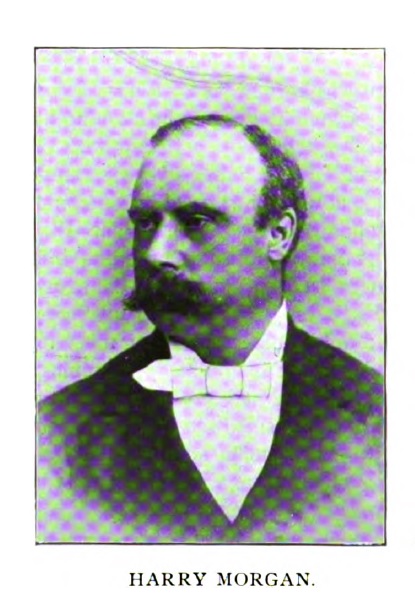
The government began public domain land sales in 1834. John Blackstone bought up substantial property on the Ridge in 1835 and 1839, and reportedly built a house in today’s North Beverly. In 1844, he sold the land to Thomas Morgan from England who moved here with his family, livestock, and hounds, and established an estate he called Upwood around 91st Street and Longwood Drive.
At the same time, settlement was going on at the southern tip of the Ridge, where the city of Blue Island was being established. Other homesteads were being established along the Vincennes Trail; Norman Rexford and Jefferson Gardner were there in 1834. Because Morgan did not like the Vincennes Trail running through his property, he rerouted it to the east below the Ridge.
Thomas Morgan died in 1851 and the estate passed to his widow, Anna, and their nine children. In 1868, a substantial portion of the estate was sold to a group of investors headed by Frederick H. Winston, and Winston took legal title from the Morgan heirs. In 1869, the group of investors incorporated as the Blue Island Land and Building Company (BILBC), and Winston transferred the title to the company.
Some of this land they sold off immediately, and it became the Village of Washington Heights that included today’s Beverly. Washington Heights was incorporated as a village in 1874, and was annexed to the city of Chicago in 1890.
The BILBC developed some of the land into a section they called Morgan Park, which was incorporated as a village in 1882, and was annexed to Chicago in 1914.
The next post will look more at the BILBC and the establishment of the Village of Morgan Park.
The Ridge Historical Society
The End of “Joliet Limestone”
By Carol Flynn
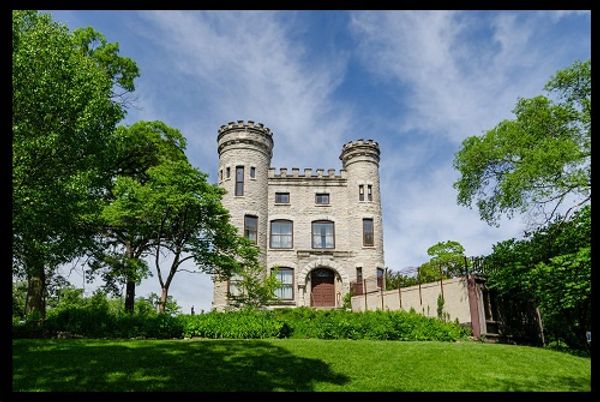
The Givins Beverly Castle, the Robert C. Givins House, located at the corner of 103rd Street and Longwood Drive, is Beverly’s best-known landmark. The Castle was built in 1887-88, which makes it over 130 years old.
But really, the Castle is millions of years old – it was constructed of “Joliet limestone.” The proper name for the stone is Joliet – Lemont dolomite, and its chemical composition gives it a yellowish or buff color not found in limestone which is usually more gray in color.
This material was quarried in the Joliet area and used for many buildings throughout the area, from the Water Tower and Holy Name Cathedral in downtown Chicago to the Joliet prison – and the Beverly Castle. The last documented building made of this stone was constructed in the 1940s – the All Saints Greek Orthodox Church of Joliet.
Last month, the last quarry in Joliet announced it was closing. This means it is more important than ever to preserve these buildings. The Beverly Unitarian Church, which owns and uses the Castle, completed restoration of its turrets in recent years.
The Ridge Historical Society
The Early Days of Morgan Park – Part 2
By Carol Flynn
August of 1868 was one of the most critical times in the history of the Blue Island.
That month, a group of investors, headed by Frederick H. Winston, purchased the land that had been held by the Morgan family since Thomas Morgan first purchased it in 1844. This began the development that led directly to the communities known today as Beverly Hills and Morgan Park.
This group, which incorporated the next year as the Blue Island Land and Building Company (BILBCo), included business and real estate men who had the vision to recognize the potential value of the land on the northern portion of the Blue Island. They invested their money in purchasing a large tract of this real estate for development and resale. Some of them chose to live here themselves.
A more detailed look at the BILBCo offers a glimpse into the business dealings of 155 years ago, and the men who made those deals.
Thomas Morgan died in 1851, and the land went to his widow, Anna Maria, and their nine children. Morgan’s will reportedly included a “dower clause,” that is, a provision that Anna could continue to use the land for her support, giving her a “life interest” in the property. “Dowers” are very common, usually conferred at the time of marriage, or sometimes by law. [Note that contemporary Illinois law does not include automatic dower rights.]
Anna was living in New Orleans in August of 1868 when Winston and his group purchased the land from the family. Some of the adult Morgan children were still living on the Ridge at the time, and in other parts of Chicago, notably Hyde Park. Winston personally took over the legal title from the Morgan heirs.
Anna died in December of 1868, in New Orleans, and her remains were returned to Chicago for burial in the family plot in Graceland Cemetery. The original family cemetery was on the Morgan estate in northern Blue Island, but prior to the selling of this land, the Morgan graves were moved to Graceland Cemetery.
The group of investors incorporated the next year. The Twenty-sixth General Assembly of the State of Illinois, convened in Springfield on January 4, 1869, passed an act to incorporate the BILBCo effective April 15, 1869.
The incorporators were listed as Charles V. Dyer, L. P. Hilliard, Thomas S. Dobbins, Charles W. Weston, John F. Tracy, John B. Lyon, Charles H. Walker, James Milliken, and Frederick H. Winston.
The purpose of the BILBCo was “laying out a town in the townships of Lake, Calumet, and Worth, or either of them, in the county of Cook, and buying, improving and selling land and town lots in said town, and in the townships of Lake, Worth and Calumet, and in the county of Cook.”
The act was granted for twenty years, during which time the BILBC could engage in legal business including entering into contracts; procuring, improving, and selling real estate and personal property; and suing and being sued.
The capital stock was set at $250,000, divided into $100 shares. The incorporators had six months to raise $150,000 of that stock, elect a board of directors, and develop governing documents to manage the interests of the stockholders.
They successfully accomplished that – likely they had it set up before the incorporation was even official and they were ready to begin business as soon as the state legislators gave the approval.
Frederic Winston served as the first president of BILBCo; the secretary/treasurer was George C. Walker; and the business agent/superintendent of operations was Col. George R. Clarke.
Winston turned over the title of the Morgan estate lands to the BILBCo. They immediately started selling off the land to the north of 107th Street, which they called “Washington Heights,” to numerous developers and individuals.
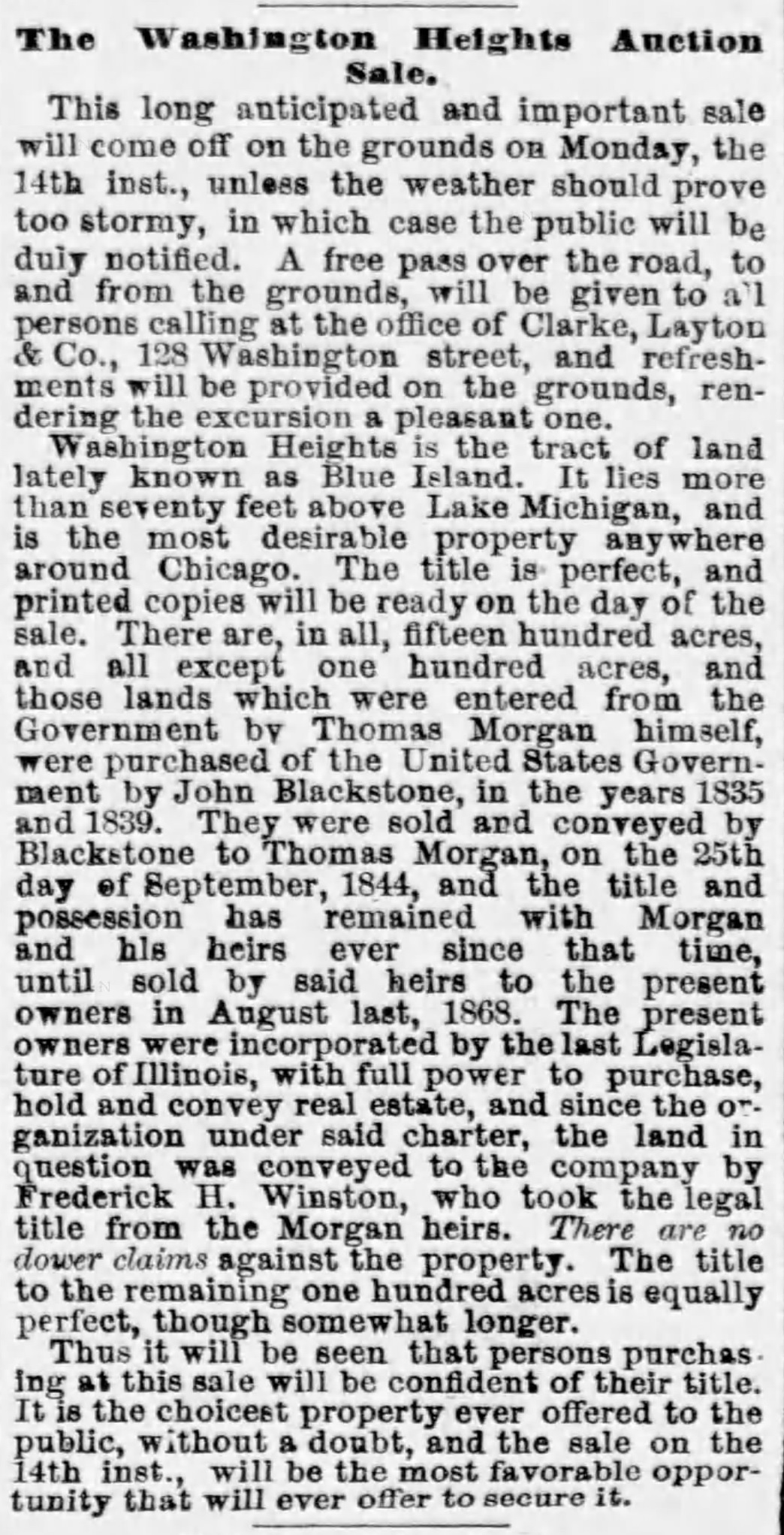
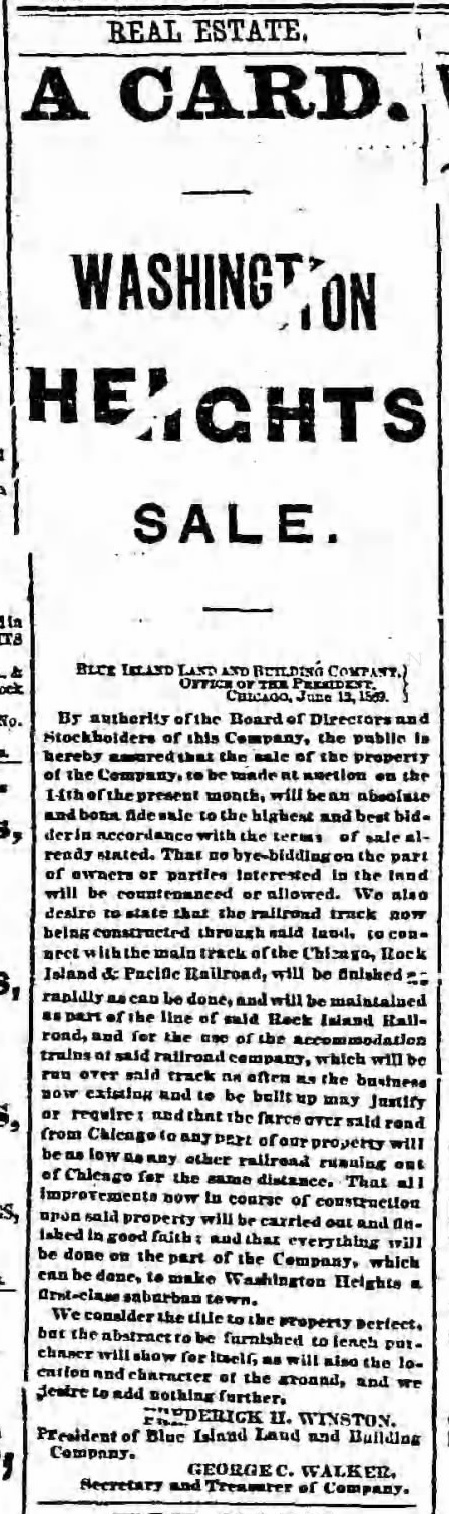
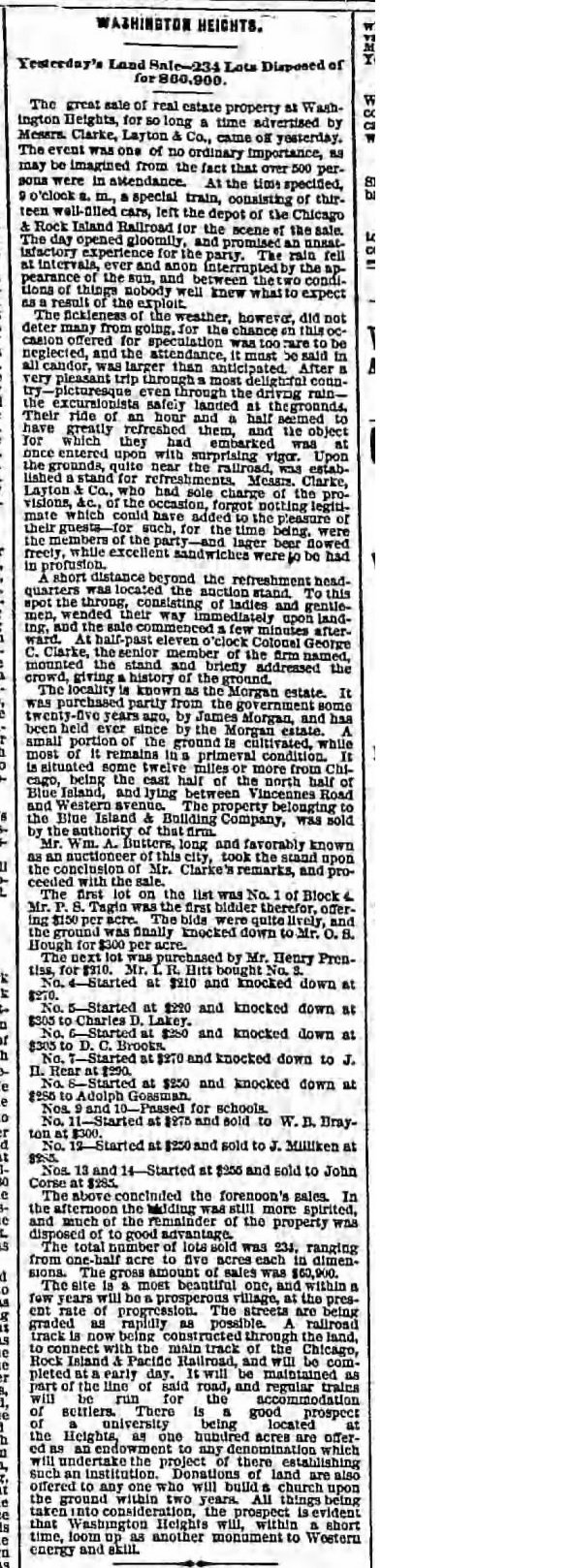
A huge public auction was held on Monday, June 14, 1869. The BILBCo took in over $60,000 that day in real estate sales.
Three newspaper clippings about that auction are attached. The development of Washington Heights and Beverly will be a topic of a future series.
The BILBCo kept the land south of 107th Street to create their own development, an idyllic village they named “Morgan Park.” The rest of this series will deal with the history of that development.
Some historically significant names appeared on that list of men involved with the BILBCo – Dyer, Tracy, Walker, Milliken, Winston, Clarke. The next post will share biographical sketches of some of these people.
The "Village in the City"
The 1970s were a transition time in American society, and the Ridge communities were a microcosm of those changes.
The Beverly Area Planning Association (BAPA) evolved into a change agent for the community during those years.
Many activities went on to promote the Beverly/Morgan Park area as a vibrant place to live and do business, and BAPA was involved in these activities.
The September Villager continues the history series in honor of BAPA's 75th anniversary, and looks at two of the "big events" of the early 1970s – the Sesquicentennial and the Victorian Village.
The one lasting effect of the Victorian Village project was the tag line for the community as the "Village in the City."

The Ridge Historical Society
The Early Days of Morgan Park – Part 3: Frederick H. Winston
By Carol Flynn
Morgan Park was started as a real estate development in the early 1870s by the Blue Island Land and Building Co. (BILBCo), a group of investors which included some very prominent Chicagoans.
This post will begin looking at some of those men who strongly influenced the development of the Blue Island.
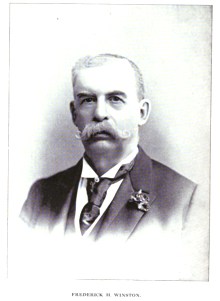
Frederick Hampden Winston was the leader of the investment group. He personally held the title to the Morgan land the investors purchased in 1868 until the BILBCo was formed the next year. He was one of the petitioners to the State of Illinois to incorporate BILBCo and served as its first president.
Winston was born in Georgia in 1830. At least one ancestor fought in the U.S. revolution. Winston’s father was a Presbyterian minister from New York, and his mother was a member of an aristocratic, slave-owning family in Georgia. When he was a young boy, his parents moved the family to Kentucky and freed their slaves for moral reasons, depleting much of their wealth. Both parents died before Winston was twelve years old.
Winston was educated at the finest private schools in Kentucky. At the age of 18, he returned to Georgia to start a business producing cotton cloth, but that was not successful. He then studied law at a U.S. Senator’s office and earned a law degree from Harvard University in 1852. He practiced law in New York before striking out for the west.
Arriving in Chicago in 1853, he immediately established himself in society; in December of that year, the Chicago Tribune mentioned his participation in an elite event of the New England Society to celebrate the arrival of the Mayflower in 1620. He was more than just an attendee, he was one of the presenters during the toasts/responses in the evening’s program.
Maria Garrard Dudley from Kentucky became his wife in 1855. They made their home in Chicago, on the north side. For decades, their address was 369 Superior Street.
Winston passed the Illinois bar and joined the law firm of, and eventually became partners with, Norman B. Judd, an attorney for railroad companies. Judd was appointed as Minister (ambassador) to Berlin by President Abraham Lincoln. Winston then worked with Henry W. Blodgett until President Ulysses Grant appointed Blodgett to a judgeship. Winston went on to be a partner in several law firms.
Winston rose to prominence as the lead attorney for the Pittsburg, Fort Wayne and Chicago Railroad, the Lake Shore and Michigan Southern Railroad, and the Chicago, Rock Island and Pacific Railroad. He was known as one of the country’s greatest experts in railroad law during the decades that railroads were rapidly expanding throughout the country, and the Chicago Legal News stated he “conducted the complicated legal business of that corporation [Pittsburg] with masterly skill and excellent judgment.”
He also became a very successful real estate investor. One biographical entry on him, written in 1899, stated that: “He had scarcely been in the then growing town [Chicago] for twenty-four hours before he saw the chances of successful real estate ventures, and before he, himself, had recognized it he began trafficking in Chicago real estate.”
In 1870, the year after the BILBCo was formed and started selling land to developers and settlers, but before Morgan Park was developed, the U.S. Cenus reported that Winston had real estate investments of $150,000 and owned personal real estate valued at $30,000.
He was involved in other businesses, also, including banking, electric street cars, and the gas industry. His name appeared often in the classified sections of newspapers for legal, real estate, and investment transactions and lawsuits and he held positions on many Boards of Directors.
Winston was described in one source as a “courteous, dignified southern gentleman united to the energetic, successful, practical man of the North.” Another source wrote he was “a well-read, gifted and thorough lawyer. In personal appearance he is prepossessing, courteous and polite.” His “solidity of character, with a smoothness and richness of mental composition, made him a most marked character among the many strong and unique men of Chicago.”
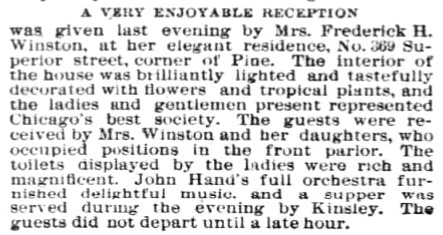
For her part, Maria Winston held her own with Chicago’s social elite. One article about a successful dinner party at their house is attached. The U.S. Censuses always listed live-in servants at their home – there were six there in 1880.
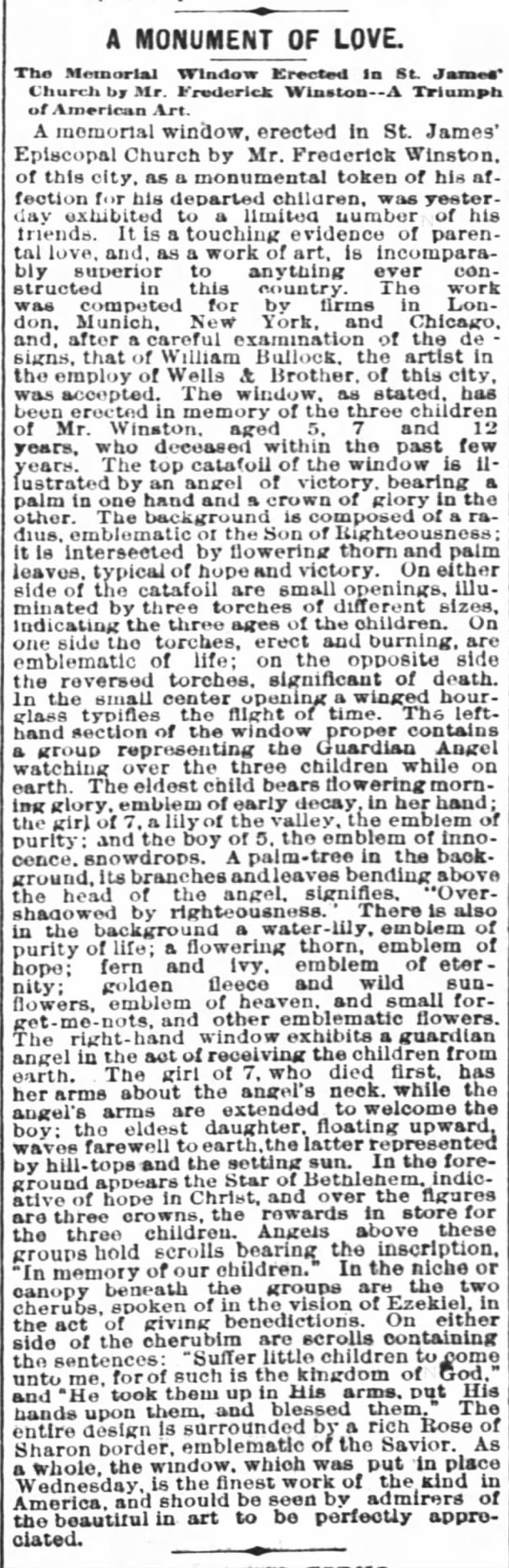
Despite their success and prestige, however, the Winston family’s life was not without tragedy. Maria and Frederick had at least nine children, but they lost daughter Ellen at age 7 in 1869, son Mervyn at age 4 in 1871, and daughter Mary at age 15 in 1875.
The Inter Ocean newspaper described in minute detail the memorial stained-glass window that Winston commissioned for St. James Episcopal Church in 1878. That article is also attached.
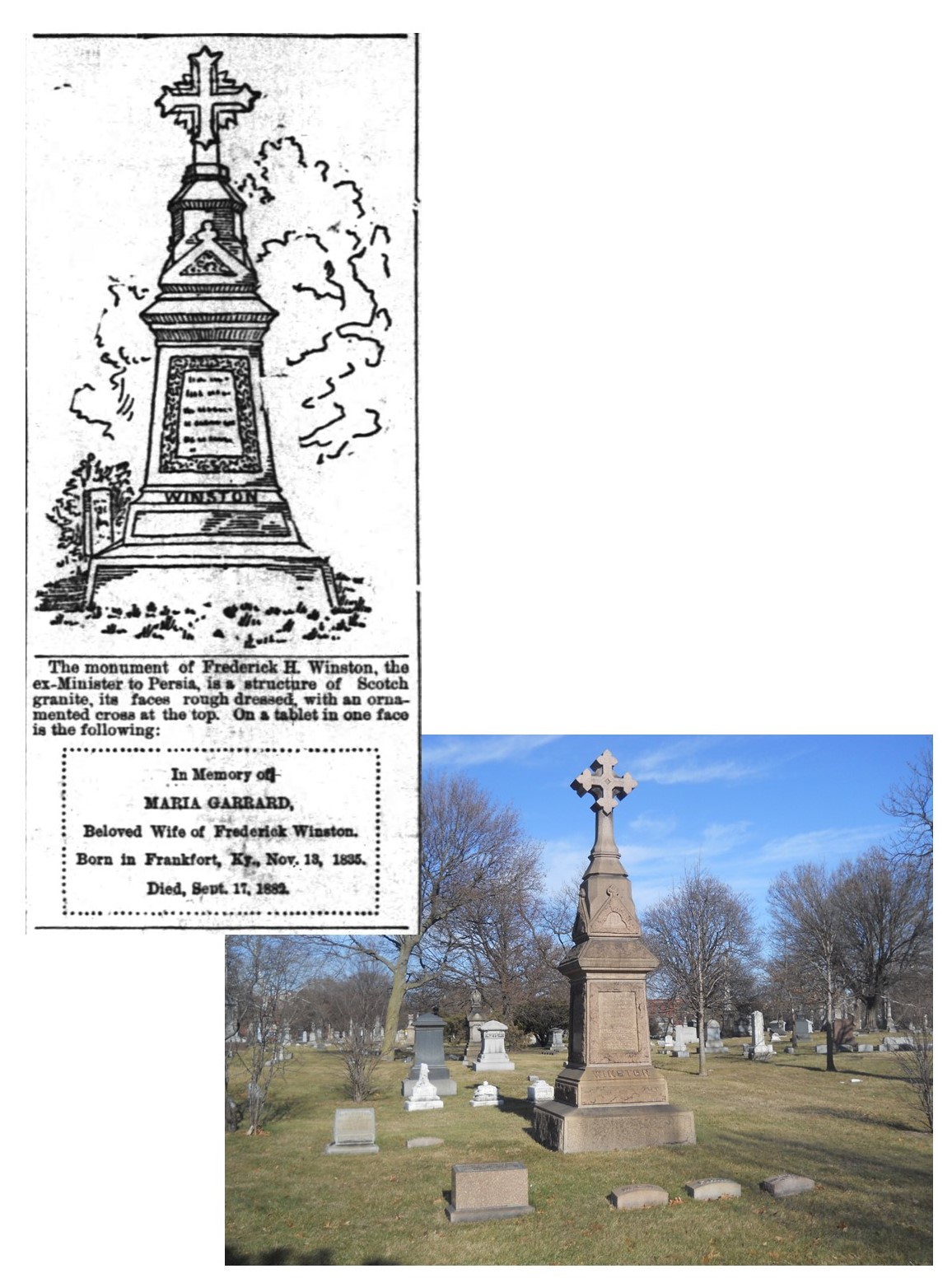
Maria died in 1882 at the age of 46. The gravesite for the family is in Graceland Cemetery, covered in an article in the Inter Ocean in 1887, attached to this post.
Winston retired from his law practice in 1884 but continued to concentrate on his real estate endeavors. He was succeeded in his law career by his son Frederick S. Winston.
The elder Winston was also a leader in the Democratic Party, the party of Stephen Douglas. As early as 1861, he took part in the funeral services for Senator Douglas alongside national and state leaders. He served as delegate to presidential nomination conventions, but he chose not to run for elected office himself.
He was known for his skills in presiding at meetings. After getting two groups to cooperate at a meeting in 1884, he commented with a smile, "Oil and water will not mix very well together, although whisky and water sometimes will."
In 1884, allegations that he masterminded election fraud in a state senate election went nowhere. That same year, he sued the Inter Ocean newspaper over an article that accused him of being part of a unscrupulous political ring. Although the court dismissed the case, the newspaper retracted the article, admitting they were wrong.
In 1885, a court case against him alleging fraud in a land purchase for one of the railroads went all the way to the U. S. Supreme Court which found in agreement with the lower courts that he had done nothing illegal. That case had taken nine years to resolve.
President Grover Cleveland appointed him as the Minister (ambassador) to Persia (Iran) in 1886. It was reported that Persia was in need of a railroad system and there was no one better than Winston to help the country develop one. In accepting the role, Winston said his goal was to increase trade between the two countries.
“I have been a practical businessman all my life. It will cost me $3 expenditures for every $1 I get from the government to accept this mission. If I do not get some credit out of it the expenditure will be a waste of money. I shall try to get that credit in the improvement of our trade,” said Winston in an interview with the Chicago Tribune.
He was sent on his “8,000-mile journey” with a lavish banquet attended by Chicago’s elite businessmen, politicians, civic and religious leaders, and journalists.
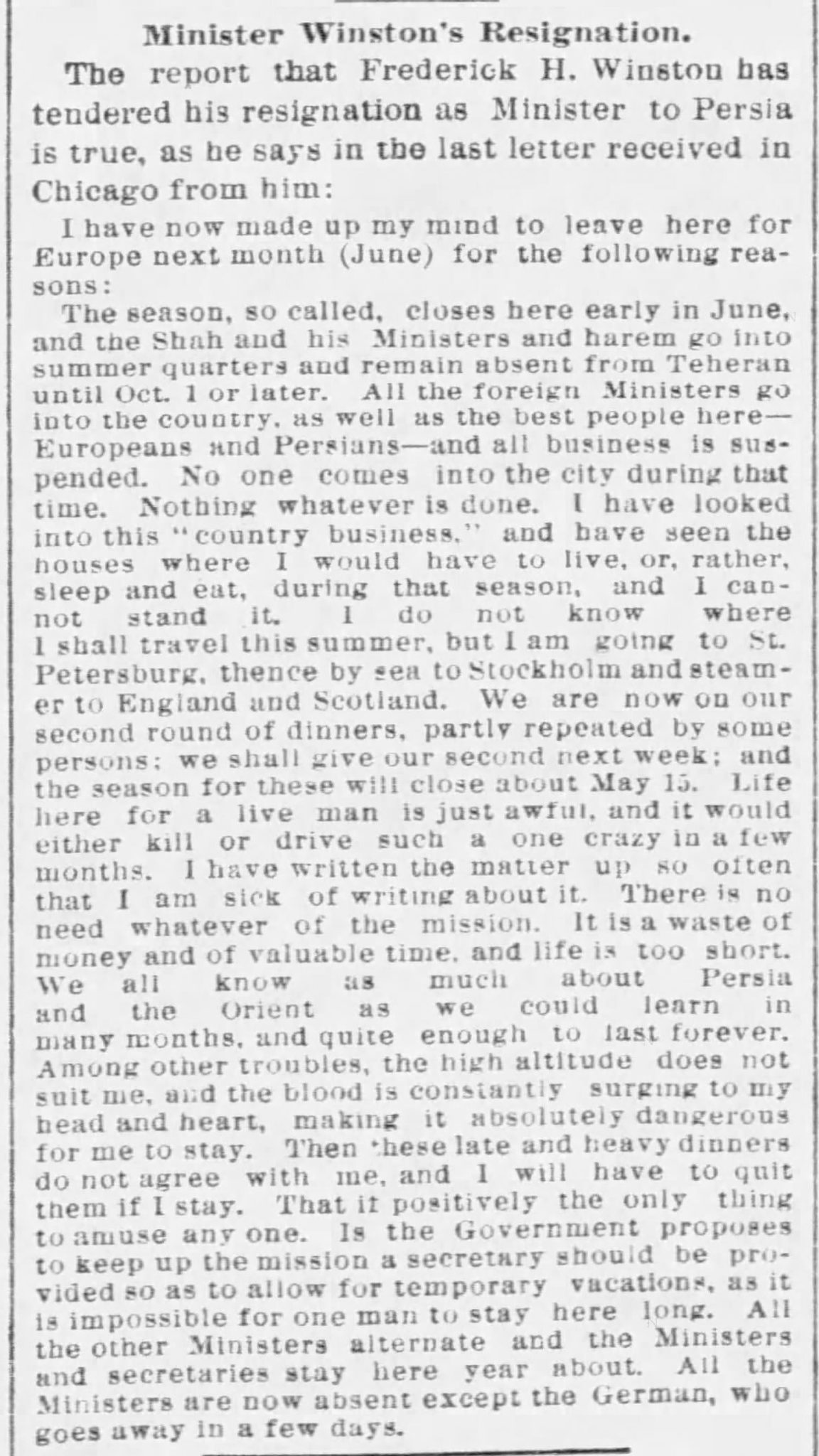
However, he became very disillusioned with Persia very quickly and resigned a few months later. He explained his resignation in a letter published in the Chicago Tribune that is attached to this post.
He spent time after that traveling in Russia, Scandinavia, England, and Scotland.
In 1886, however, he was also connected to a young actress named Jennie Woods, who died in Chicago allegedly from excessive opium smoking. The article reporting on that is also attached.
In 1887, he was linked in the papers to another actress, Eleanor Calhoun. It was reported they had been engaged before he left for Persia, but she broke it off for an engagement with a Hearst son. The Hearst family put an end to that, and she became re-engaged to Winston. Nothing more came of that. She did earn some renown on the stage and later married a prince. Winston was 57, and Calhoun was 22.
Winston also held many appointments under Illinois State governors, and Governor Oglesby promoted him to Brigadier General in the Illinois National Guard. He went by “General Winston” in his later years.
He was involved in numerous activities and clubs in Chicago and the state, including the Illinois and Chicago Historical Societies, the Union Club, and others. He was elected to membership in clubs in other cities. He was particularly active in organizations related to his ancestry, such as the Sons of the American Revolution.
Winston was a member of the Lincoln Park Board of Commissioners and served as President for twelve years. During his time, the park was expanded and many improvements were made.
In 1891, Winston became president of the Chicago Junction Railways and Union Stockyards Company, which was formed to buy up the stock of the Union Stock Yard and Transit Company, and they did come to own 98% of the stock, in effect making the corporations one and the same.
The Chicago stockyards industry was vitally connected to the railroad industry. The railroads, including those that Winston was affiliated with, were always major owners of the company’s stock. Winston was well acquainted with John B. Sherman, the founder of the Union Stockyards, who purchased most of the land known today as the Dan Ryan Woods and ran an experimental stock farm there.
At the age of 64, Winston was called “hale and vigorous.”
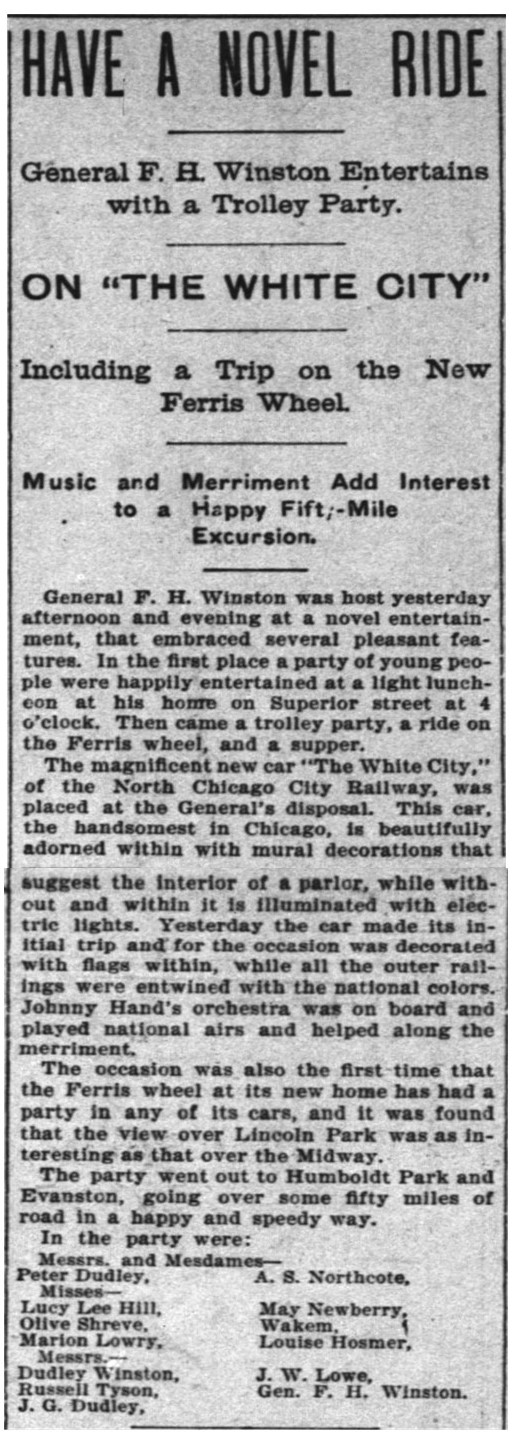
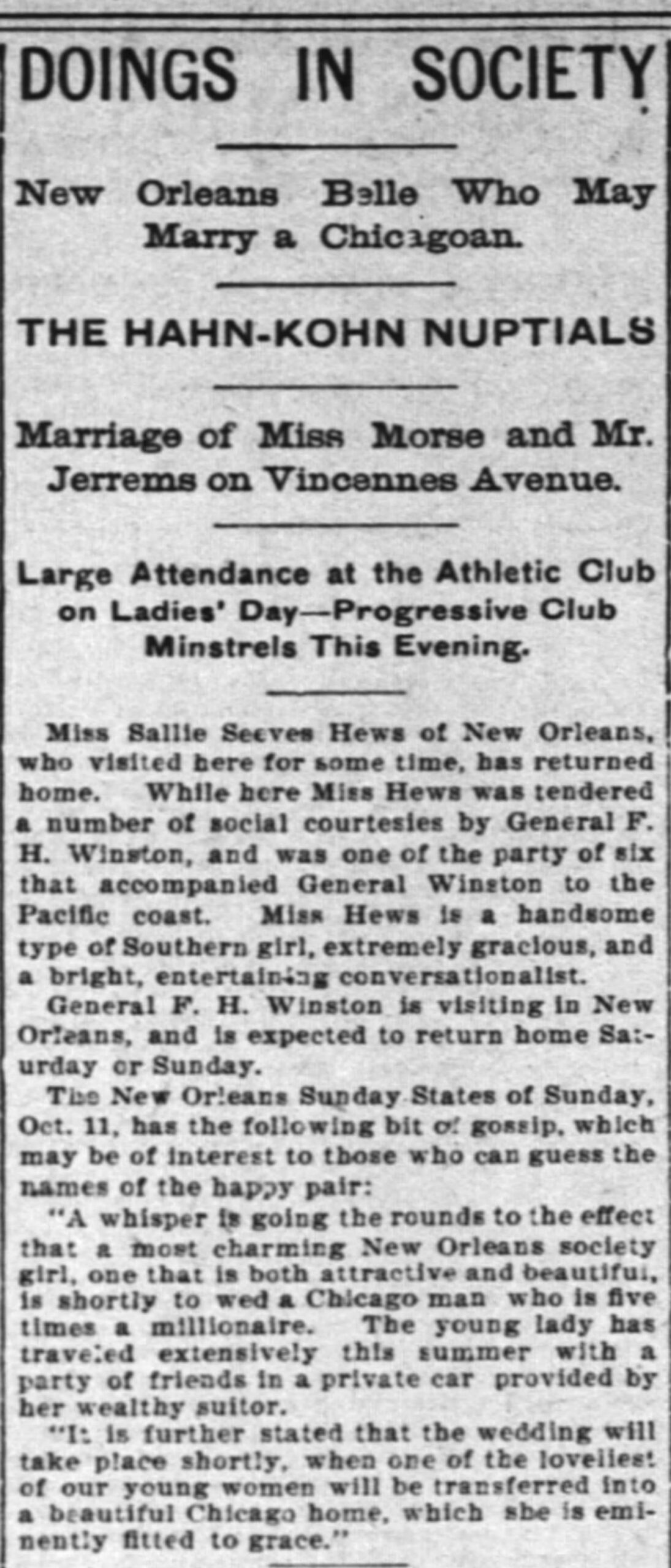
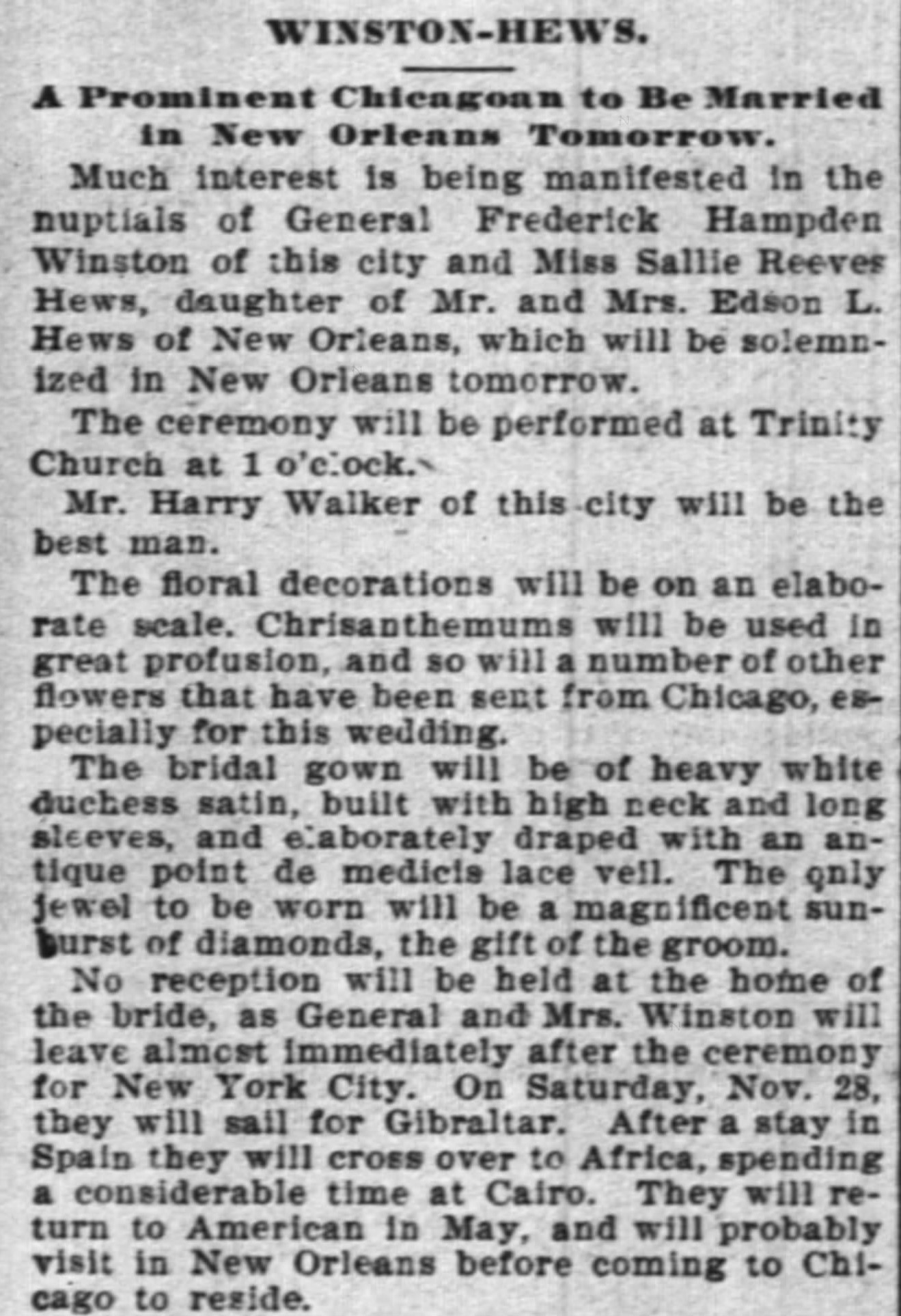
In 1895, he held a “trolley party” that was covered in the newspaper (attached). It did not mention a certain young woman from New Orleans who might have been in attendance. There was speculation that General Winston, as he was now known, and Sallie Reeves Hews might marry. They did marry in 1896, per the attached newspaper articles. Winston was 65 and Hews was 24.
Tragedy again struck in 1898 when his son Dudley Winston died at the age of 32.
In 1900, Winston was still living on Superior Street with his wife Sallie, his youngest son Ralph (age 22), and four servants. He listed
his occupation on the 1900 U.S. Census as “capitalist.”
In declining health, Winston traveled to Florida with his wife and one of his daughters to escape the Chicago winter. He died there in February 1904, at the age of 73. His remains were brought home to Chicago for burial in Graceland Cemetery with his first wife and deceased children.
Winston never lived on the Ridge, but he recognized the value of the land. By the time the charter of the Blue Island Land and Building Co. (BILBCo) expired in 1889, his name was no longer listed as one of the shareholders of the company, but he had been a major player in starting the effort.
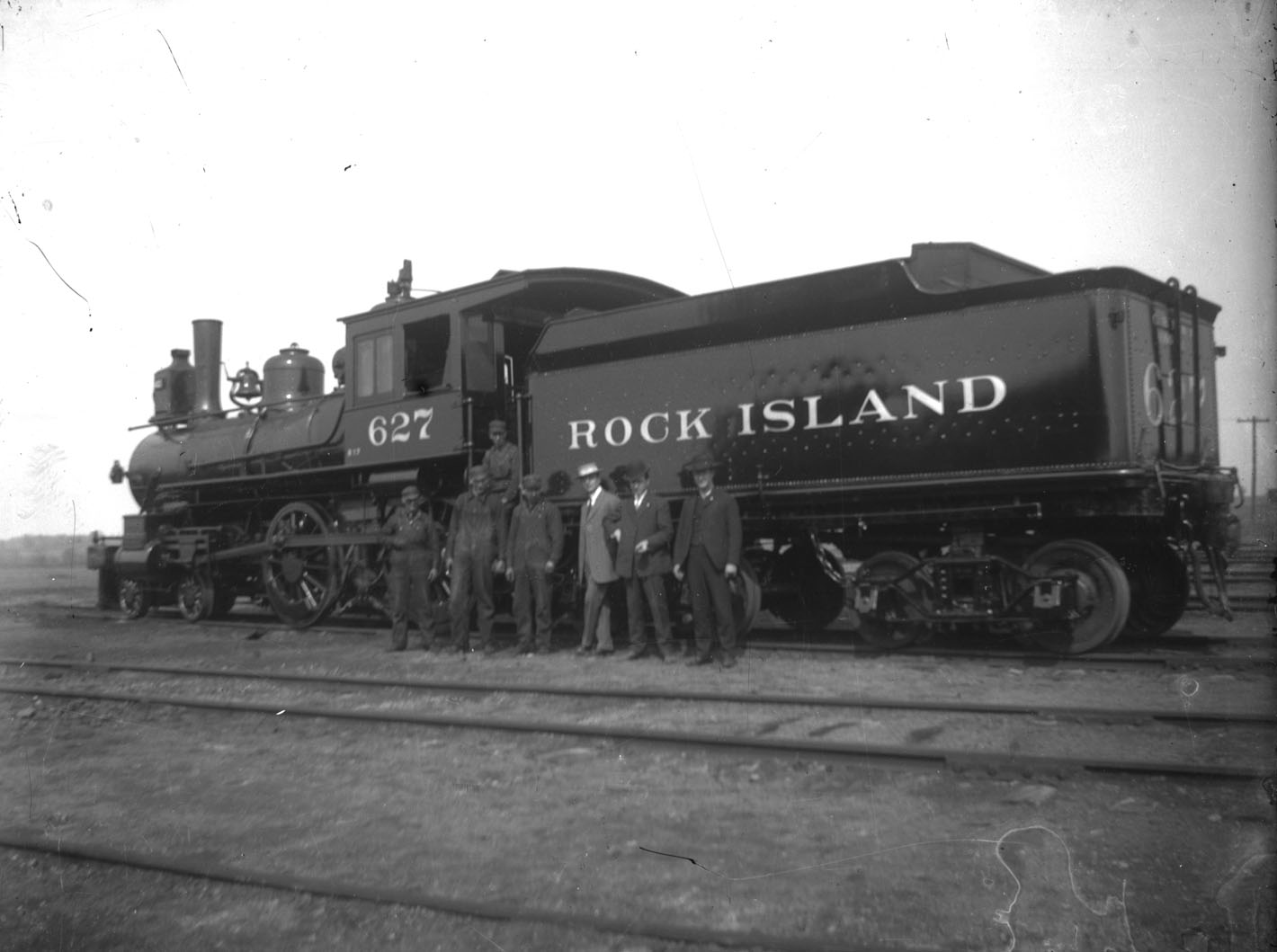
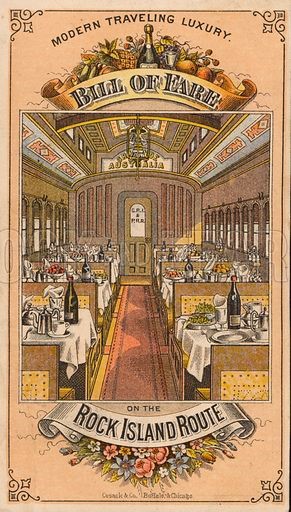
Winston was a prime example of the connection between the railroads and real estate. The development of Morgan Park became possible because of the Rock Island Railroad. Winston was the corporate lawyer for the railroad as well as a major investor in the land of the Ridge.
This connection between the railroads and real estate will be further explored by looking at other investors in the BILBCo in coming posts.
Preserving historic buildings is very important for our heritage. Obviously, there are not enough resources to save every old house or building from the wrecking ball, but when there are people willing to raise the funds and do the work to repurpose a historic treasure for the good of a community, then those efforts should be supported.
In the Beverly community, the Ridge Historical Society is part of the effort to save the Eugene S. Pike House, located on the edge of the Dan Ryan Forest Preserve at 91st Street and Longwood Drive. We hope to have an update on the status of the Pike House soon.
In Joliet, efforts are underway to save the George Washington Casseday House. This article explores that. The house was built in 1851 by Casseday, who owned quite a bit of land in Joliet including the land the historic Joliet Correctional Center is built on.
It is now in the works to start an African American history museum in the building.
The Ridge Historical Society
The Early Days of Morgan Park – Part 4: Other BILBCo Leaders, Railroads
By Carol Flynn
The last post looked in detail at Frederick H. Winston, one of the founders of the Blue Island Land and Building Co. (BILBCo), the group of investors that developed Morgan Park.
The intent of the post was to give an idea of the type of speculators who bought up and resold land all around Chicago, and all around the country, in the mid- to late-1800s. They made fortunes from their investments.
Many, if not most, of these men were connected to the railroads. They at least owned stock in the railroad companies and some actively ran railroads.
The history of railroads and the history of development of the land are intertwined, throughout the country and for the Blue Island Ridge communities.
By the 1830s, the adaptation of steam engines for powering trains started to revolutionize transportation. Up to then, moving people and goods was accomplished by boats on waterways and wagons and coaches pulled by horses or oxen on land. Now, a machine fueled by burning coal could make travel much more efficient, accessible, convenient, and comfortable.
To encourage building railroads and expanding to the west, the U.S. and state governments gave away millions of acres of land to the railroad companies that could be sold off at enormous profits once the land was accessible by train for development.
By 1850, 9,000 miles of railroad tracks had been laid. The east and west coasts were finally being connected in a much more efficient way and Chicago became the major hub between the two points.
The southern tip of the Blue Island was the first local area to be developed because it was on the system of waterways that included the Little Calumet River and Stony Creek, and then the first I&M feeder canal was built in 1848.
The city of Blue Island traces its founding to the 1830s as a “river town” as industry built up around there. Access to Chicago, twelve miles to the northeast, however, was still overland using the ancient Vincennes Trail. During rainy seasons and winter the road was almost impassable.
The first railroad tracks were laid in Chicago in 1848. After that, railroad companies quickly built lines of tracks that connected Chicago to other cities in all directions.
In 1852, the Chicago, Rock Island & Pacific Railroad (CRI&P) laid tracks between Chicago and Joliet. The tracks ran to the east of the land that would become Beverly and Morgan Park, angling southwest along Vincennes Road, and passing through the city of Blue Island.
Blue Island changed from a river town to a rail town as other railroad companies came through the area. The railroad yards at Blue Island are still very busy today.
In 1869, the CRI&P started laying tracks for a line to come off the main line and run west along 99th Street to the growing area of Washington Heights, then turn south along Walden Parkway and meet up again with the main line in Blue Island. This was referred to as the “dummy line.” The line was completed in 1870.
In 1889, the “dummy line” was reconfigured to extend service to north Beverly. The line now left the main line at 89th Street and ran west to a passage just east of Longwood Drive, turning south to Blue Island. This is the route the Metra Rock Island line uses today.
Some of the major investors who owned and ran the Blue Island Land and Building Co. were also the men who owned and ran the Chicago, Rock Island & Pacific Railroad Co. They took ownership of the Morgan estate land in 1869, then expanded their railroad line to the area.
This increased the value of the land, and they then resold lots of it to developers for a substantial profit. They kept the land south of 107th Street and created their own development they called Morgan Park.
It is usually stated that the coming of the railroad to the Blue Island led to its development. This was no happy coincidence; it was well thought out and planned by the shrewd businessmen of the day.
As was covered in the previous post, Frederick H. Winston was the president of the BILBCo and the chief lawyer for the CRI&P.
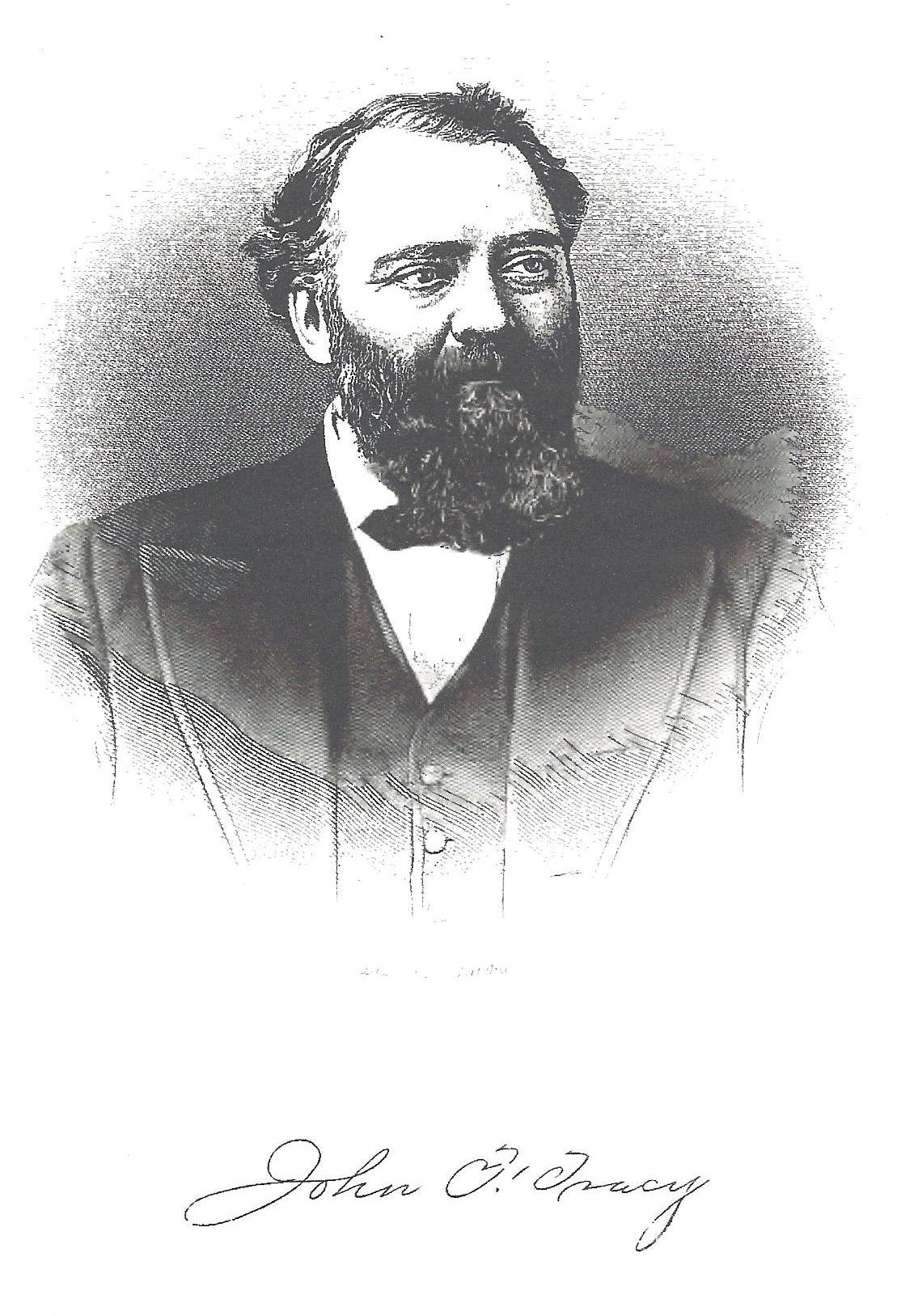
Another BILBCo investor was John F. Tracy, the President of the CRI&P.
John F Tracy was born in Erie, Pennsylvania, in 1827. His father was a contractor who built canals and railroads, and Tracy followed in his footsteps.
After working on the building of the Erie and Northeast Railroad, he became the Superintendent and ran the railroad. He went against the wishes of the community to successfully expand the line in 1854, after which he left Erie and moved to Chicago to become the Assistant Superintendent of the Chicago and Rock Island Railroad.
He became a major stockholder in several railroad companies, as more and more companies were starting, merging, and expanding.
However, the expansion of the railroads was not without controversy. As the railroads made millionaires out of people like Winston and Tracy, they caused the financial downfall of those connected with older means of transportation, like the river boat companies.
A major issue that the CRI&P, and Tracy as Superintendent, became involved in was the building of railroad bridges over the Mississippi River. The boat companies claimed that this obstructed river traffic, leading to accidents and damage to both boats and bridges. The bridge builders and railroads claimed much of the damage was sabotage.
One case involving the river boat Effie Afton crashing into the first bridge built on the river in 1856, connecting Rock Island with Davenport, went all the way to the U.S. Supreme Court, which found in favor of the bridge company in 1863. A young lawyer named Abraham Lincoln was part of the legal team representing the railroad and bridge interests.
Another case in 1859, in which Tracy was called to testify, involved alleged plans to bomb a bridge at St. Louis.
Ultimately, the interests of the new technology, the railroads, won out. The Chicago Tribune stated in 1878 that "Mr. Tracy was the man who fought it through to a triumphant success."
Tracy rose in the CRI&P to become President in 1866. He also secured control of the Chicago and Northwestern Railroad and became president of that company. He had over 3,500 miles of railroads under his control.
Tracy was known for the expansion of his railroads, and always running financially sound companies. One biographical sketch stated: “He was one of the master spirits among the progressive railroad men of our country, and was largely instrumental in pushing forward the great iron thoroughfares which now carry across this vast continent the commerce between the Atlantic and the Pacific.”
Although his influence in the “commercial world” was descried as “immense,” he was personally described as “a quiet, unassuming man, who neither sought nor cared for notoriety.”
Tracy never married. In his private life, he was described as “one of the least ostentatious and most kind-hearted of men.”
He never lived on the Ridge. In fact, he spent most of his time in New York and Erie, and not that much time in Chicago. He suffered from Bright's disease, a past name for nephritis, which led to chronic renal disease. Due to declining health, he retired and returned to Erie, where he died in 1878 at the age of 51. It was reported that “his large wealth was bestowed generously in public and private charity.”
In the next posts we’ll look at a few more of the BILBCo investors, especially those who had a more direct connection to the Ridge.
The city is installing some kind of street dividers along Western Avenue, through the Beverly and Morgan Park communities.
The street is all torn up, and several people mentioned they saw old train tracks under those layers of cement.
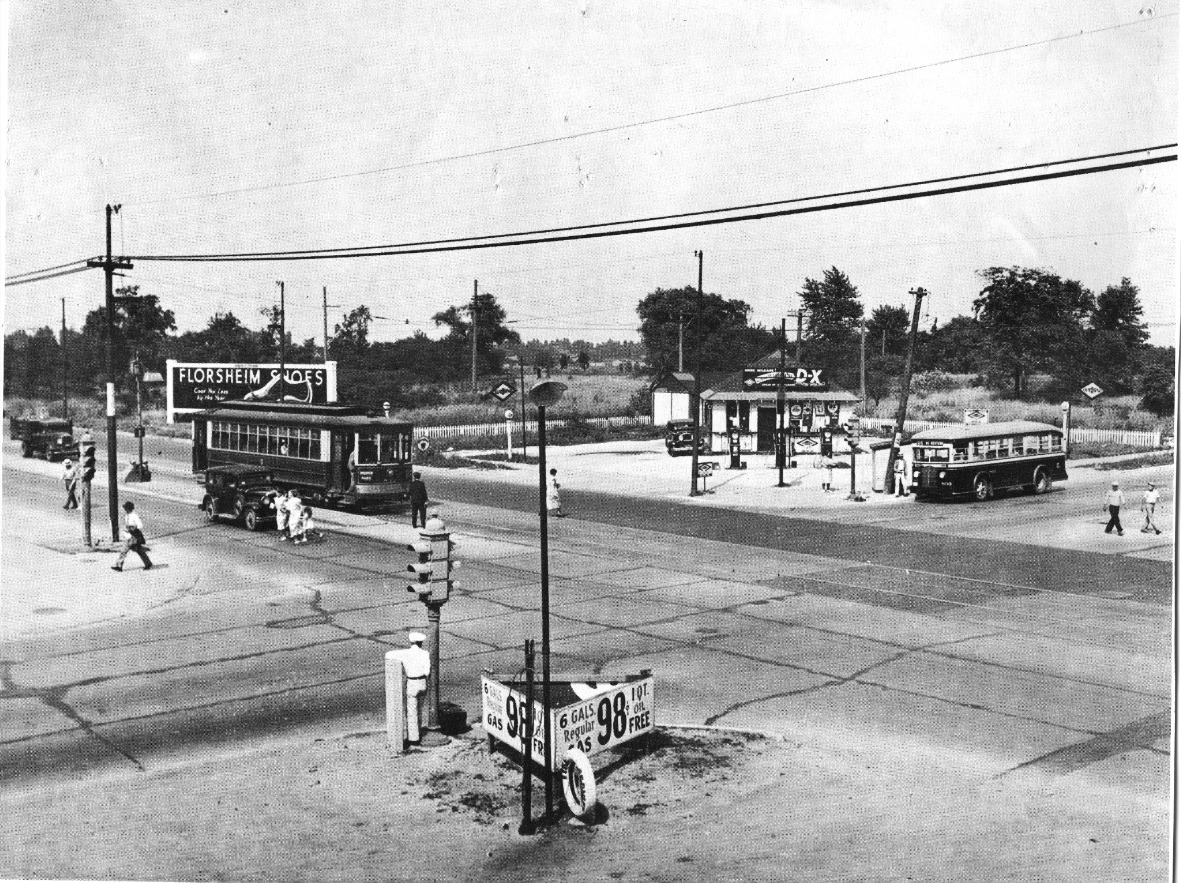
Streetcars did once travel up and down Western Avenue. Here's a favorite photo of one from the RHS collection. The corner is 95th and Western, facing northeast. The photo was taken from the corner where Evergreen Plaza stands. The streetcar is traveling south down Western Avenue.
1930s? I have to find the date of the photo. Notice the price of gas – 98 cents for six gallons. Prices were going up – it used to be 10 cents per gallon!
Some "context clues" about determining the age of the photo: given the looks of the cars and the women's clothes, it's likely the 1930s. There is a big ad for Florsheim shoes. They started making women's shoes in the 1930s.
EDITED: The photo is from 1935.
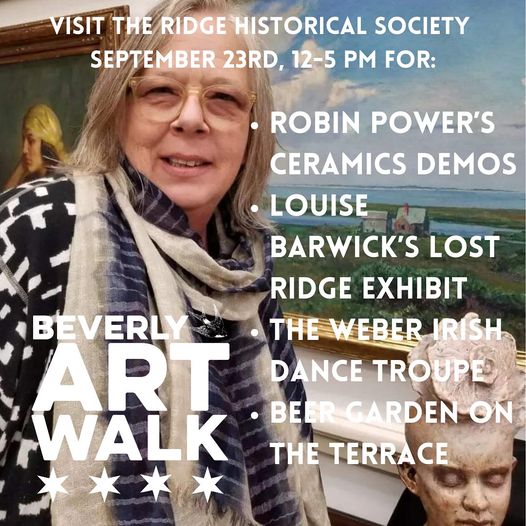

It's that time of year – the Beverly Art Walk is almost here!
This year is 'especially special' because it's the tenth anniversary of the Art Walk and the founding of the Beverly Area Arts Alliance. That's a historical milestone.
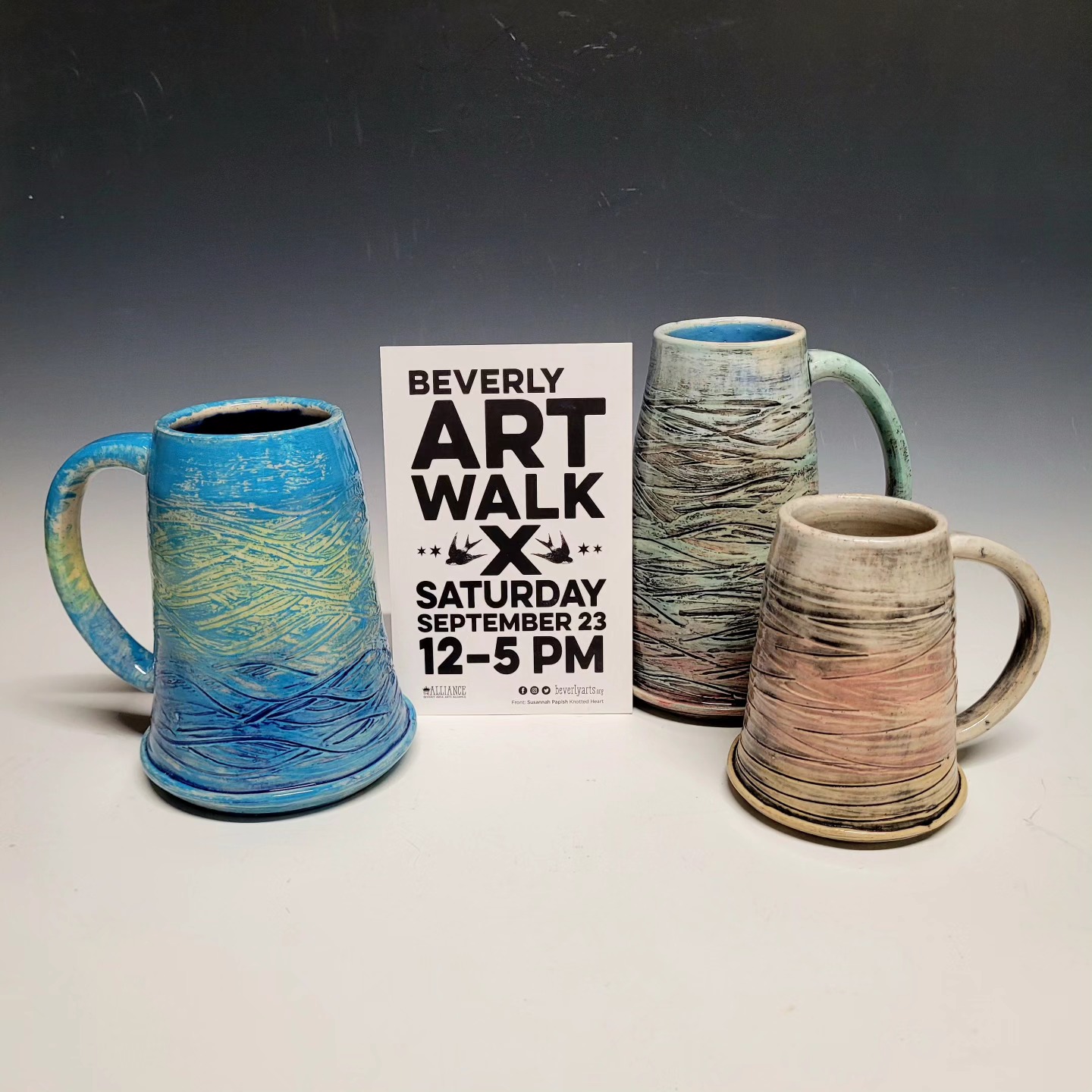
On Saturday, September 23, 2023, from 12 noon to 5 p.m., the Beverly/Morgan Park community will come alive with art exhibits and demonstrations, music, craft vendors, family events, food and drink, and so much more.
The Ridge Historical Society is very excited to participate this year, as always. At RHS, visitors will find:
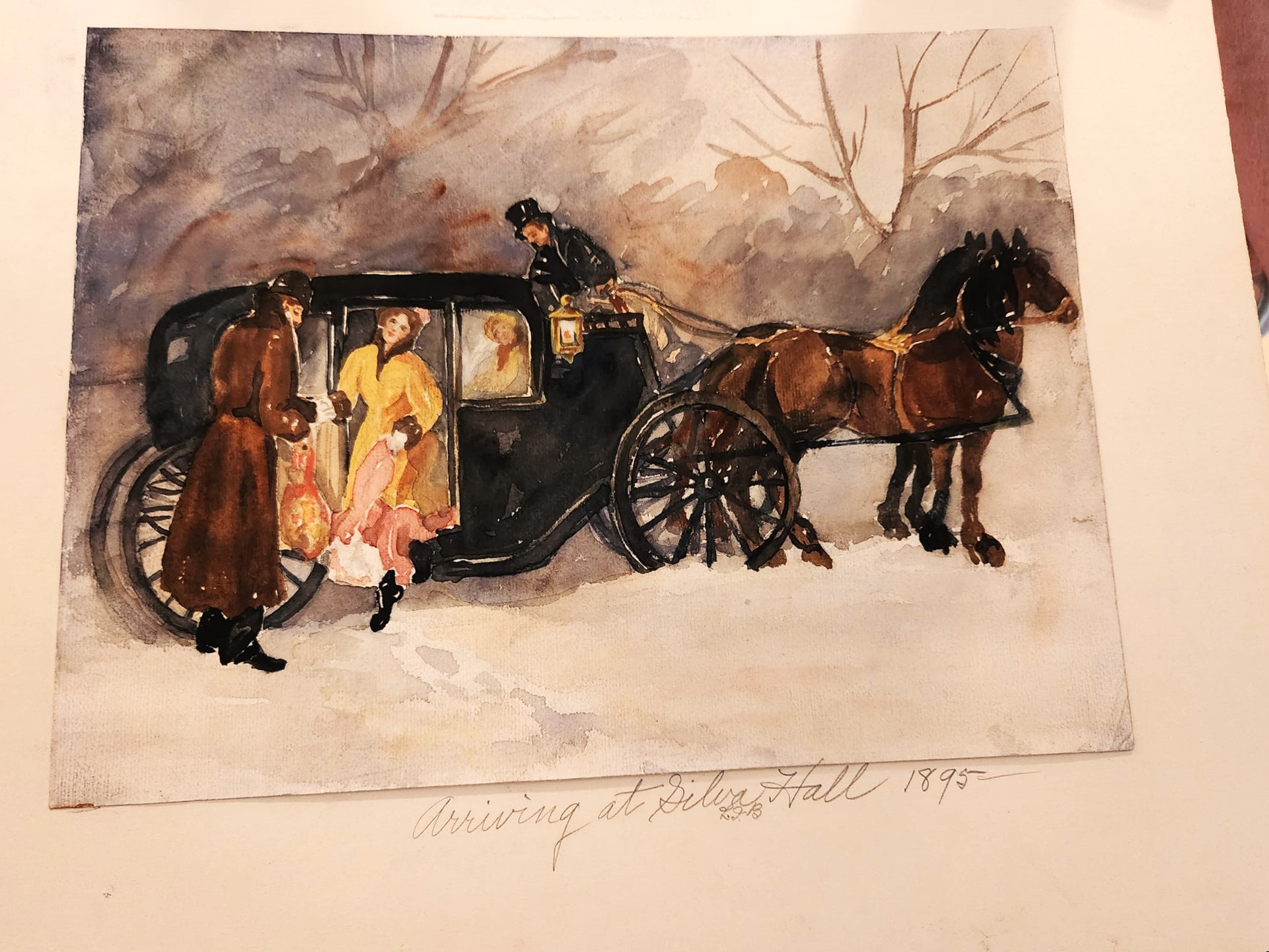
– A brand new exhibit – "Louise Barwick's Lost Ridge"
– Artist Robin Power demonstrating ceramics-making
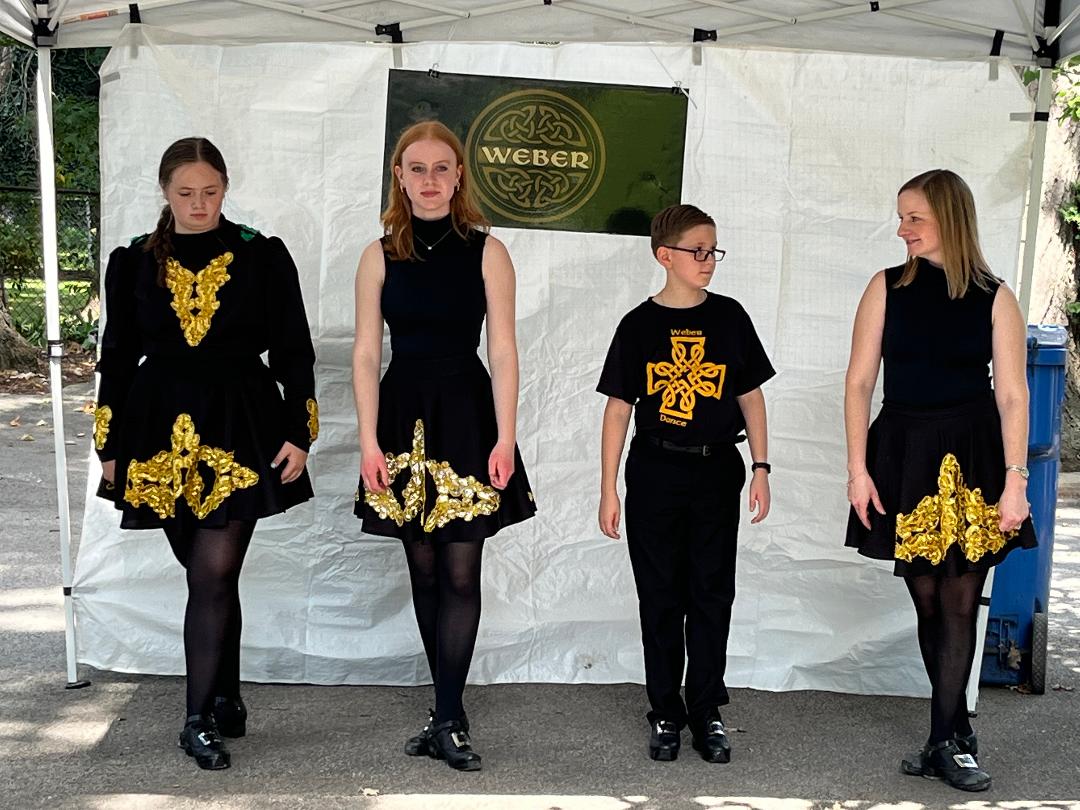
– Performances by Irish dancers from Weber Irish Dance
– Beer tasting featuring Horse Thief Hollow products
Watch this page this coming week for information on all these events. The address for RHS is 10621 S. Seeley Avenue. (Parking is on Seeley Avenue, then walk up the driveway.)
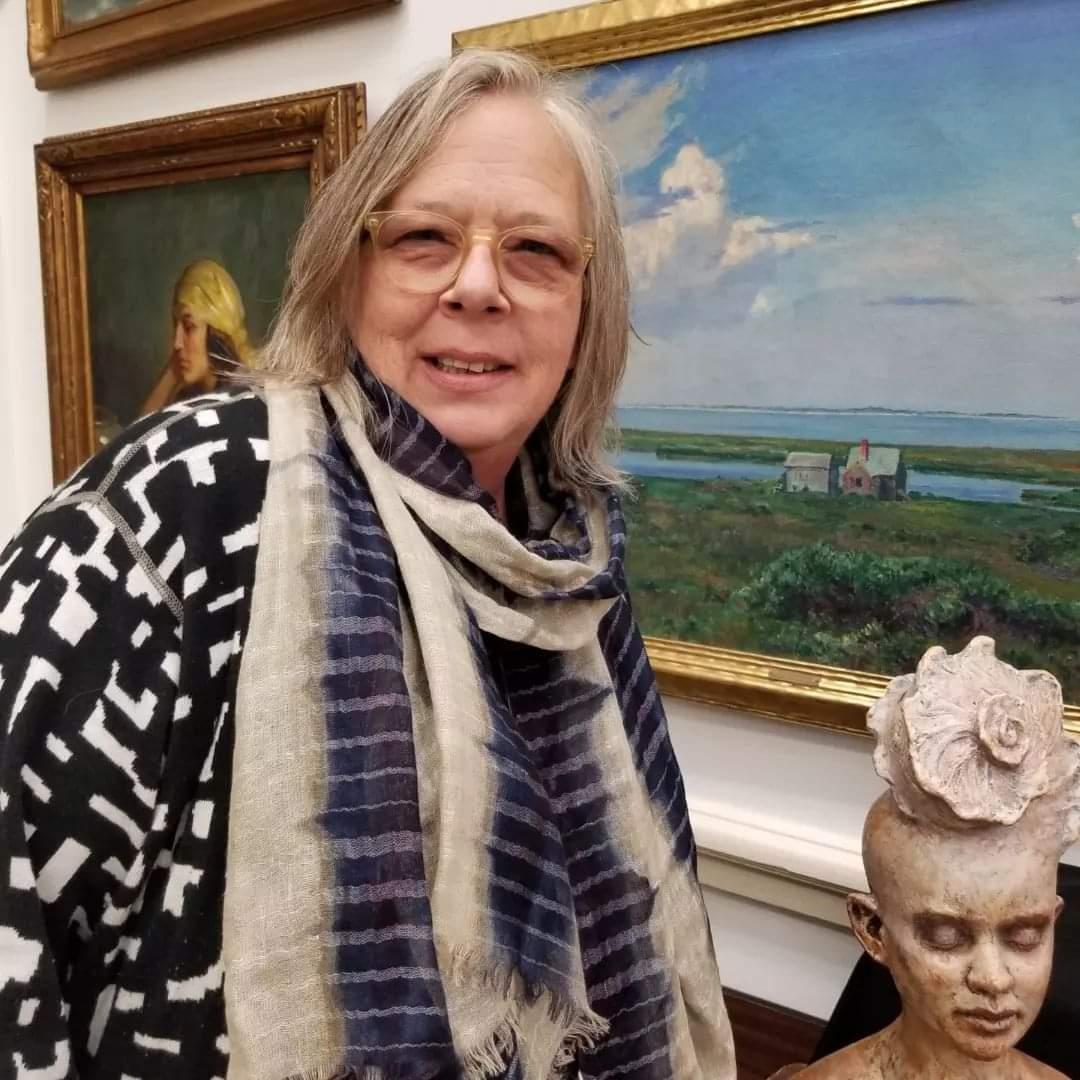
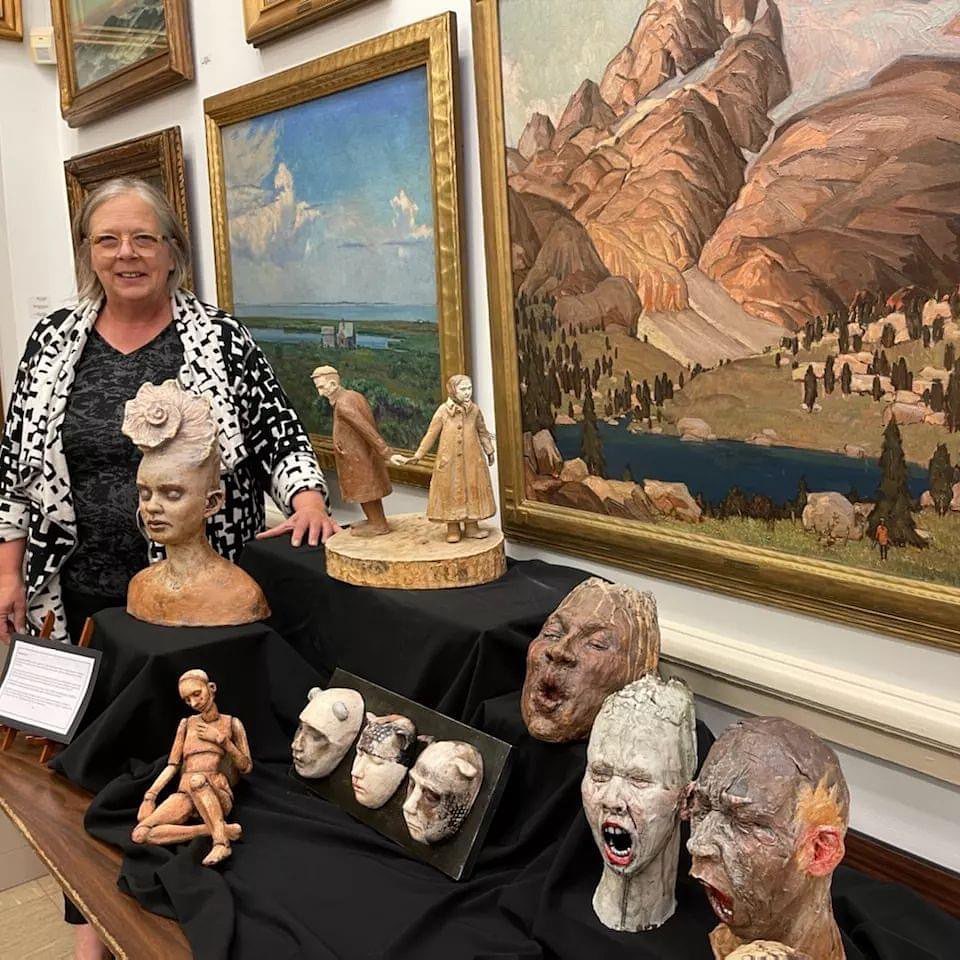

The Beverly Art Walk at the Ridge Historical Society – this Saturday, September 23, 12 noon to 5 p.m., 10621 S. Seeley Avenue, Chicago.
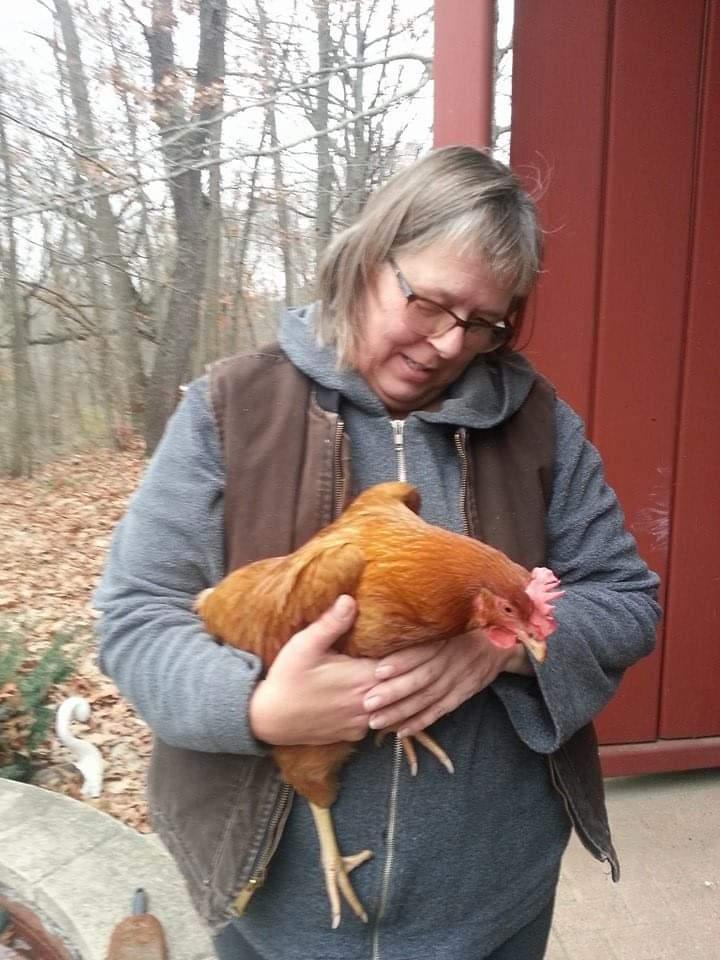
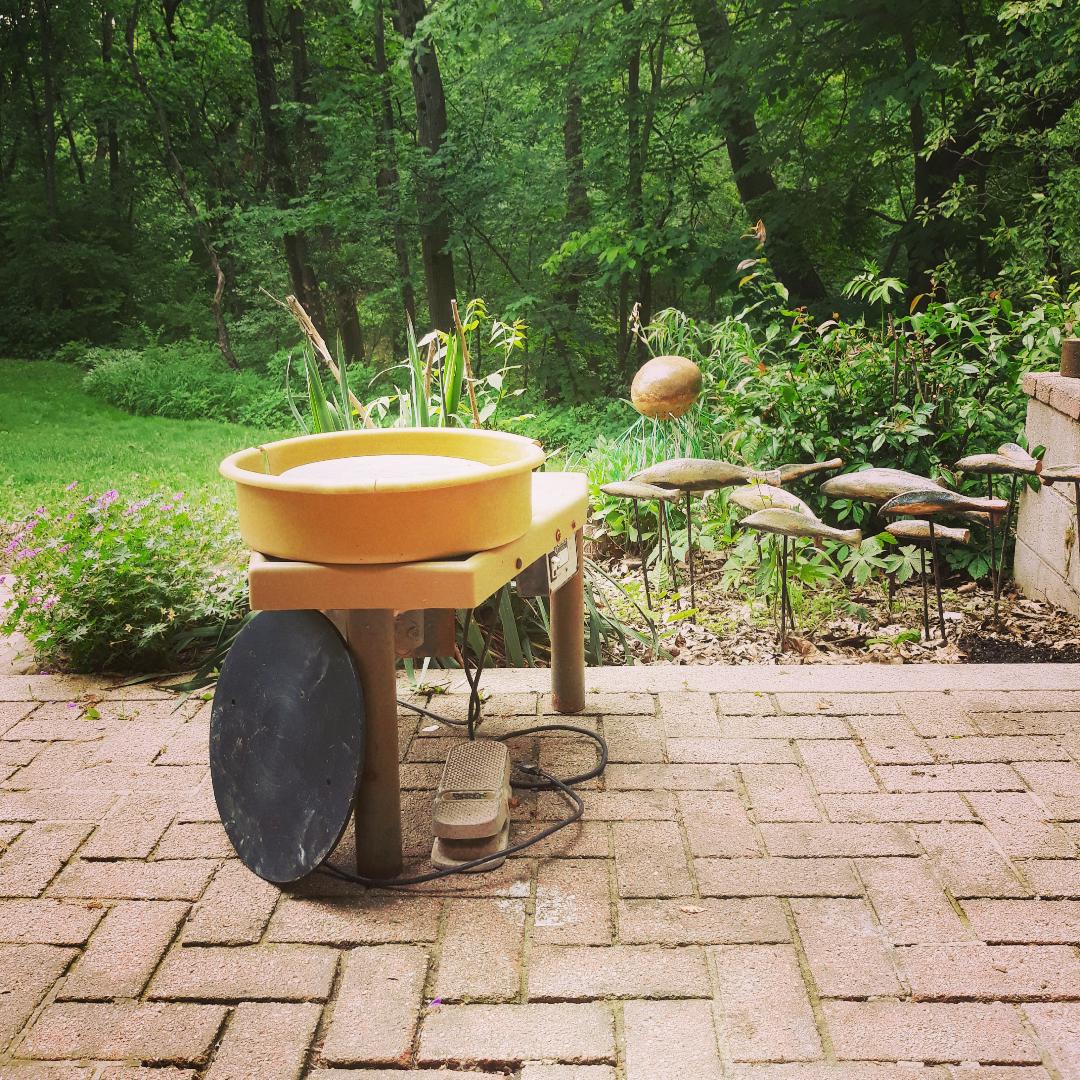
RHS is very excited to welcome Robin Power for a demonstration of ceramics-making on the RHS terrace for the Art Walk.
Robin is recognized as a superb artist and educator, plus she's a great person.
She has a BFA from the School of the Art Institute of Chicago. She is a proficient artist in several areas, from basket-weaving to doll-making, but her real love is hand-sculping exquisite ceramic figures of humans and animals. She teaches at her home studio in Lemont as well as places like Moraine Valley College and way up in the north suburbs. She has done programs for the Arts Alliance that were very well received.
At RHS she will be demonstrating the use of a pottery wheel. She will be bringing a variety of her "festive beverage steins" with her for sale. Horse Thief Hollow Brewery beer products will be available for tasting. Everyone knows cold beer tastes best in a stoneware mug!
Watch this page for more on the events at RHS for the Art Walk – the premier of the new exhibit, "Louise Barwick's Lost Ridge," and entertainment by Weber Irish Dancers.