
Explore the RHS Facebook Archives, a rich repository of local history written by Carol Flynn. For two decades, Carol brought a deeply dedicated voice to public education at RHS. Her role as Facebook administrator through mid-2025 naturally extended her prolific research into meticulously detailed articles, most notably her multi-part historical series posts. Today, Carol continues her local history writing for The Beverly Review and other outlets.
2022
“Invisible Labors” is a collaborative project to explore the role that women played in the use of the land, as gatherers, farmers, gardeners, and artists, in the history of the Ridge communities of Beverly and Morgan Park. It is one of five projects currently supported by 3Arts, a nonprofit organization that supports Chicago’s women artists, artists of color, and Deaf and disabled artists who work in the performing, teaching, and visual arts. 3Arts includes a built-in match that helps Chicago artists finance new creative work.
“Invisible labors,” curated by Susannah Papish, the Director of boundary, the art project space in Morgan Park, has several components. It started last fall with a garden of native plants and a paper-making exhibition at boundary by artist and educator Melissa Potter, a professor at Columbia College Chicago.
The next component will be a publication featuring the research and writing of the Ridge Historical Society’s experts on local history. With research assistance form RHS Historian Linda Lamberty, RHS researcher/writer Carol Flynn, who develops all the stories that appear on the RHS Facebook page as well as stories for the local newspapers and other sources, will write about the pre-history days of Native Americans and their use of the land; the coming of the white European settlers and their development of the land; and the history of the early community of Black Americans who settled here after the U.S. Civil War. For the record, Carol Flynn is legally disabled.
The publication, which is still in the planning stages, will include artwork and other contributions from Susannah and Melissa, in addition to the written stories.
Susannah Papish has started a fund-raising campaign to offset some of the expenses of the project through this link: https://3arts.org/projects/invisible-labors/
We hope that if you truly support the arts in the Beverly/Morgan Park community, and/or appreciate the historical stories shared by the Ridge Historical Society, that you will consider putting a few dollars towards this project. We will be very grateful for the contributions.
The RHS page will share some of the highlights of the stories in the coming days.
Artist Louise Barwick lived in one of Beverly’s oldest and most charming houses on 103rd and Seeley. She painted beautiful local scenes in water color, as well as made a name for herself in the academic field with geographic modeling techniques. Her story is one that will be told in “Invisible Labors.”
Linda Lamberty, Ridge Historical Society Historian, and Carol Flynn, Ridge Historical Society researcher/writer, are honored to be part of “Invisible Labors,” a collaborative project with Susannah Papish, artist, educator and Director of boundary, the arts project space in Morgan Park; and Melissa Potter, feminist interdisciplinary artist and writer, and Professor at Columbia College Chicago.
“Invisible Labors” began as a project at boundary last year that included Melissa’s garden of native plants and an exhibition of papermaking, an artistic medium at which she excels. This led Susannah to start thinking about how the land was used in the Ridge area before it was just about all claimed by “development.”
Susannah reached out to Linda and Carol from RHS, with whom she worked previously on other projects, and rich discussions started about the history of the land from the time of the Native Americans to the arrival of the European settlers to the Great Migration of African Americans from the Southern United States.
This led to the idea for an artistic publication on the role that women played in the use of the land, as farmers and gardeners, and as artists. Carol will be a primary author with stories about the women of the Ridge and their connections to the land, based on research conducted with Linda. There will be additional writing from Melissa, as well as artwork related to the topic. We’re still thinking about formatting options for the publication.
March is Women’s History Month, so we are announcing this project at this time.
Susannah has put together a description of the project as well as a campaign to raise some funding to help with the cost of developing this project, which can be accessed at the website https://3arts.org/projects/invisible-labors/.
Thank you for your interest in the project. The publication will be out this summer. Please let us know if you have any questions or comments.
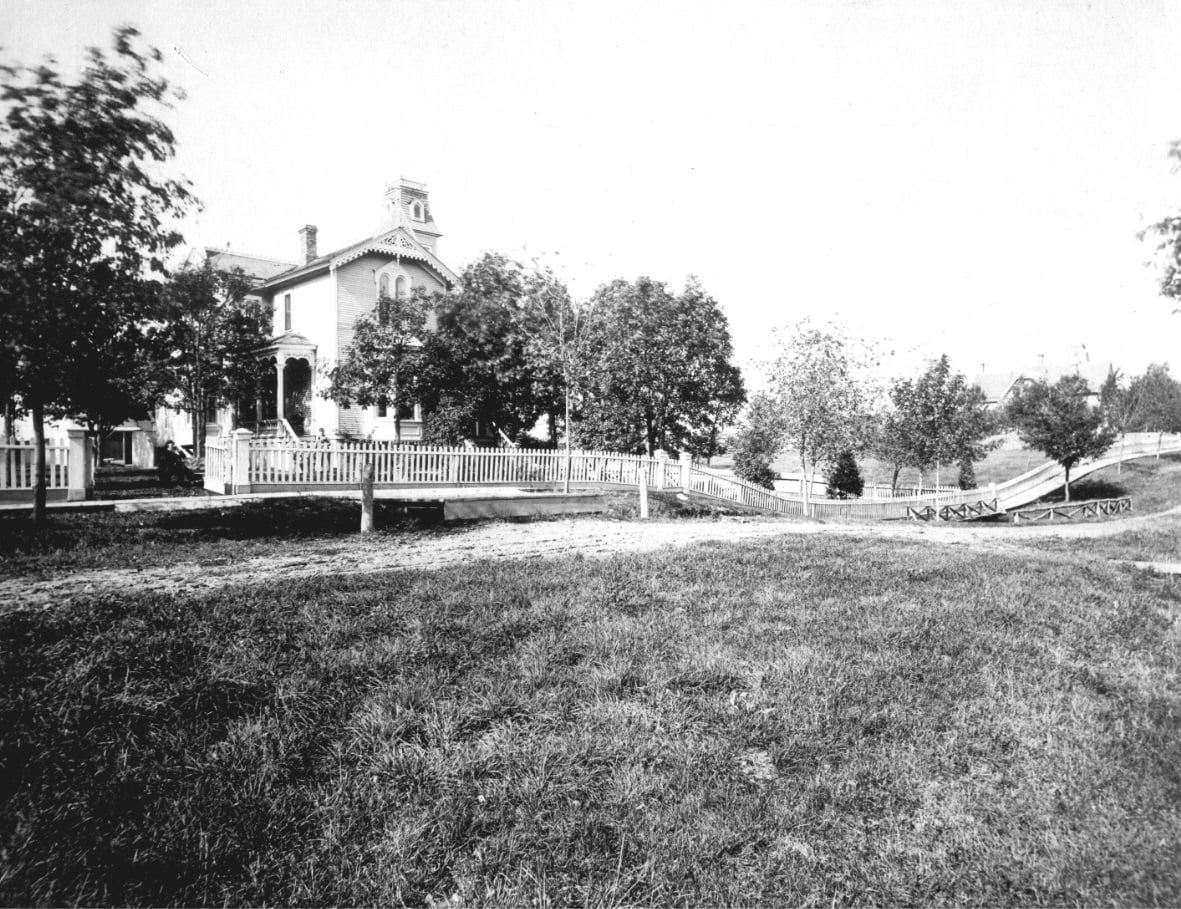
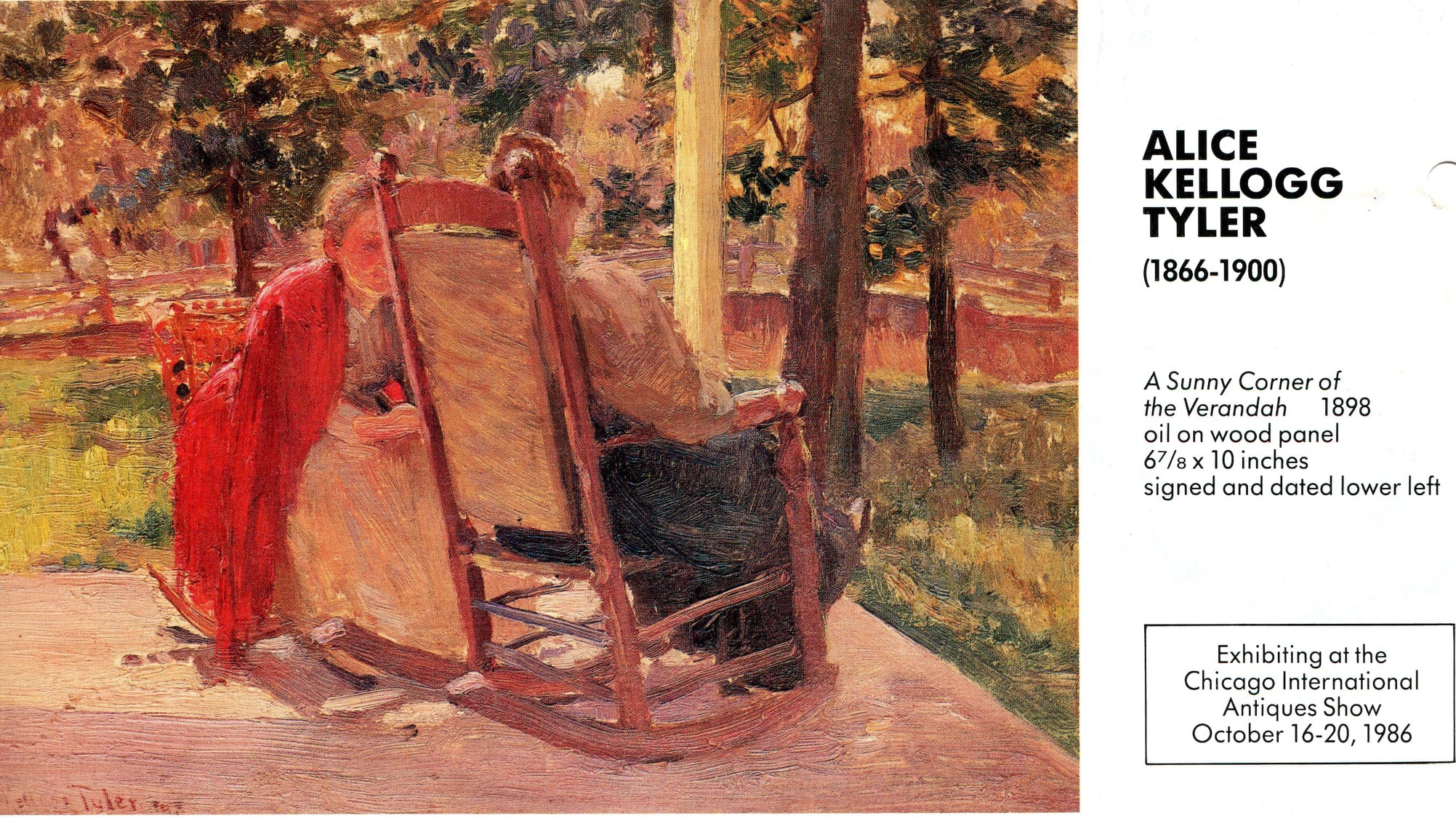
Image is of a painting by Alice Kellogg Tyler of the verandah of their farmhouse on the Ridge.
The Ridge Historical Society
International Women’s Day
By Carol Flynn
Tuesday, March 8, is International Women’s Day, and March is Women’s History Month. The Ridge Historical Society has shared many stories in the past about significant women from the Ridge and their contributions.
One of the favorite heroines of the community is Gertrude Blackwelder and her story really can’t be over-told.
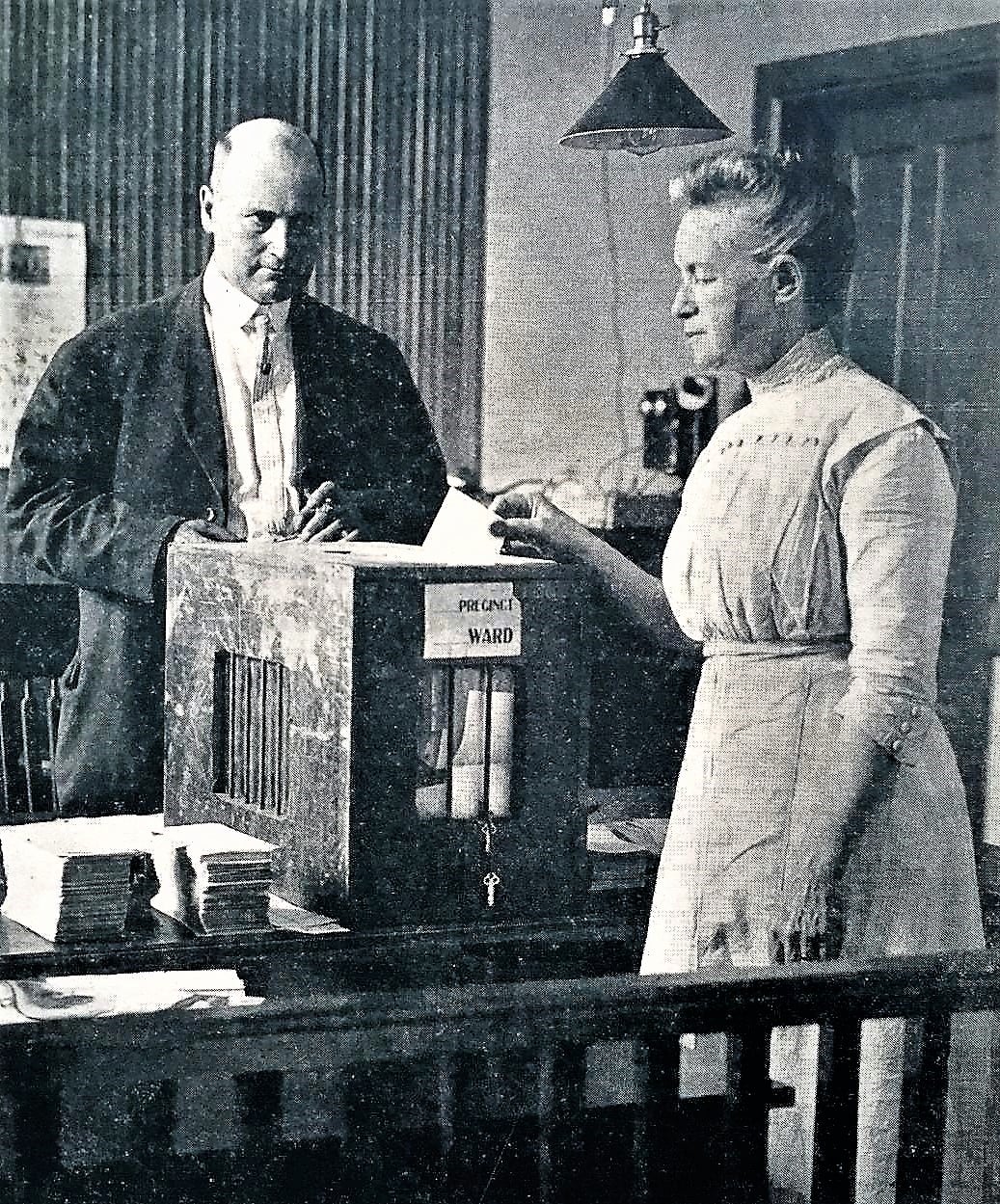
Gertrude Blackwelder made history on Saturday, July 26, 1913, when she cast her ballot in Morgan Park’s special election on building a new high school.
Reported Town Talk, a local paper, “As this was the first opportunity given women of Cook County by virtue of the recently enacted Women’s Suffrage law to vote upon questions other than candidates for school boards, nothing could have been more fitting than that Mrs. I. S. Blackwelder, former president of the Chicago Woman’s Club, and consistent worker for the betterment of women and children, as well as mankind as a whole, should cast the first woman’s vote in Morgan Park and Cook County.”
A photo of Mrs. Blackwelder casting that vote appeared in numerous papers. The Illinois law was the final push that led to the U. S. Constitution’s Nineteenth Amendment in 1919, granting women the right to vote.
The Progressive Era of 1890-1920 was a time of great reform and advancements, particularly in government and social areas. Gertrude Blackwelder embodied the spirit of that Era, working for women’s suffrage and other causes.
Alice Gertrude Boughton was born in 1853 in New York. Her father, a Baptist minister, valued education. In 1869, she joined her sister in Kansas to attend the newly established university there. Following graduation in 1875, she was the first female graduate to be appointed to the faculty and, in 1890, she became the first woman to give a commencement speech. Improving education opportunities for women and other disadvantaged groups became another important cause for Gertrude.
In 1877, Gertrude married Isaac Simeon (I. S.) Blackwelder, and moved to Chicago. Blackwelder (1840-1926) rose to top management in the insurance industry, starting as an adjustor handling claims from the Great Chicago Fire of 1871.
The Blackwelders settled in Morgan Park, where I. S. served as president of the Village Board. Sons Paul and Eliot were born. The family acquired the Ingersoll house at 10910 S. Prospect Ave., adding a Queen Anne-style front to the existing Italianate-style structure.
At that time, the wives of wealthy men did not “work” outside the home. They applied their intelligence, skills, and wealth to projects through volunteer organizations. Gertrude was elected to membership in the prestigious Chicago Woman’s Club (CWC), where she worked alongside Jane Addams of Hull House and Bertha Honore Palmer.
Gertrude’s special interest was vacation schools, summer programs offering nature, arts, music, and outdoor play activities for impoverished city children. For several years, she chaired the Vacation School Board, overseeing schools set up by the Chicago Permanent Vacation School and Playground Committee of Women’s Clubs. This coalition, with 212 delegates representing 50 clubs, worked closely with the Chicago Board of Education. Gertrude wrote several articles on vacation schools for college publications.
Due to her leadership abilities, Gertrude was chosen for higher office in the CWC. She served as Second and then First Vice President, and as President from 1906 to 1908. During those years, issues CWC addressed included children’s healthcare and daycare, the juvenile court system, crimes against children, working rights and conditions for women and children, sanitation and disease prevention in Chicago neighborhoods, pure food laws, and programs for the blind.
Even as an executive officer, Gertrude made time to chair the Story Telling Committee, organizing and conducting story hours at schools, libraries, and recreation centers.
At home, the Blackwelders were involved in “all things Morgan Park.” At the request of local women, Gertrude co-founded the Morgan Park Woman’s Club in 1889. Pre-COVID, this was the oldest women’s club still existing in Chicago.
The Blackwelders supported the annexation of Morgan Park to Chicago, and the building of the high school. Both sat on local school boards, and Gertrude headed the Public School Art League which obtained artwork to decorate the school. A proposal in 1923 to rename the high school for the Blackwelders resulted in naming the auditorium Blackwelder Hall.
Later, the Blackwelders moved to Stanford, California, where son Eliot was a college professor. Gertrude died there in 1938.
“When I entered the University, in January, 1869,” wrote Gertrude in the 1908 Graduate Magazine of the University of Kansas, “Such was my delight at the opportunity for higher education, then largely denied to girls, that no thought of our limitations disturbed the serenity of my youthful mind.”
That attitude prevailed throughout Gertrude Blackwelder’s life: she gave no thought to limitations. Her influence and accomplishments reached far beyond Morgan Park. Women’s History Month is a fitting time to give her recognition.
This photo is of Gertrude Blackwelder casting the first ballot, and it appeared in the Chicago Tribune, July 27, 1913. With her is Henry Heizer, local lawyer who served as Clerk of Election. Some people comment that Heizer looks disapproving, but that was not the case – he was totally supportive of the effort.
The Ridge Historical Society
The Ridge’s Historical Connection to Ukraine
By Carol Flynn
The eyes of the world are on the country of Ukraine in Eastern Europe at the moment.
There are over one million Ukrainian Americans. The first Ukrainian immigrant on record came to Jamestown in 1607. Large-scale immigration to the U.S. began in the 1880s, and was very heavy in the early 1990s after the collapse of the Soviet Union.
The historical connection between one prominent Ukrainian family and the Ridge has been documented.
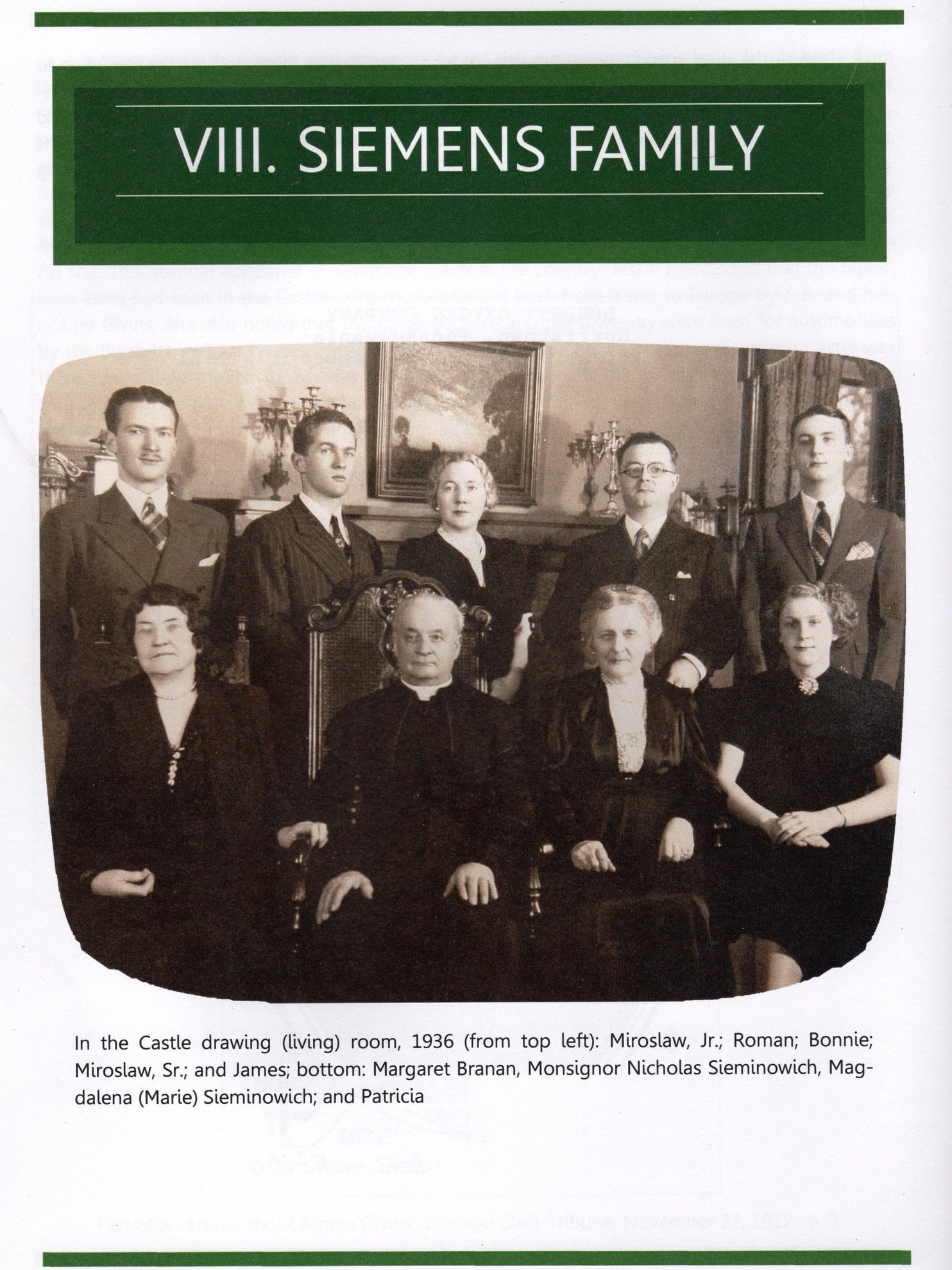
Dr. Miroslaw and Bonnie Siemens (Sieminowycz, Sieminowich) owned and lived in the Givins Beverly Castle at 103rd St. and Longwood Drive from 1921 until the Beverly Unitarian Church bought the building in 1942. At the time of Dr. Siemens’ death in 1967, at the age of 82, the family was living at 9559 S. Longwood Drive.
Dr. Siemens was born in 1885 in Ukraine and came to the USA in 1907. He graduated in 1913 from Bennett Medical College, affiliated with Loyola University. He was naturalized as a U.S. citizen in 1914, and served in the U.S. military during World War I. He was a major, a regimental surgeon, with the 497th Field Artillery. He then practiced at Roseland Community Hospital and kept an office in the Castle. He was also the physician for the Nickel Plate Railroad.
Dr. Siemens’ parents, Nicholas and Maria Magdalena Seiminowich, also lived in the Castle. Nicholas was a Ukrainian Catholic priest who rose to monsignor. In this rite, married men can be ordained priests.
Bonnie Veronica Barry Siemens, born in 1890, was Irish Catholic. They married in 1915 and had four children, Miroslaw, Jr., Roman, James, and Patricia. Bonnie's mother Margaret Branan also lived with the family. Bonnie had tuberculosis and the grandparents did much of the childcare.
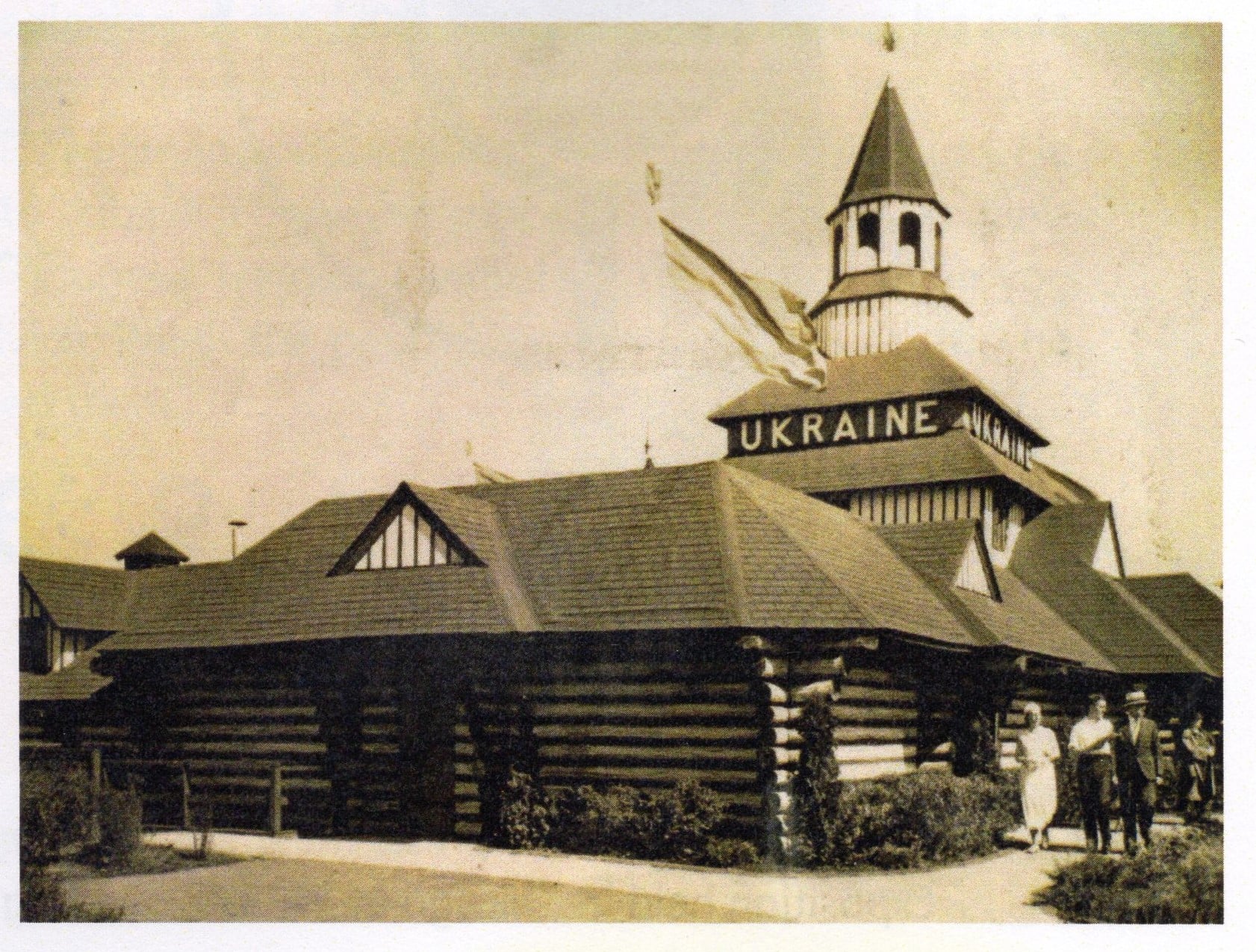
Dr. Siemens was very active and important in the Ukrainian American community. One notable achievement was to serve as the planner, fundraiser, and chair of the Ukrainian exhibit at the Century of Progress World’s Fair in Chicago in 1933-34. The exhibit showcased the country’s traditional arts and culture, including pysanky, the famous Ukrainian Easter eggs decorated using a wax-resist method.
In 1939, Siemens was called to testify before the Special Committee on Un-American Activities of the U.S. House of Representatives. He was president of the United Hetman Organization, proponents of a governance system in Ukraine run by a “hetman” or head of state that had been in operation up to the late 1700s. The organization was investigated for possible subversive activities, but no charges were ever laid against the group. Lacking widespread support, the group dissolved in 1942. Siemens was a leader of an effort to form a successor organization but there was insufficient support.
He was a benefactor of St. Nicholas Ukrainian Catholic Cathedral in Ukrainian Village on Chicago’s north side. In the early 1950s he was instrumental in establishing the Ukrainian National Museum, and served as honorary president.
Dr. Siemens has been called the “first ambassador for Ukraine in the U.S.” because of his efforts to preserve Ukrainian history and to help refugees from the country. Many dignitaries including the Crown Prince of Ukraine visited the family in the Castle.
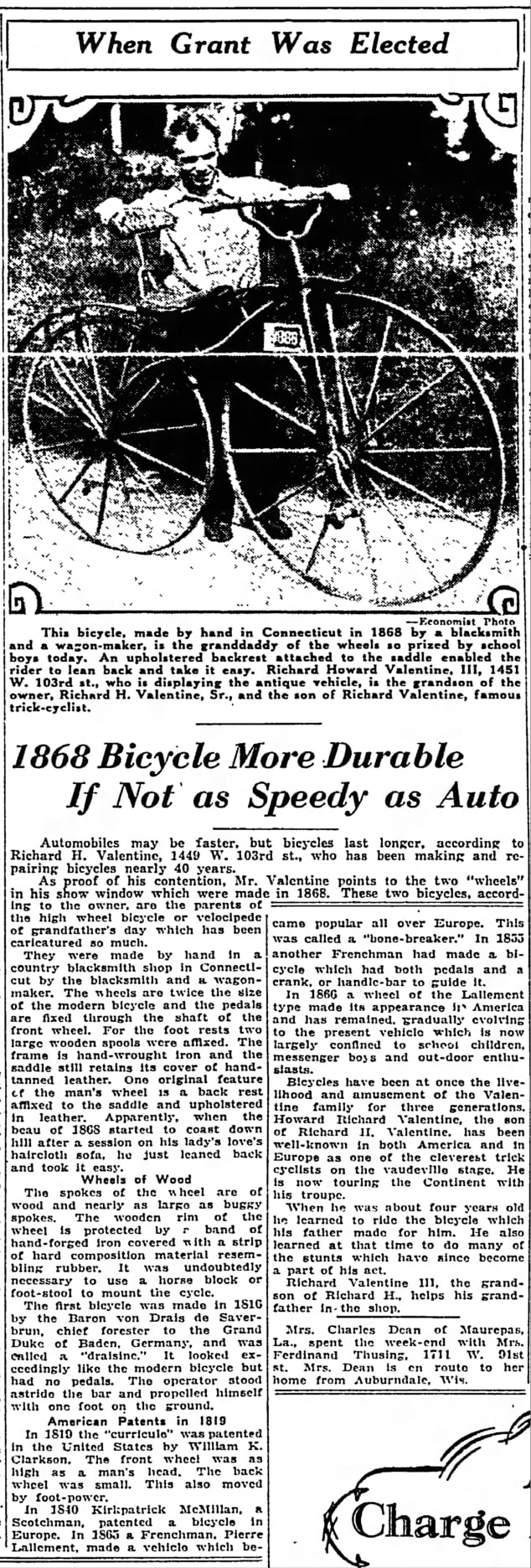
The Ridge had its own Valentine family in the community. Here is one interesting article about them. This is from the Southtown Economist, September 25, 1928.
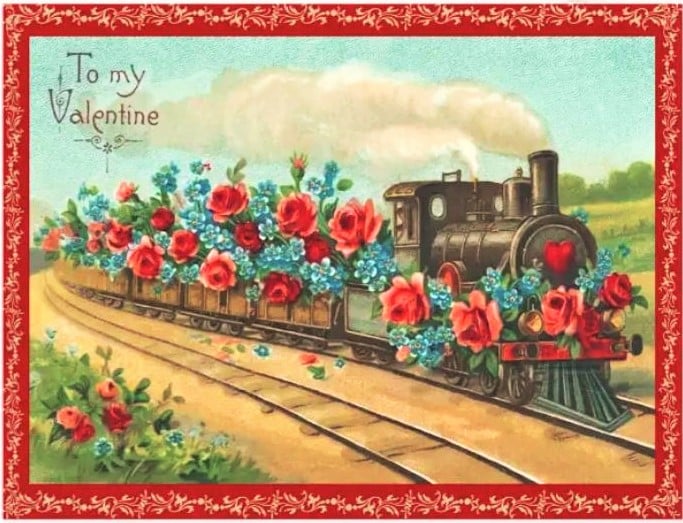
Happy Valentine's Day from the Ridge Historical Society!
Here's a vintage postcard appropriate for the day – the railroads were a huge factor in the history of the Ridge communities, and here is one carrying Valentine's wishes to all our followers.
The Ridge Historical Society
Save the Pike House will be on TV
By Carol Flynn
The television program “The American Dream Chicago” will air a segment on the "Save the Pike House" campaign on WGN Channel 9 on Saturday, February 19, at 10:30 a.m.
Beverly resident Meg Mulrenin, who has the realty company Town Realty Chicago, is the host for this segment. This show is a national program designed to highlight local real estate, culture, and lifestyle in neighborhoods across the country. Meg, selected as one of six hosts for the Chicago cast, is an industry professional representing our unique area of Chicago. She got involved in the show “for viewers to see what a special place the Beverly Hills/Morgan Park community is – the stunning homes, the fabulous business owners, the PEOPLE who make this the best place to live.”
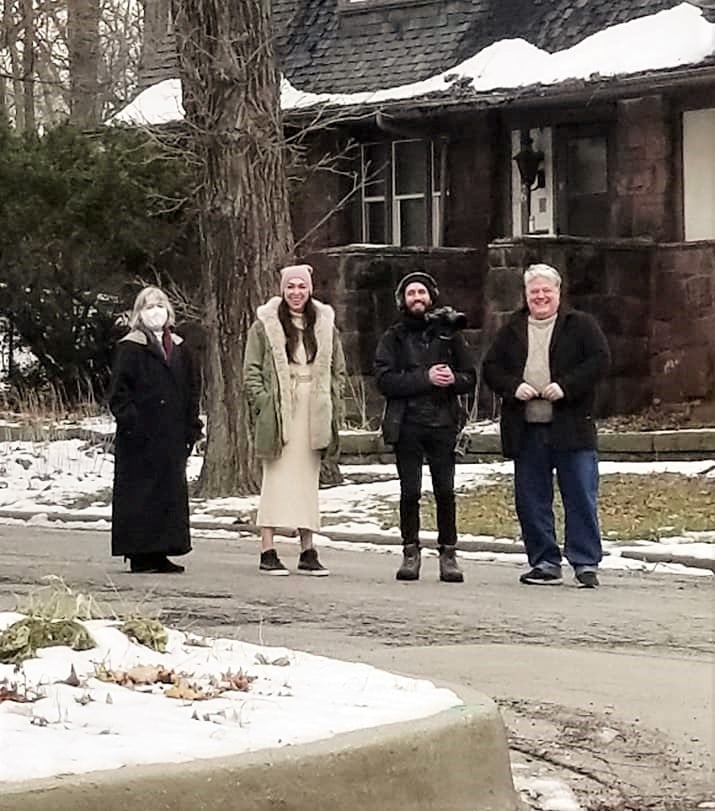
Meg reached out to RHS through our Facebook page, and on an overcast day in January, Meg and cameraman Mat Astacio joined RHS Historian Linda Lamberty and RHS Board member Tim Noonan for a look at the Eugene S. Pike House exterior and a discussion on its current situation.
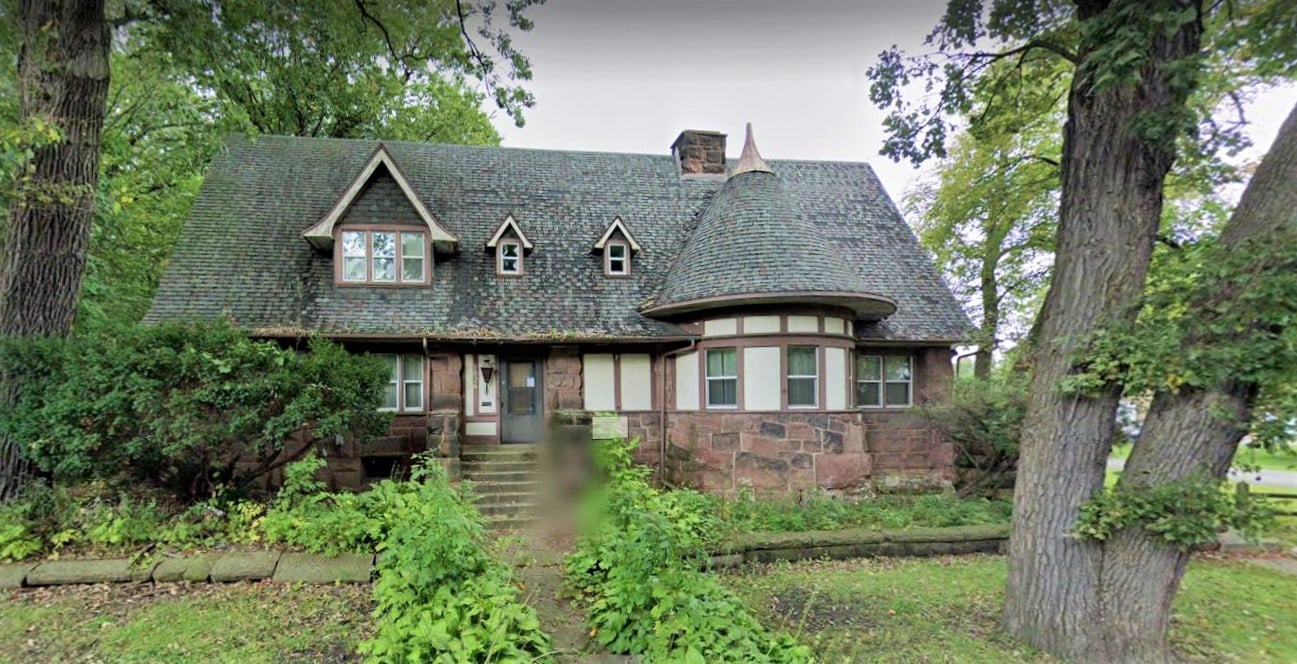
The Eugene S. Pike House, at the corner of 91st Street and Longwood Drive, was designed by architect Harry Hale Waterman and built for Pike, a real estate developer known for his post-Chicago Fire skyscrapers, in the 1890s. It is a contributing structure to the establishment of the Ridge Historic District listed on the National Register of Historic Places. The house has been part of the Dan Ryan Woods, owned by the Forest Preserves of Cook County, for the past 100 years. It has seriously deteriorated and its future is uncertain.
Hopefully, this national coverage will help bring attention – and positive solutions – to saving this Beverly landmark.
Pictured from left: Linda Lamberty, Meg Mulrenin, Mat Astacio, and Tim Noonan in front of the Pike House. Photo by C. Flynn.
Ridge Historical Society
Save the Pike House – Post 2: Architectural Significance and Current Condition
By Carol Flynn
The Pike House at 91st Street and Longwood Drive was built in 1894 as part of the private estate of Eugene S. Pike, the real estate developer and financier. Pike’s primary residence was a mansion on the exclusive Prairie Avenue, but he bought land on the Ridge for personal use and to develop lots for sale.
Pike was an avid horticulturist. Before coming to Chicago from Ohio, he established and operated as a business a nursery for fruit and ornamental trees, rose bushes, and grape vines he exported from France. His customer base was largely the Southern states, and unfortunately the business ended with the U.S. Civil War. On the Ridge, he found the perfect place to continue this passion while he developed “skyscrapers” in downtown Chicago and residential/business areas mostly on the southside of the city.
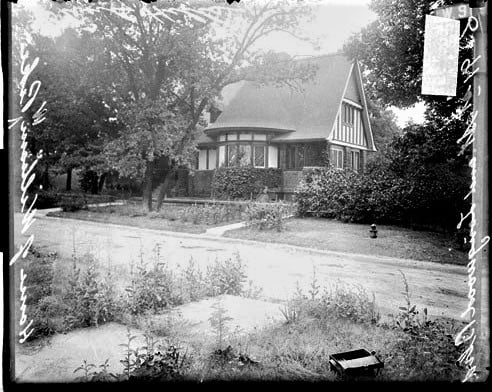
The Pike House was designed as a “gardener’s cottage” by architect Harry Hale Waterman in the Tudor Revival style. The house has a base and lower exterior walls of red sandstone, and upper walls of wood beams and stucco. Architectural elements include a round tower and a steeply pitched roof with tiny dormers with flared ends. The round tower adds a French Norman look to the building.
An important architectural feature of the house is how well it is designed for its setting. The house sits on the edge of the Dan Ryan Woods, a part of the Forest Preserves of Cook County (FPCC). The house blends in with the natural environment of the wooded area so well that the American Institute of Architects stated in its AIA Guide to Chicago (2014), “Expect Hansel and Gretel to come tripping past this house set on the edge of the woods.”
Although the existing building appears as if it were constructed at one time, it was actually completed in two stages. The west side was added sometime between 1898 and 1921, and the entrance was moved from the east side to the center front of the house, repositioning the tower to the right of the entrance.
In 1921, 32 acres of the Pike estate, including the house, were purchased by the FPCC to be added to the existing preserves land that FPCC owned to the north of the Pike estate. According to newspaper accounts, FPCC intended to use the house as a superintendent’s headquarters. The house eventually became known informally as the “Watchman’s Residence” when it was adapted for that use in the 1960s. It was used as a residence during its history, and that will be covered in a later post.
The building is significant to the community for several reasons. It has long been a landmark due to its location on the edge of the forest preserve, engaging the interest and imagination of those who pass by it. The Pike House is designated as a contributing structure for the Ridge Historic District, one of the largest urban historic districts listed on the National Register of Historic Places.
For 100 years, the house has been under the stewardship of the FPCC. In 2017, the FPCC shared a Conversion Feasibility study prepared by Kuklinski and Rappe Architects that includes information on the current condition of the house.
In 1962, the interior of the house was completely gutted to convert it into a “watchman’s residence.” None of the original historic features inside the house, except for a sunporch, remain. The house has been vacant for years and is described in the feasibility study as “in poor condition with masonry issues and a damaged roof.” The plumbing, electrical, and heating systems need replacement.
It is understood that it will take considerable resources to restore this building and adapt it for reuse.
Next post: Architect Harry Hale Waterman
The Ridge Historical Society
Nostalgia Print
By Carol Flynn
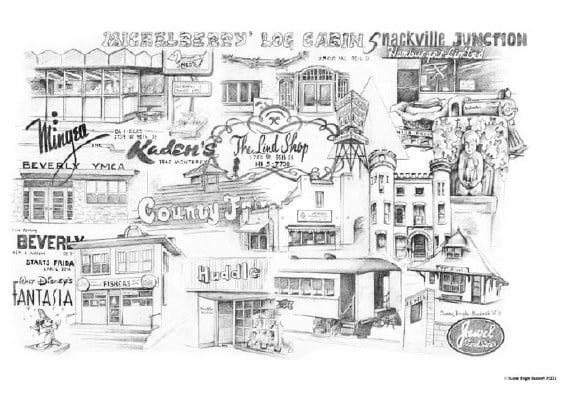
This print popped up on another Facebook page and I just want to let people know it is available through the Ridge Historical Society. Artist Sue Engle Budash of the Morgan Park High School class of 1967 created this nostalgia montage drawing, “Symbols of the Sixties,” for a reunion. It features a number of Beverly and Morgan Park businesses and/or their logos. I believe the prints are 11” by 14” and cost $25.00. You can contact the RHS office directly to buy these – ridgehistory@hotmail.com.
Ridge Historical Society
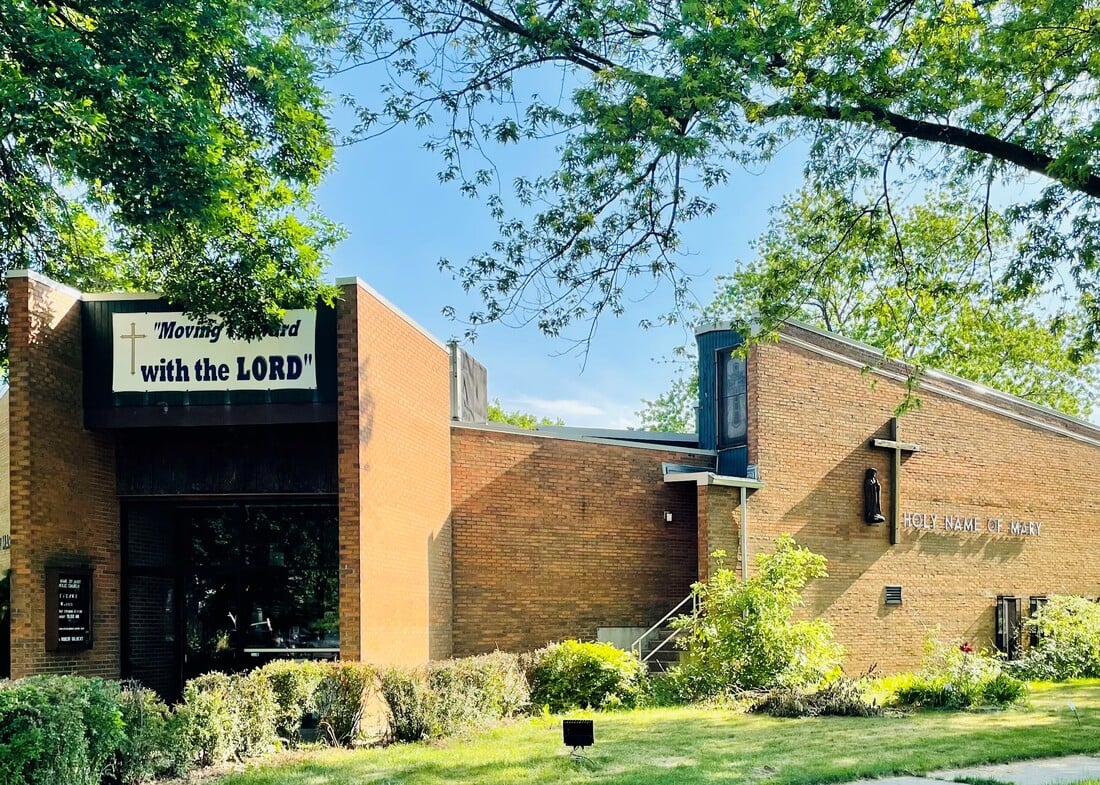
Catholic Churches in the Ridge Communities: Sacred Heart Mission Church and Holy Name of Mary Parish
By Carol Flynn
Sacred Heart Mission Church at 116th and S. Church St., and Holy Name of Mary Parish at 112th and Loomis St., both in Morgan Park, are two more of the historic Catholic churches in the Ridge communities recently affected by the Archdiocese of Chicago’s “Renew My Church” initiative. The fates of these two churches are interconnected.
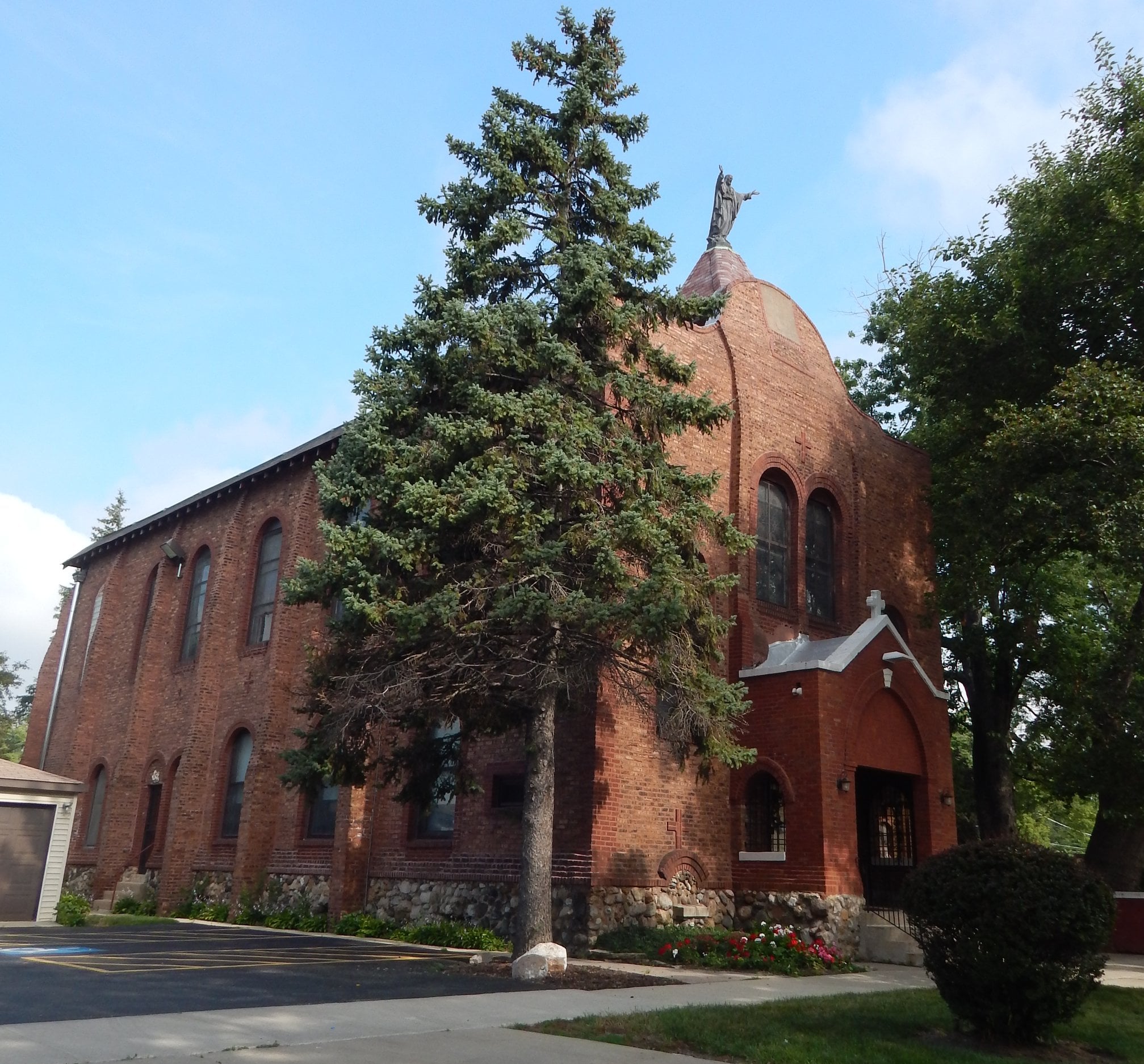
Sacred Heart Mission Church was founded in 1892 in Alsip as a “national” church, that is, to serve a nationality of immigrants without defined geographic “parish” boundaries. In this case, the church was founded for the French settlers in the area. Many of them worked at the Purington Brick Yards at 119th and Vincennes, and Sacred Heart moved to its present location in 1904-5.
A frame church was built, and the story goes that the brickyard employees were allowed to take “seconds” of bricks to use for the church. By 1922, when enough bricks had been saved, the present brick facade was added. The church as it stands now is actually the old frame church clad with this donated brick. With time, most of the French families moved on and were replaced by German and Irish workers.
Holy Name of Mary Parish was founded in 1940 to serve the African American residents in Morgan Park. Black Catholics, some of whom were the descendants of slaves from the State of Louisiana, traditionally Catholic, petitioned the Archdiocese to form a parish, and worked to raise the money to build the church.
Holy Name of Mary was not the first Black parish in the Archdiocese – St Monica’s Church was founded as a “national” church at 36th and Dearborn St. in 1893 to serve the growing Black community on the south side – but it was the first formed by Black Catholics themselves.
Sacred Heart Mission Church was closed by the Archdiocese from 1979-1982, but the congregants never gave up on their campaign to “Save Our Shrine,” and the church was reopened in 1983. At that time, it was made a “mission” church, operating out of Holy Name of Mary Parish. A “mission” church serves a special, non-geographic ministry, and maintains a separate identity from the parish that sponsors it.
Now, the Archdiocese is combining Holy Name of Mary Parish with two others from the area (SS. Peter and Paul and St. John De La Salle) into a new parish with a new name effective this summer. Holy Name of Mary Church will remain open and be the sole location for regular Masses.
The Archdiocese also reviewed Sacred Heart Mission Church and took no action on that church at this time, but announced its “future structure will have continued discernment.”
The four most historic Catholic churches connected to the Ridge communities have been affected by the “Renew My Church” initiative – St. Benedict in Blue Island, St. Margaret of Scotland in Washington Heights, and Holy Name of Mary and Sacred Heart in Morgan Park.