
Explore the RHS Facebook Archives, a rich repository of local history written by Carol Flynn. For two decades, Carol brought a deeply dedicated voice to public education at RHS. Her role as Facebook administrator through mid-2025 naturally extended her prolific research into meticulously detailed articles, most notably her multi-part historical series posts. Today, Carol continues her local history writing for The Beverly Review and other outlets.
2023
The Ridge Historical Society
March: Women’s History Month – Part 3 on the Hofer Sisters
By Carol Flynn
The five daughters of the Hofer family that lived in Beverly were leaders in the kindergarten movement in the U.S.
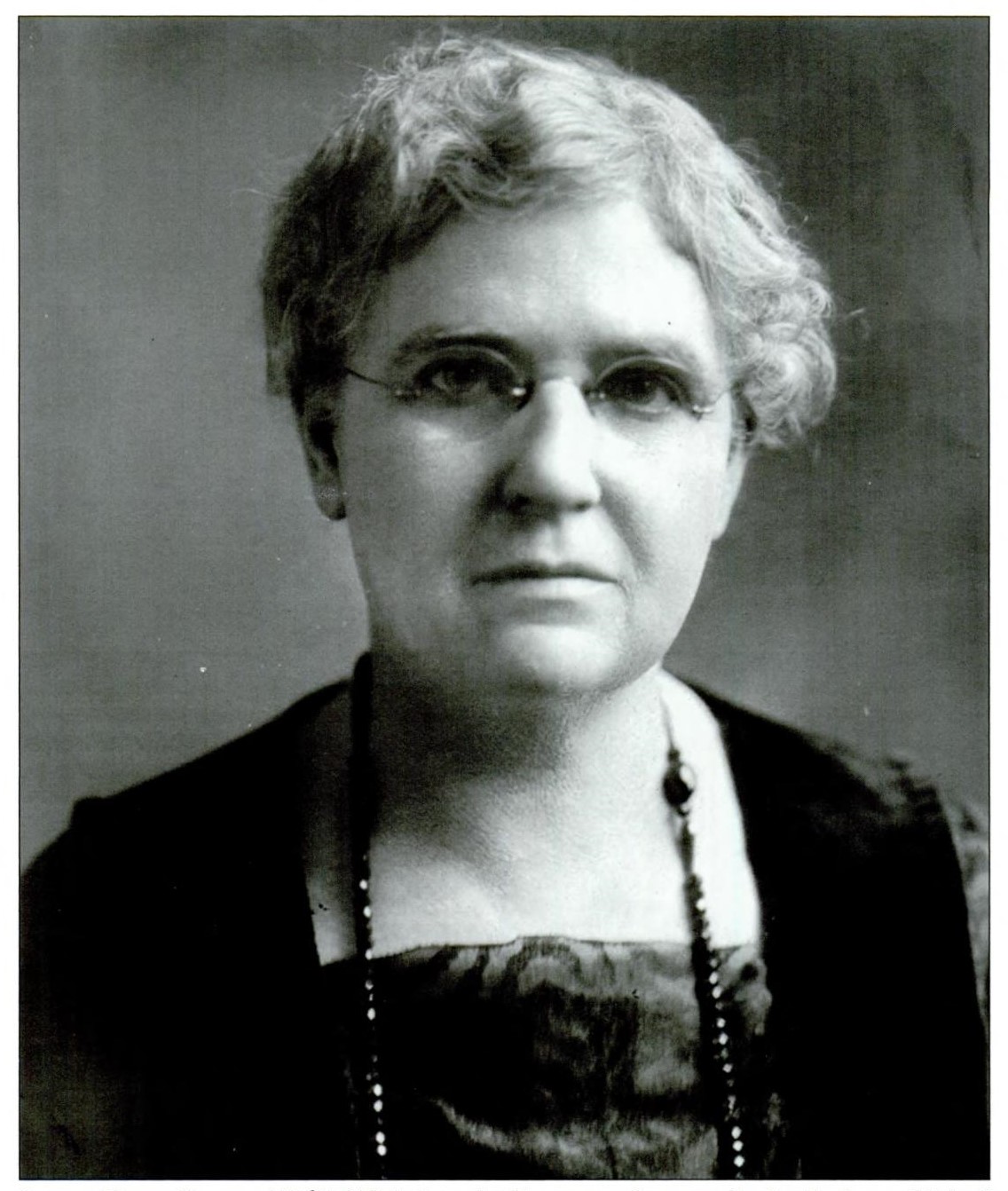
Oldest daughter Mari, profiled in the last post, was an expert in music education for children. This post will look at the second daughter, Bertha, whose career focused on education, administration, and social settlement services, especially for mothers and children.
Bertha Hofer Hegner (1862-1937), like her siblings, was born in Iowa, where her parents settled after immigrating from Baden, on the German-Swiss border.
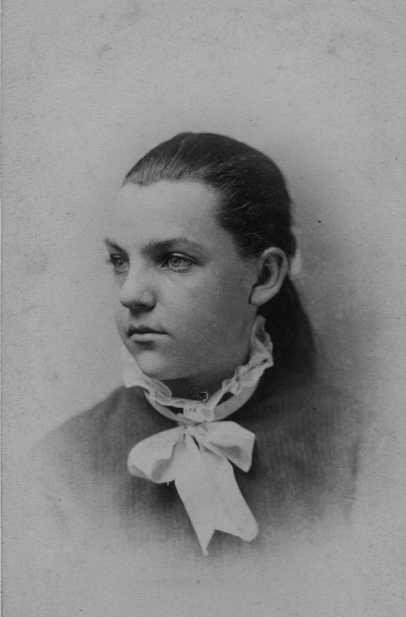
In the 1880s, several of the Hofer daughters moved to Chicago. Bertha enrolled in a training school for kindergarten teachers run by Elizabeth Harrison, a well-respected educator, as part of the Loring School, a private day and boarding school for girls in the Kenwood area.
[As an aside, the Loring School moved to Beverly and operated in the England J. Barker House at 107th and Longwood Drive from 1935 to its closure in 1962.]
Bertha graduated from that program in 1890, the same year her parents sold the newspaper they were running in Iowa and moved to Chicago, to 1833 West 96th Street, in Beverly, about where the entrance to Ridge Park now exists.
Bertha taught in Lake Forest for a few years, then in 1894, she completed graduate studies in Berlin, Germany, at the Pestalozzi-Fröbel-Haus. The kindergarten movement had started with Swiss educator Johan Pestalozzi in the late 1700s, and was furthered in the 1800s by Friedrich Froebel in Prussia/Germany. Froebel’s niece ran the program in Berlin. Bertha later did further graduate study at the University of Chicago and Columbia University in New York.
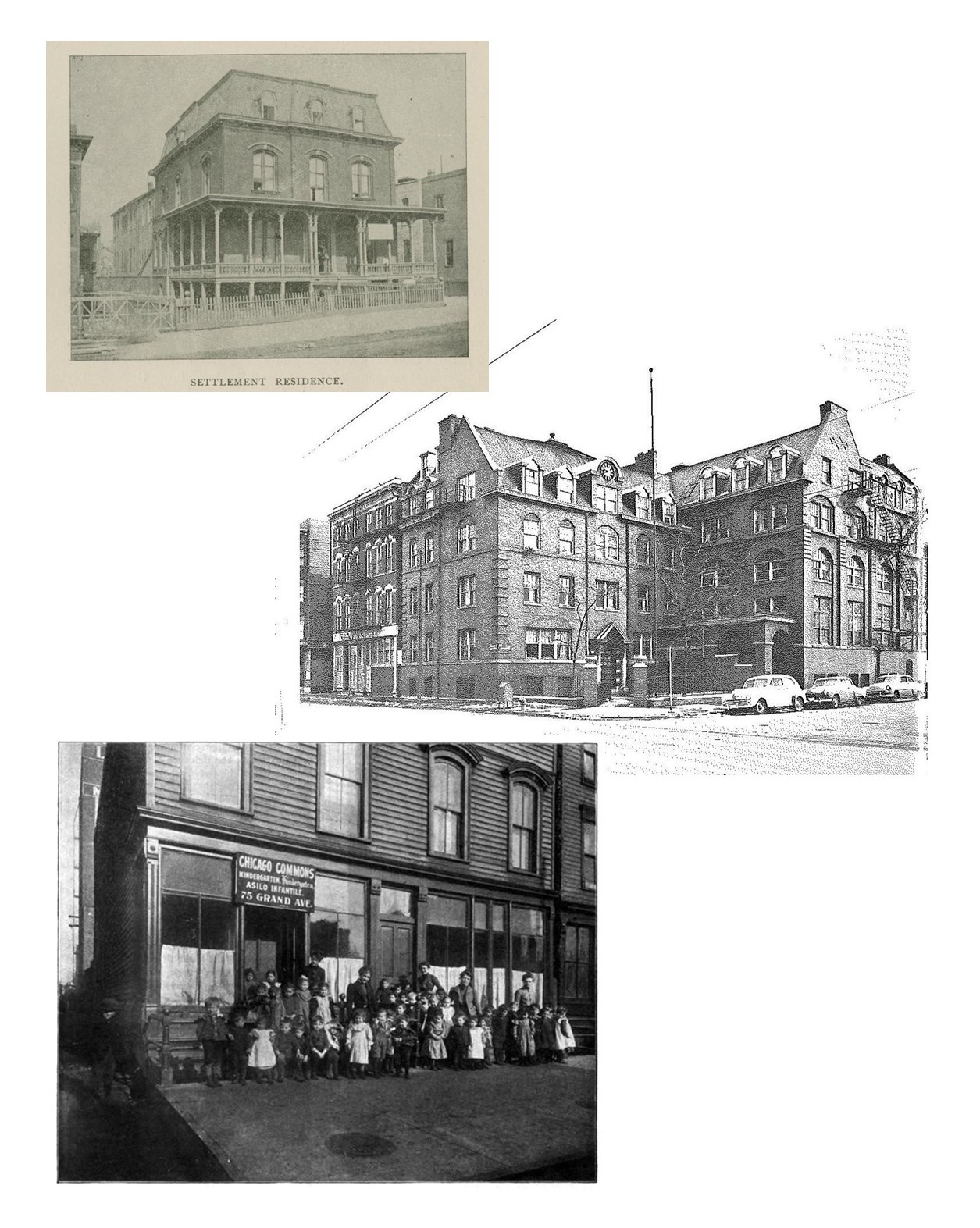
Chicago saw its first kindergarten in 1873, followed by a training course for teachers a few years later. In 1895, Bertha started the first kindergarten and teacher training program at the Chicago Commons Social Settlement.
Social settlements, started during the Progressive Era of reform, were centers for neighborhood social services usually located in crowded, low-income city areas, primarily populated by recent immigrants. The centers were called settlement houses because social workers, educators, ministers, and health care workers lived on site, or “settled” there, to be close to the people they were assisting.
In addition to providing food, clothing, medical care, and other basic needs, the settlements offered schooling to help people develop skills and knowledge for better jobs and advancement, and to improve their lives in general. Many of the settlements were affiliated with churches.
Hull House, started by social worker Jane Addams, was the most famous U.S. social settlement, but there were others in Chicago that were just as well-regarded.
The Chicago Commons Social Settlement was founded in 1894 by Graham Taylor on the near northwest side of the city.
Taylor was a professor at the Chicago Theological Seminary who specialized in training social workers at the University of Chicago. He was joined in his efforts by Herman F. Hegner from Wisconsin and Iowa, who had graduated from the Milwaukee Normal School for training teachers in 1890, and from the Chicago Theological Seminary in 1894, and was ordained a minister in 1895. Taylor and Hegner were the head residents at the Commons.
Bertha was also a resident at the settlement, and in June of 1896, she and Herman Hegner married.
By this point, the Hofer sisters were developing reputations for their various expertises, and Bertha was described as “one of the Hofer sisters, a graduate of the Pestalozzi School in Berlin, whose kindergarten work is widely known through her lectures and her writings.” The Hofer sisters were appearing on stage now with people like Jane Addams and Elizabeth Harrison.
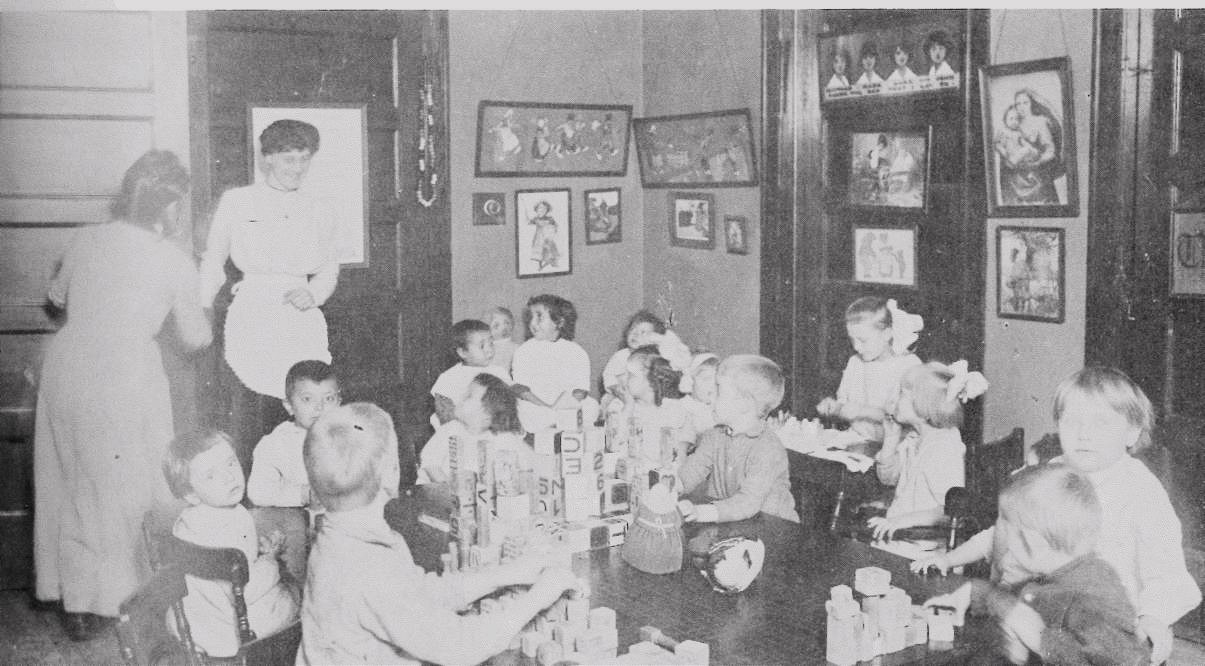
Bertha’s kindergarten became an important part of the Commons’ operations, the foundation for other education programs, like an industrial training school, and services for mothers, children, and families, like a mother’s club and childcare classes. The neighborhood residents strongly supported the kindergarten.
In 1896, Bertha started the Pestalozzi-Froebel Teachers College through the Commons to train kindergarten teachers. In the summers, they offered special teacher institutes. Usually, teachers preferred to attend summer programs in resort areas, not inner cities, but they flocked to Bertha’s program, described at the time as “a boon to would-be successful kindergartners.”
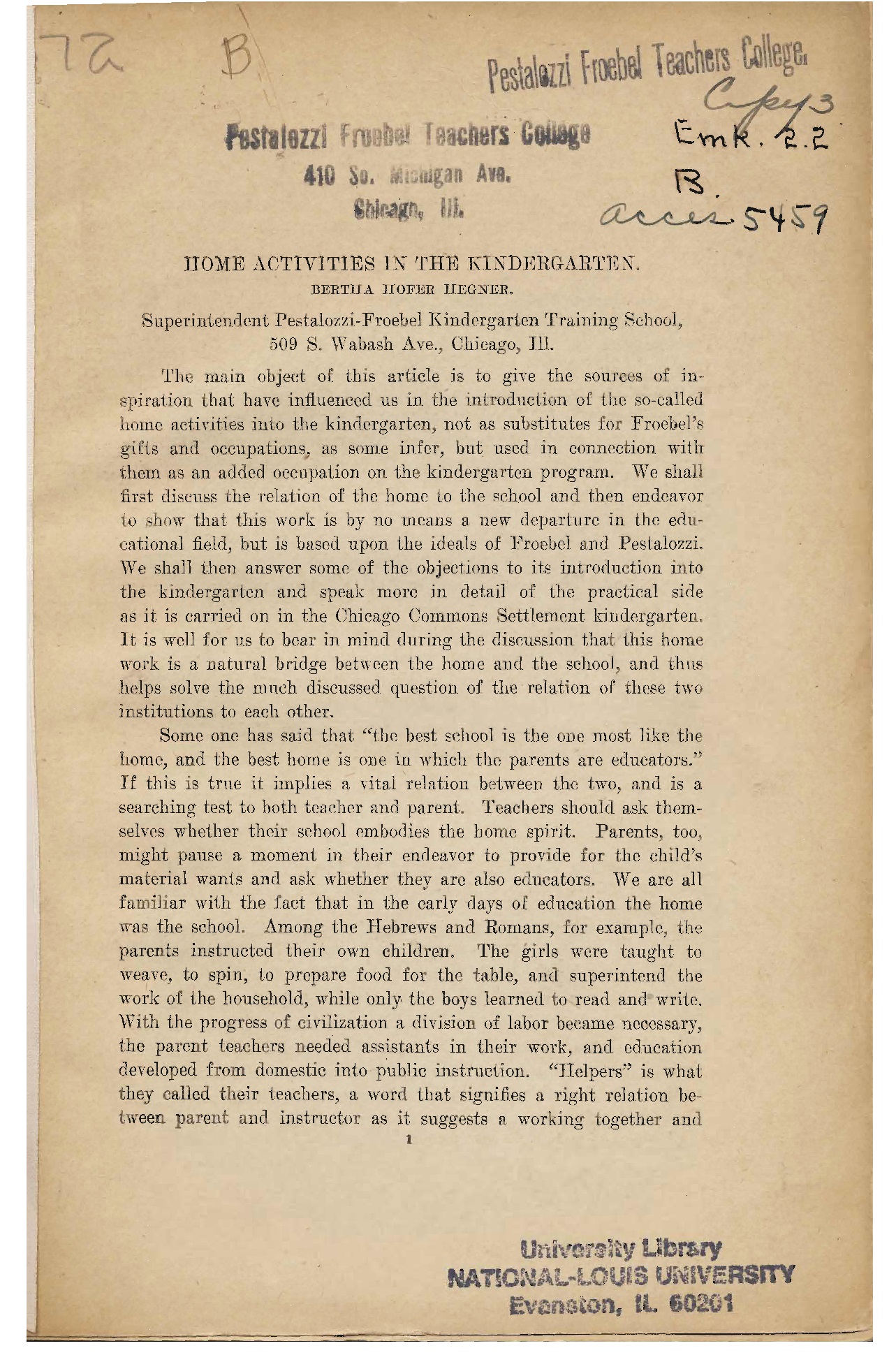
Progressive theory called for educating people to become useful and contributing members of society in general, as well as learning trades for employment. Supportive of working mothers, Bertha introduced “home activities” in her kindergarten to train children to help with basic home chores. This did not replace the teachings of Pestalozzi and Froebel, but, in Bertha’s words, added activities based on their “ideals” to create “a natural bridge between the home and the school.”
Some of the activities the kindergarten children engaged in included washing and putting away items they used including small-scale utensils and dishes; dusting the classroom furniture like the piano; emptying the waste basket; caring for the fish, birds, and plants; and washing the dolls and their clothes. Older children in the settlement’s other education programs helped in the settlement kitchen and dining room, and with the residents’ quarters and general housekeeping. The little ones assisted the older children.
They did these chores accompanied by songs, stories, and pictures. At holiday times, they did special projects like jack-o-lanterns and popcorn garland. In spring, they helped with the outside gardens and milking the cows.
The children loved these projects, and so did the parents. Mothers reported their children willingly helped at home as a result of these activities at school. The children helped throughout the neighborhood, for example, by cleaning up litter.
Training teachers on how to incorporate these home activities into school activities became part of the training program of Bertha’s college.
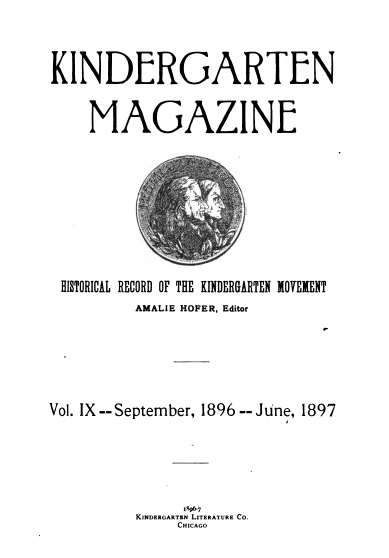
In 1904, Bertha published a scholarly article titled “Home Activities in the Kindergarten” in Kindergarten Magazine, which was reprinted numerous times. The U.S. Department of Education reproduced the article and distributed thousands of copies.
Bertha and Herman moved from the Commons to raise their family, two daughters and a son, and for Herman to take ministries at several churches in the city. They did some traveling to Europe and the Holy Land.
In 1904, Bertha resigned as head of the kindergarten to concentrate on the training school. Her sister Amalie joined her at the school for several years as principal, and her sister Mari was on the faculty for Music and Games. Herman and Graham Taylor were also on the faculty.
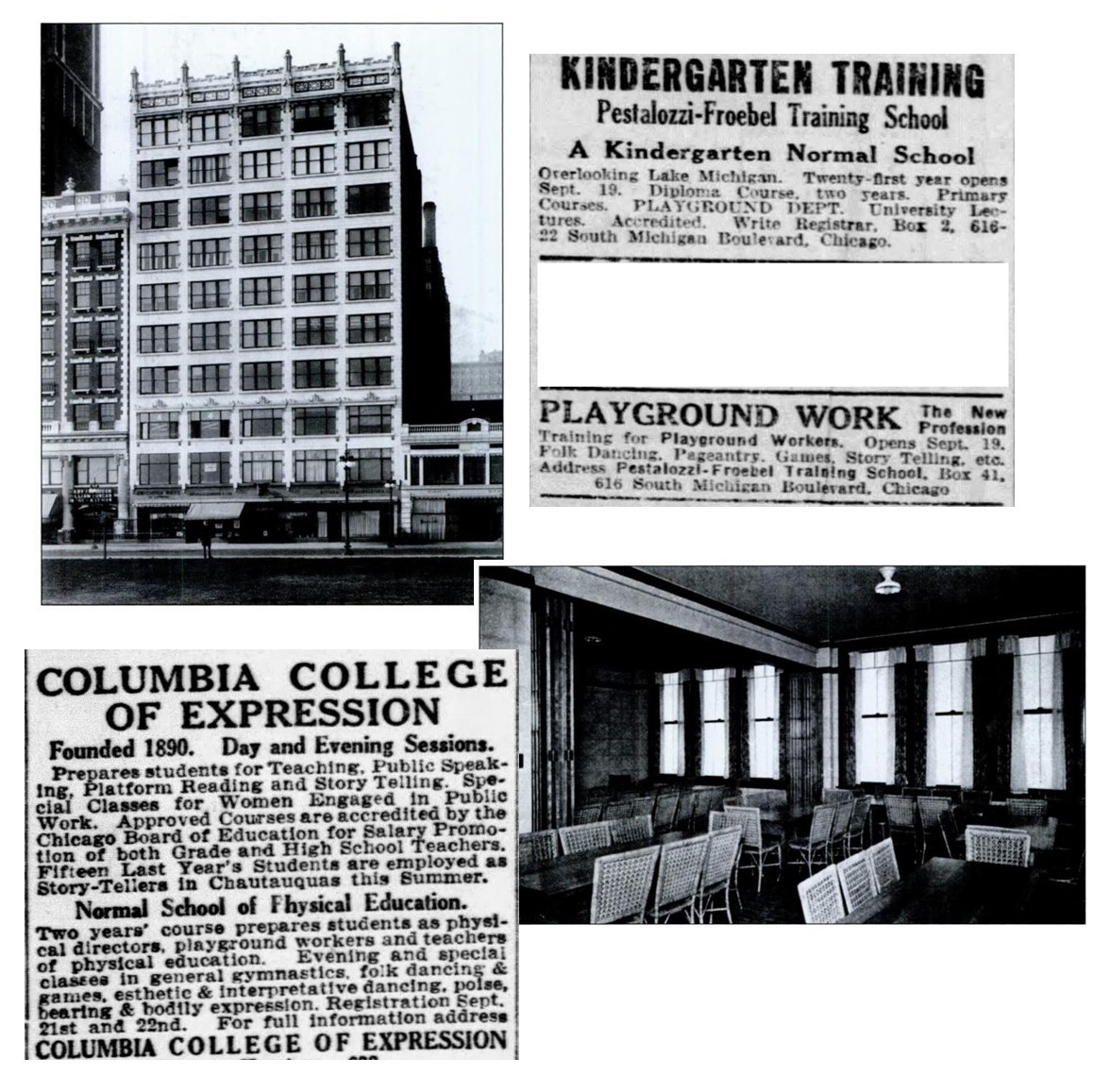
In 1913, Bertha moved the school, now free-standing from the Commons, to a new location, at 618 S. Michigan Ave. Herman became the full-time business manager for the school.
In 1927, the Columbia College of Expression, which offered programs in dramatics, public speaking, and physical education, ran into financial difficulties, and was purchased by the Hofer-Hegner school, and moved to the same building. Bertha ran both schools until she retired in 1936, and her son took over. Bertha introduced a program in 1934 to train people for radio work, something new at the time.
Bertha died in 1937. She left a legacy of education programs that lasts today. Both her kindergarten training school and the dramatic arts school were incorporated into other schools that still exist.
The third daughter, Amalie Hofer Jerome, was a pioneer in the playground movement and will be profiled next.
The Ridge Historical Society
March: Women’s History Month – Part 4 on the Hofer Sisters
By Carol Flynn
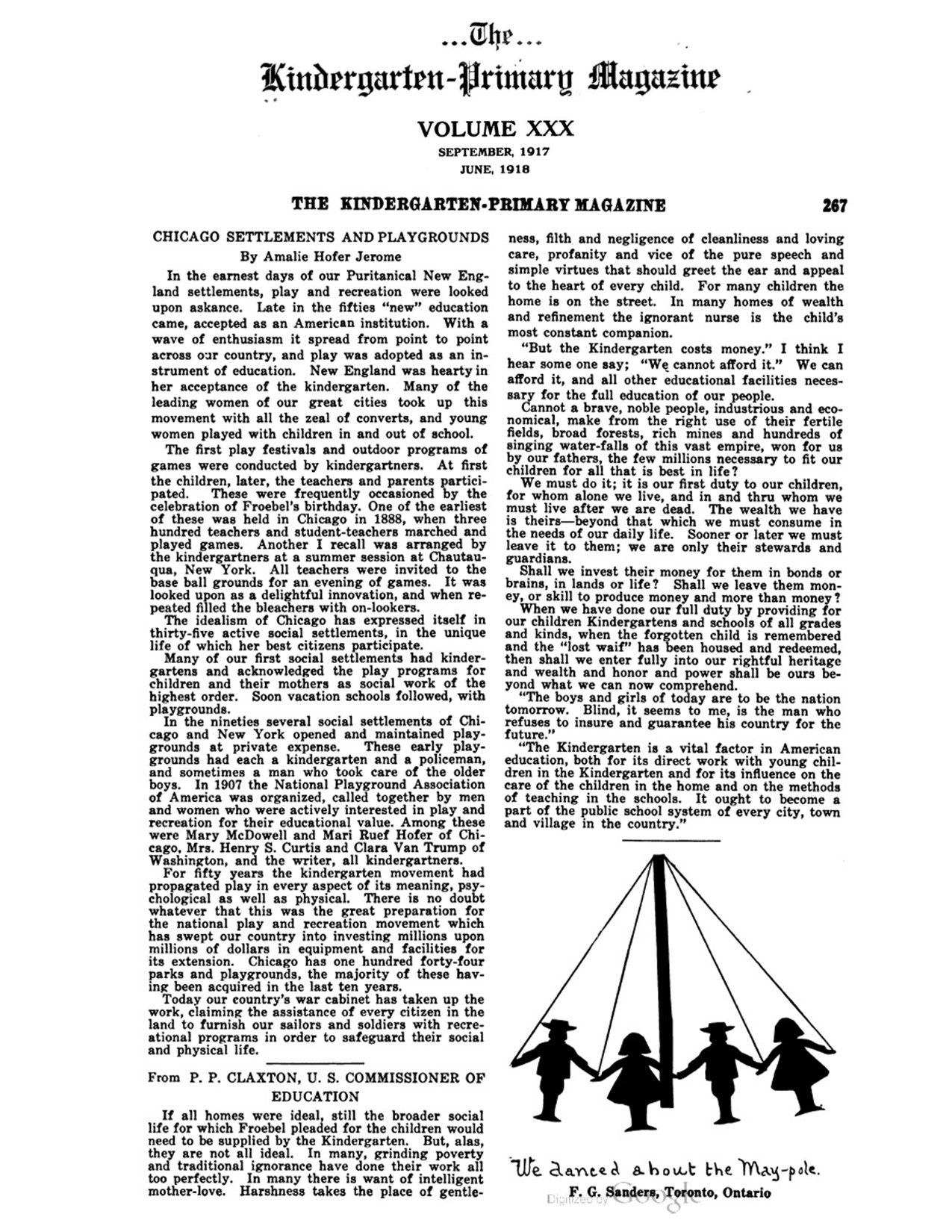
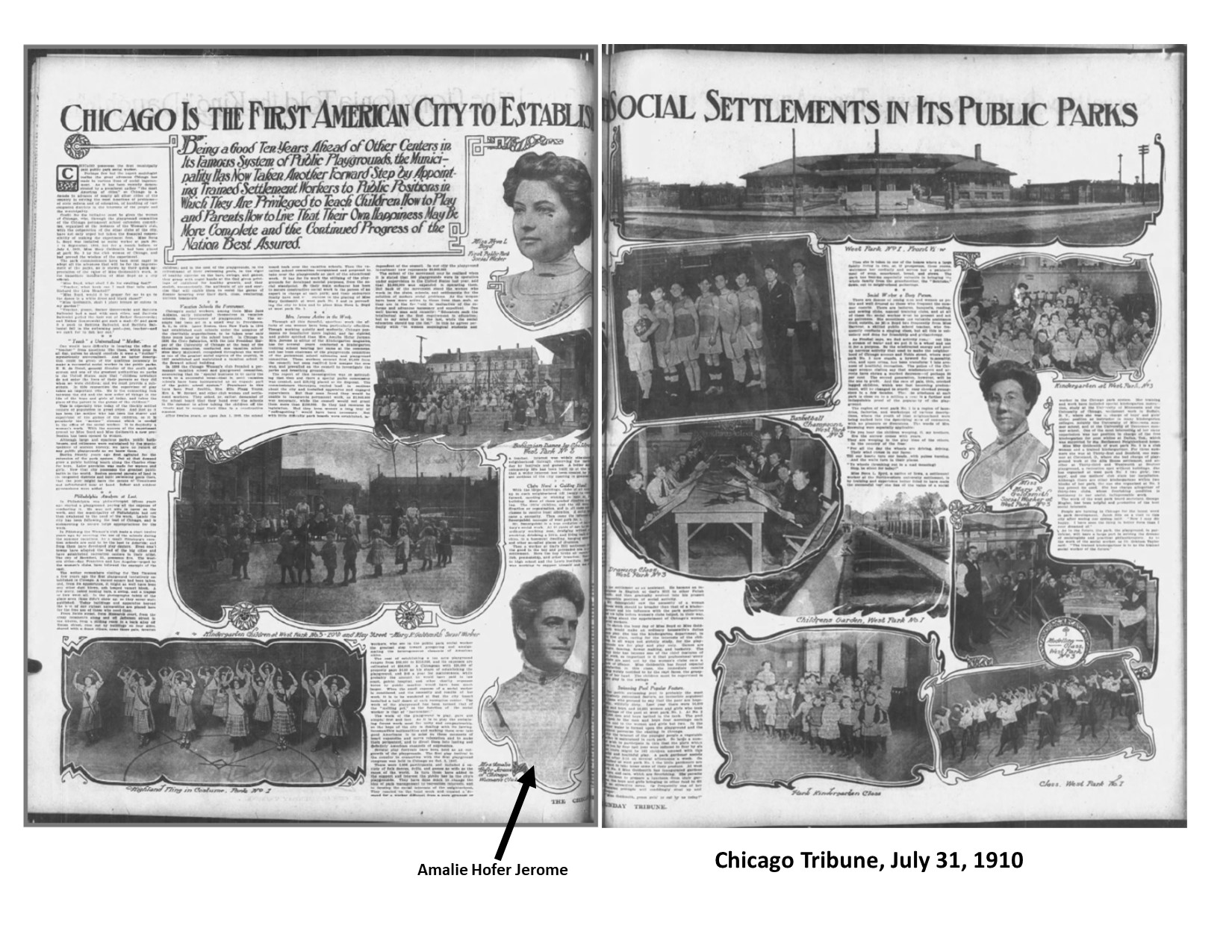
“Through all this forceful, excellent work the efforts of one woman have been particularly effective. Though working quietly and modestly, Chicago possesses no benefactor more logical, and far sighted, and public spirited than Mrs. Amalia Hofer Jerome. Mrs. Jerome is editor of the Kindergarten magazine, has for several years conducted a kindergarten training school bearing her name at the commons, and has been chairman of the playgrounds committee of the permanent school extension.”
– Chicago Tribune, July 31, 1910
This accolade was written for the third Hofer sister, Amalie, who with her four siblings, became a leader in the kindergarten, settlement, and playground movements, well beyond the borders of Chicago.
Oldest sister Mari was a recognized expert in music education and programs; second sister Bertha was a renowned educator and administrator.
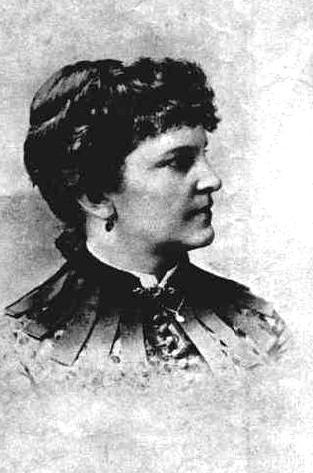
Amalie Hofer Jerome (1863-1941) was most associated with publishing, speaking, and playgrounds, as well as being an educator.
Amalie learned about the publishing trade from working with her father at the family’s newspaper in Iowa. All eight children were involved in running the newspaper. Her three brothers moved to the West coast and started newspapers of their own. Amalie and her younger sister Andrea moved to Chicago and published materials for the kindergarten profession.
Like her sisters, Amalie came to Chicago to further her education and career. She graduated from the Chicago Kindergarten College, the program conducted by Elizabeth Harrison, and took graduate classes at the University of Chicago.
Amalie went to work as an instructor in the kindergarten department of the Armour Institute, now the Illinois Institute of Technology.
In 1892, the Hofer sisters took over as editors of the floundering Kindergarten Magazine, started around 1886. They revitalized the publication, which offered scholarly articles, book reviews, detailed reports of presentations at education conferences, and sharing of information from kindergarten programs around the globe. It was the only magazine of its kind, and the leaders of the kindergarten and other social movements contributed to it. Articles covered everything from psychology and international education politics to ideas for classroom crafts and holiday parties.
The sisters set up their own publishing company, the Kindergarten Literature Company, with an office downtown, and also started a magazine for children and mothers called Child Garden of Story, Song, and Play. Hofers ran these magazines for over ten years.
One newspaper described all of the Hofer sisters as “deep and clear thinkers” having “great energy and enterprise.” They often worked together but they also all had their own careers and interests. Amalie seemed to be everywhere at once. Listing all of her accomplishments is not possible, but here are a few highlights.
Amalie found time to be principal of her sister Bertha’s training school for kindergarten teachers, started at the Chicago Commons Social Settlement. She taught at the prestigious Chatauqua Summer Schools for teachers in New York. She taught at the Summer School of the South in Knoxville, Tennessee, with sister Mari. She was the U.S. delegate to the Paris Educational Conference. She was a member of the Publications Committee of the Western Drawing Teachers’ Association and spoke at their annual meetings. She was a leader of a PEO in Illinois.
During the annual meeting of the National Education Association in 1892, a group of kindergarten professionals proposed the formation of an organization to focus on the interests of this growing area of practice, and to work on programs for the 1893 Columbian Exposition in Chicago. The International Kindergarten Union was started, and Mari, Bertha, Amalie, and Andrea Hofer became charter members. Amalie later served as president.
Amalie took a four-month trip around the world to visit kindergartens in other countries. She visited Cuba, the Hawaiian Islands, Japan, China, India, Egypt, the Philippines, Italy, France, and England. Upon her return, she gave “delightfully interesting and educational talks” on her travels. Throughout her career she was a frequent presenter and author of articles, known for her practical and engaging approach.
Next post: More on Amalie Hofer Jerome.
The Ridge Historical Society
Women’s History Month – Part 5 on the Hofer Sisters
By Carol Flynn
This continues the story of Amalie Hofer Jerome started in the last post.
In addition to their kindergarten endeavors, Amalie and her sisters were active members of many women’s clubs, including the Chicago Woman’s Club. In 1916, Amalie co-authored the Annals of the Chicago Woman’s Club for the First Forty Years of Its Organization 1876 – 1916, used today as the primary authority on this historically significant club.
Although women could not vote – and as expected, all of the Hofers including the parents and sons were suffragists – they were still very interested and involved in politics. Amalie was ward leader through one of the clubs.
As enlightened citizens, the Hofers paid attention to global politics. Their father had been a revolutionary in Germany, and the kindergarten movement was an international endeavor. The Hofers were progressive in their politics and advocated for international understanding and peace.
In 1905, Austrian pacifist Baroness Bertha von Suttner won the Nobel Peace Prize. In 1912, the Baroness reached out to the women of the U.S. to work for international peace. Amalie and her oldest sister Mari led the Chicago Woman’s Club to vote to invite the Baroness to come to the U.S. to present her cause to the American public. The Hofer sisters secured funding for the lecture tour from the World Peace Foundation, and helped arrange for the baroness to speak to 120 educational, civic, and church societies across the country.
In 1909, at the age of 45, Amalie married Frank Jerome, a furniture merchant. Jerome was a widower with several adult children.
Marriage did not cause Amalie to “settle down.” In fact, from 1910 to 1916, she was head resident of the Fellowship House Social Settlement at 831 West 33rd Street, in the stockyards, established in 1895 with Amalie’s help. She was active with the settlement’s women’s club, and even after stepping down as head resident, she stayed on the settlement’s board, managing the settlement house activities.
In addition to the settlement movement, which was discussed in the last post about Bertha Hofer Hegner, the kindergarten movement was closely connected to another reform movement of the Progressive Era, the playground movement.
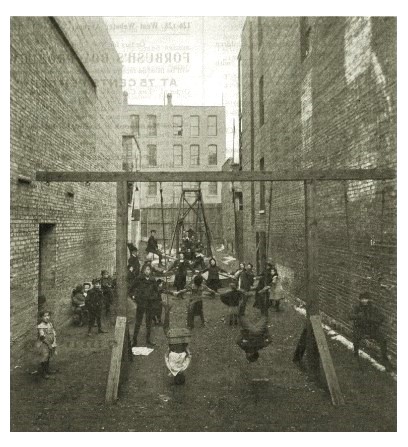
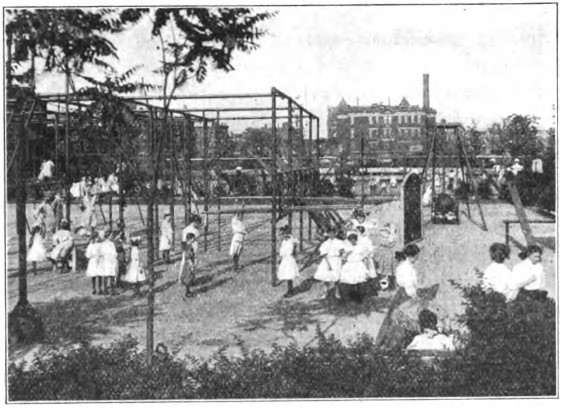
The playground movement was started in the 1890s by reformers who advocated that supervised play could improve the mental, moral, and physical well-being of children, and this expanded to include adult activities as well. City parks and playgrounds, swimming pools and fieldhouses were built, with trained play leaders and planned activities.
In 1907, the Playground Association of America was started, with President Theodore Roosevelt as honorary president and Jane Addams of Hull House as a vice president. Amalie and Mari Hofer were founding members. They also helped start the Playground Association of Chicago, and Amalie sat on the board of directors and was later president. She worked with people like Jens Jensen, the landscape architect for Chicago parks.
The group arranged “great play festivals” like one in Garfield Park in 1909 that featured gymnastic and athletic drills, and folk games and dances. It was attended by 30,000 people. Amalie was on the planning committee.
In 1910, Amalie published an article in The Annals of the American Academy of Political and Social Science on “The Playground as Social Center,” which became a classic in the profession.
The 1910 Chicago Tribune article (quoted at the beginning of the last post) was a two-page spread on the playgrounds of Chicago, which had just hired social workers to oversee play activities, the first city in the country to do so.
In 1913, Amalie was a founder of the Civic Music Association in Chicago. For several years, in the evenings and on Sunday afternoons, free concerts and community songfests had been given in the field houses of the city’s parks by notable musicians, and the time had come to better organize the activities. There was no one more qualified to do this than Amalie Hofer Jerome.
As a leader of the Playground Association and the Chicago Woman’s Club, Amalie had been instrumental in arranging the concerts. She now took on the role of chairman of the executive committee of the new organization. With her guidance, numerous groups, such as the Northwestern University choir and the Illinois Theater orchestra, provided free concerts in the parks, bringing enjoyment of the arts to groups of people who could not afford pricey concert tickets.
In her role with this music association, Amalie was named an honorary vice president for the lighting ceremony for the first Chicago municipal Christmas tree in 1913. The 35-foot tree on a 40-foot base was set up just north of the Art Institute and was covered with electric lights donated by the Commonwealth Edison Company. Over 100,000 people attended that first lighting ceremony.
People like the Hofers never really “retire,” and Amalie continued her work well into her senior years. As an example, in 1929, as a member of the Board of Directors of the Park Ridge School for Girls, she presided at the ceremony for the corner-stone laying for a new dormitory designed by Beverly architect John Todd Hetherington.
The Hofers have a family burial plot in Mount Hope Cemetery on 115th Street, and Amalie and Frank Jerome were laid to rest there.
Next posts: The youngest Hofer sisters, Andrea and Elsa.
Happy Easter from the Ridge Historical Society
April 9, 2023
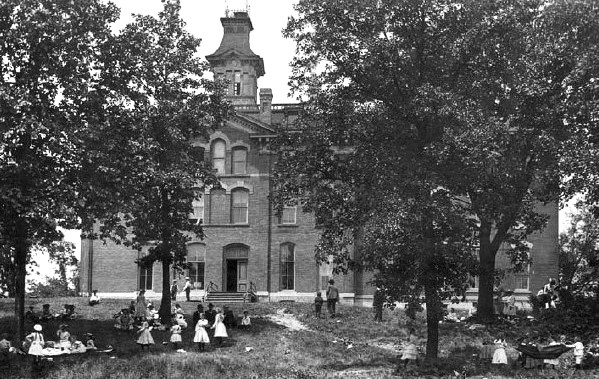
The Chicago Female College was established in 1874-75 on the Ridge, at 114th Street between Longwood Drive and Lothair Avenue. Gilbert Thayer served as its first formal president. In keeping with Morgan Park’s commitment to a strong religious foundation, the Thayer family were dedicated members of the Presbyterian church.
Daughter Julia Thayer was an educator in music, ancient history and literature, and English. She was a teacher at the College, and followed her father as president of the College upon his death in 1892.
Julia’s real love, however, was poetry. Of all her accomplishments, it was her poetry that made her best known in her lifetime.
In 1889, The Magazine of Poetry featured Julia and six of her works. By then she had been publishing her poetry for almost twenty years, but the article revealed that it had taken her some time to feel comfortable sharing her work with others “due to the sensitiveness peculiar to the mind of a poet.”
Julia had started writing poetry as a child. While reading to an invalid grandmother, she would slip in her own work without revealing it was hers. To Julia’s dismay, her grandmother declared the work “silly trash.”
But for Julia, poetry was “inevitable,” and she gradually started offering her work for publication, at first anonymously.
The 1890 “Local and National Poets of America” wrote of Julia that “she is seen at her best in religious poems and simple lyrics,” and “there is a conscientious fidelity in Miss Thayer’s work” that brought her “a laurel wreath that will not fade.” The article reported that she wore a plain gold ring that was a priceless keepsake for her because she received it for one of her poems.
Newspapers back then often included poetry, short stories, and serial works of fiction by authors; in fact, that is how some famous authors and their works first became known to the public. In 1876, the Chicago Herald newspaper published what would become one of Julia’s best-known poems, “The Easter Altar-Cloth.” Other newspapers and literary magazines throughout the country later also carried the piece.
The poem tells the story of a nun who is working hard to finish an altar cloth on the eve of Easter Sunday. She has worked on this cloth a long time and really hopes to have it finished that night. She gets called to her duties and considers not going, but honors her commitment to tend the sick and dying at the local hospital, knowing that now the altar cloth will never be completed in time for Easter services. However, when she returns to her cell as Easter Day breaks, she finds that angels have completed the altar cloth for her.
Here is Julia Thayer’s poem to celebrate Easter.
Easter Altar-Cloth
Julia H. Thayer
Solemn days of Lent are closing, and in soft ethereal light
Earth and sky delay, transfigured, at the sepulchre of night,
While reluctant steal the shadows o’er the smoothly-burnished sea,
Loth to gloom the shining pageant with their purple mystery.
Wonder, where the misty sunlight on that distant city falls,
Stands a convent, dark and stately, rearing high its ancient walls.
Long ago – so runs the story – at this very day and hour,
Wan and pale, a nun was sitting in that topmost gloomy tower.
On her lap were folds of beauty, broidered with the finest art,
Gleaming with the sacred symbols she had wrought so long apart;
And the fabric’s dazzling whiteness, marvelous in leaf and line,
Seemed a snowdrift frosted over with each emblematic sign.
Ah, how many years in secret she had labored, day by day,
That some happy Easter morning she might on the altar lay
There at last her precious treasure, as an offering to her Lord,
With each thread a prayer inwoven answering to His holy word.
Now her task is almost ended; all but finished there it lies!
In and out the needle glances – fast, and faster still it flies –
While the last rich beams of sunset o’er the dusky gloaming come,
Flinging bars of golden glory in the narrow, sombre room.
In those wondrous lights and shadows Rembrandt loved to paint so well
Like a patron-saint of labor there she sits – but list! a bell
Strikes upon the breathless silence, and she starts up cold and white.
“Yet again, and must I leave thee! Oh, I can not go to-night!
“I must stay my dream to finish; someone else can do, I know,
Just as well my every duty if for once I do not go.
Peace! Begone, temptations evil! Longer here I must not stay.”
And she crossed herself and sadly laid the glistening cloth away.
Clad in mournful sable habit, through the doorway see her glide,
Through the corridors, as silent, through the arching portals wide;
Out across the court deserted, till at length she gains the street,
Mingles with the throng, nor pauses till her tired, aching feet
Reach the hospital that rises just outside the city’s wall,
Where its dark, funereal shadow on the landscape throws a pall.
Safe at last within its shelter from the tempter’s dreaded claim,
Dying eyes are watching for her, dying murmurs speak her name.
Here she sits beside a pallet, reading words of cheer, and there
Kneels and wafts a soul to heaven on the faithful wings of prayer.
Thus employed with ceaseless mission, night anon has worn away,
And the starry hosts have vanished through the glowing arch of day.
Like another fleeting shadow, does the gentle sister seem,
As she steals back to the convent in the morning’s early gleam.
And a thousand silver voices ring out on the Easter air
As she enters through the doorway, climbs again the winding stair.
She has reached the cell so dreary, where she sees with saddest heart
Snowy cloth outspread before her – but what means that sudden start?
Lo! in perfect beauty, finished there each vine, each symbol lies –
Who has guessed her guarded secret? Who prepared this strange surprise?
While she stands perplexed with wonder, see, a brightness floods the room,
Greater than the noontide’s splendor, rarer than the dawning’s bloom.
Prostrate low before the vision, thrilled with love, she knows full well
Only pitying hands of angels could have wrought that miracle.
The Ridge Historical Society
Little Blue Flowers – An Annual Event
By Carol Flynn
This topic is posted every spring because the subject always comes up.
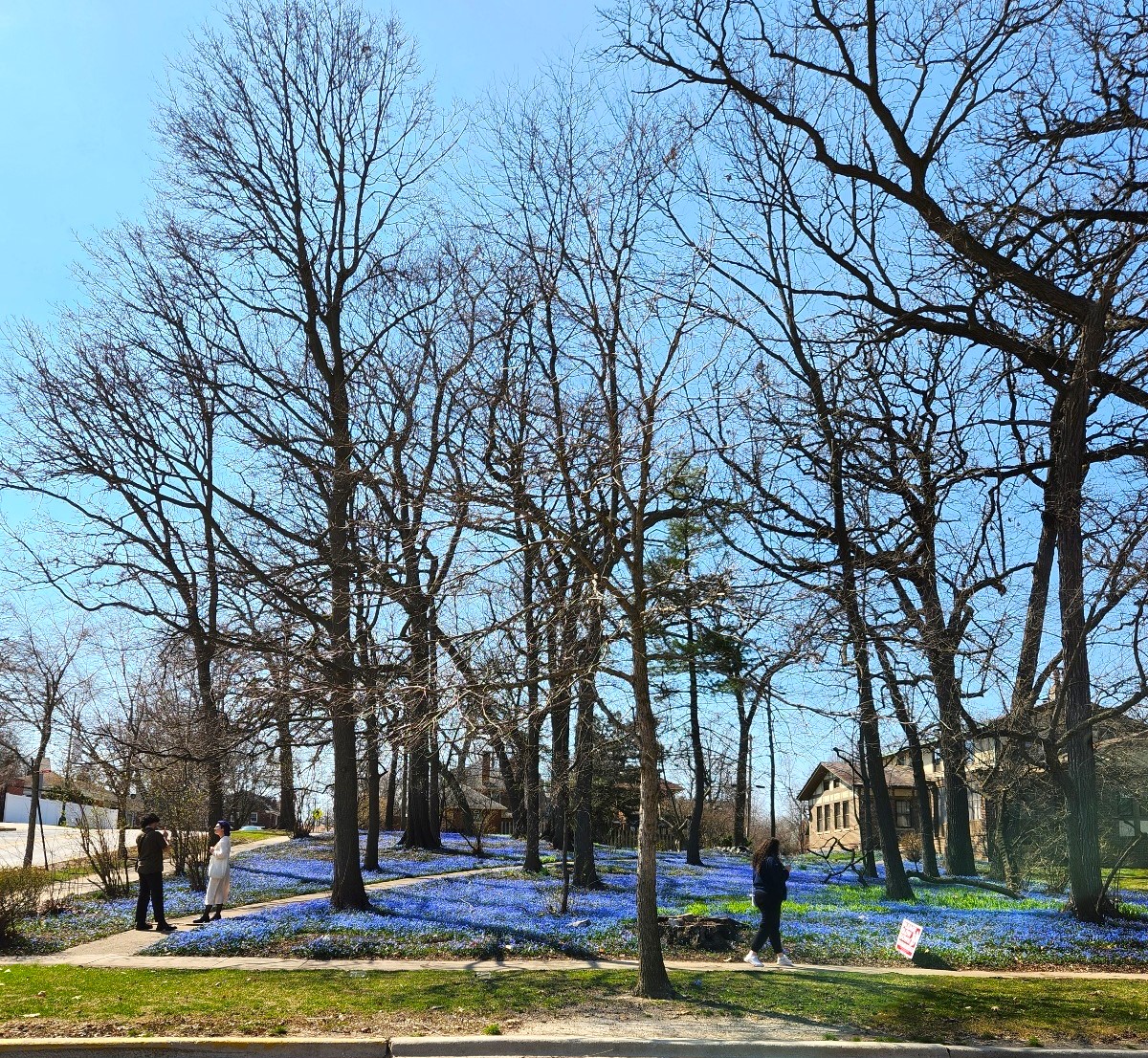
Springtime is here on the Ridge, and many lawns are covered with a little blue flower. This is Siberian squill (Scilla sibirica), which is not native to the USA but was introduced by European settlers.
This flowering plant is mentioned in many horticulture materials from the 1870s and on, although surely it was in the "New World" long before that. Siberian squill was commonly recommended for and used in gardens by that time. It is a bulbous perennial that spreads underground and is very hardy, withstanding freezing cold winters. This plant is not native to Siberia, however, but it does come from the Caucasus area.
Siberian squill is an invasive species that can replace native wildflowers, but the good news is that bees love this plant. The bees are just coming out of their winter phase and will be looking for food sources. Siberian squill, clover, and dandelions are all early plants that offer food for the bees.
There’s no way to tell when the first Siberian squill bulb was introduced on the Ridge. Some of the fine houses in the community date back to the 1870s, and they likely used the plant in landscaping and gardens.
There is a beautiful display of Siberian squill on an oak-wooded lot at the northwest corner of 99th Street and Longwood Drive that reminds everyone just how lucky the folks in the Ridge communities are to have the abundance of “nature” we have here. (Photo by C. Flynn.)

SATURDAY, APR. 29, 2023 – 2PM
The Ground We Walk On:
The Geology of the Ridge
Andrew Phillips, PhD, Presenter
The Illinois Geological Survey At Mt. Greenwood Cemetery
Dr. Phillips will discuss the mapping project, and the techniques, procedures and protocols used to document the geology of a site. The program will take place at Mt. Greenwood Cemetery where the Geological Survey team did mapping work last fall. Beginning with a formal presentation, Dr. Phillips will then lead those interested on a short walk through the grounds to learn something about what geologists see when they study a site.
Get tickets online: https://bit.ly/ridge-geology

UPDATE: Save the Eugene S. Pike House
Last year the RHS/BAPA Historic Buildings Committee, Ridge Historical Society and Beverly Area Planning Association began working to save the historic Eugene S. Pike House, located on 91st Street in the Dan Ryan Woods, and to find a suitable and sustainable reuse of the house.
To that purpose, the Committee, with the assistance of Landmarks Illinois, created the Eugene S. Pike House Foundation and received 501(c)(3) not-for-profit status. Creating this foundation, which is overseen by a volunteer Board of Directors composed of representatives from BAPA, RHS, BIA and the community, will enable the new organization to continue to engage community members and elected officials in efforts to work with the Forest Preserves District of Cook County (owner of the Pike house) to stabilize the house, identify and secure a suitable reuse, and strategize ways to fund restoration.
April 28, 2023 is the extended deadline for the RFEI submissions to the Forest Preserves District.
The Eugene S. Pike House Foundation will be submitting a Request for Expression of Interest (RFEI) letter. The new Foundation’s proposal will outline the intention to raise awareness, funds, and assistance needed to underwrite essential repairs and updates for the Pike House. The Beverly Arts Alliance, another local not-for-profit organization has submitted a Request for Expression of Interest (RFEI) letter as a potential end user for the Pike House. Other submissions are encouraged.
The Pike House Foundation welcomes volunteer assistance from area people who represent fields such as tax law, construction and restoration trades, real estate, not for profit organization, and historic preservation, as well as interested members of the community. To learn more and get involved, contact Debra Nemeth, Ridge Historical Society, dnemeth.rhs@gmail.com or Grace Kuikman, Beverly Area Planning Association, gkuikman@bapa.org. Our new foundation is committed to helping interested persons or groups throughout the RFEI process.
Visit savethepikehouse.org for details, RFEI and Addendum 5 with the submission link.
Sunday, MAY 7, 2023 – 2pm
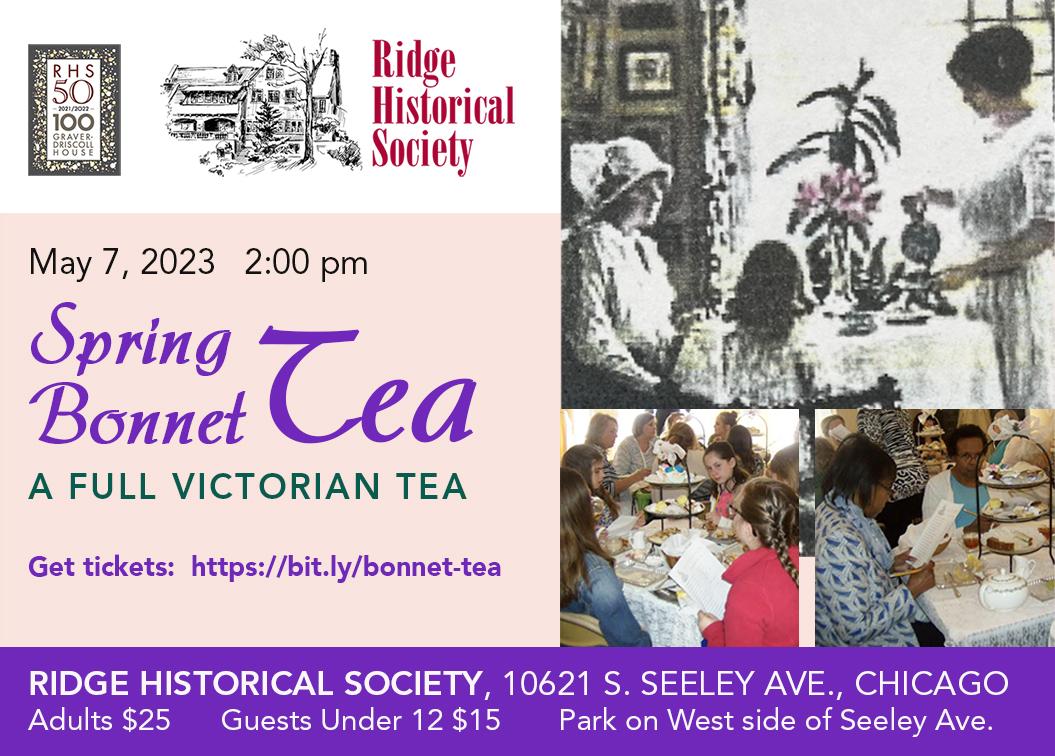
Spring Bonnet Tea
RHS is happy to be able to hold this annual fundraiser event again. Join us for a Full Victorian Tea featuring a fine selection of savories, scones and pastries. Ladies, please wear a spring hat or bonnet!
A wonderful multi-generational event — bring your daughters or granddaughters!
This Full Victorian Tea is set in the Historic Graver-Driscoll House, on the Ridge in the Beverly Hills neighborhood of Chicago.
Adults $25 Guests Under 12 $15
Get tickets online: https://bit.ly/bonnet-tea
RSVP: ridgehistory@hotmail.com 773.881.1675

The Ridge Historical Society
National Poetry Month – Part 6 on the Hofer Sisters
By Carol Flynn
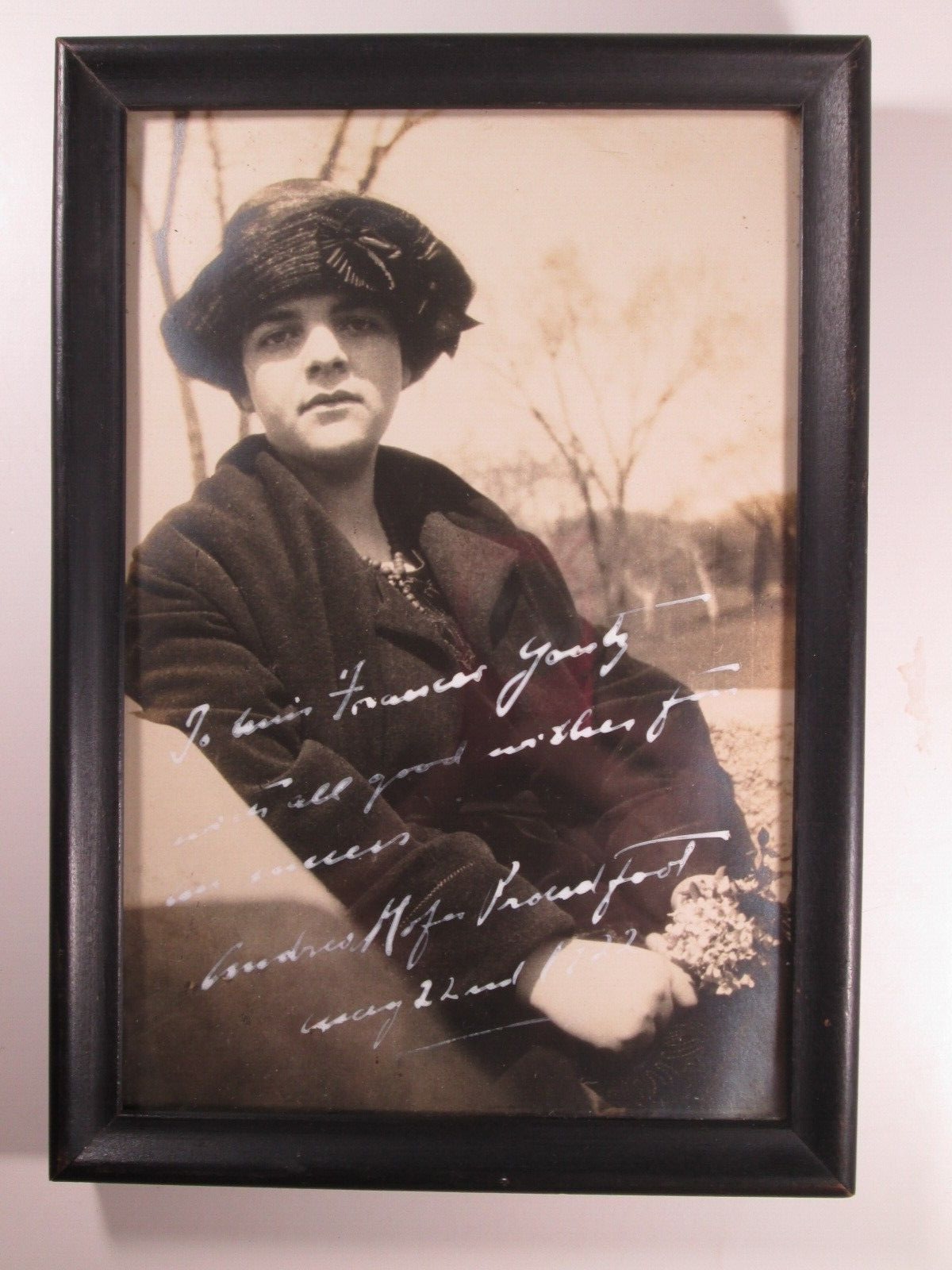
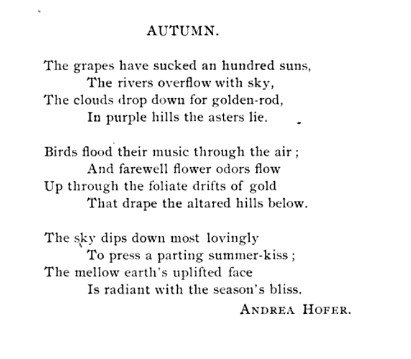
Continuing our series on the Hofer sisters of Beverly, this post presents Andrea Hofer Proudfoot (1866 – 1949), the fourth of the five sisters. Like her sisters, she was a pioneer in the kindergarten movement. She was also the poet in the family, a timely story for National Poetry Month in April.
In the mid-1880s, Andrea joined her sisters in moving to Chicago from Iowa for education and career opportunities.
Documentation of her education has not been found yet, but was likely similar to her sisters’. Theirs included attending the Chicago Kindergarten College and doing graduate work at the University of Chicago and other universities, and at least one of them, Bertha, studied in Germany at a kindergarten college run by the niece of Friedrich Froebel, the pioneer educator in the kindergarten movement. The kindergartens in the U.S. were based on Froebel’s system, and the Hofers were strong advocates of his teachings.
Andrea was a writer, and was interested in the publishing field, which she and her brothers and sisters learned about at the newspaper their father ran in Iowa.
In 1889, Kindergarten Magazine was started, offering professional articles and practical tips for kindergarten teachers. The magazine was also designed to appeal to mothers of young children. It quickly became important in the field, with well-regarded educators like Elizabeth Peabody and Francis W. Parker involved.
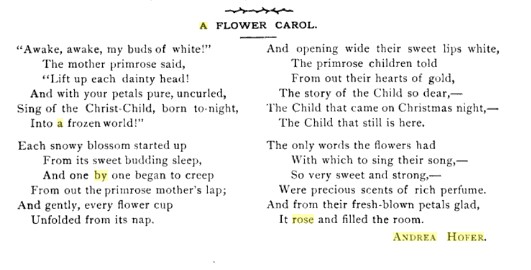
Andrea volunteered as assistant editor for Kindergarten Magazine in 1890-91, and several of her articles and poems appeared in the magazine. Examples were “Lessons in Zoology,” “Francois Delsarte – His Life Work,” “A Morning’s Talk for Froebel’s Birthday,” “Don’t Say Don’t,” and “The Labor Problem and the Child.” Her poem, “A Flower Carol,” is presented here.
Andrea also wrote articles on kindergarten that appeared in other journals, like the Northwest Journal of Education. One example in 1893 was “Kindergarten – A Little Talk on Literature for Children,” which discussed gift-book giving for children. The article started with the statement, “’There is nothing too good for the children,’ is the rule of the Kindergarten.”
In 1892, Andrea and her older sister Amalie bought Kindergarten Magazine, and on January 1, 1893, their new corporation, the Kindergarten Literature Company, was started. They were listed as co-editors of the magazine. Their parents and other supporters contributed financially to the magazine. Andrea, Amalie, and older sister Mari Hofer, the musician in the family, all contributed significantly to the content of the magazine, and it became the premier publication in the kindergarten field.
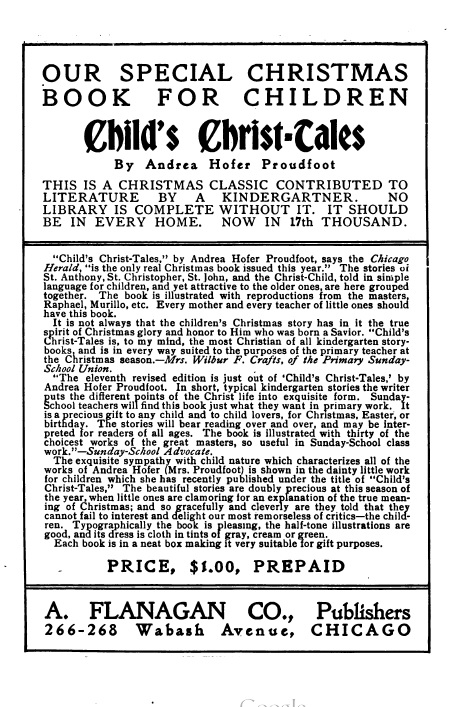
Andrea wrote a small book, Child’s Christ Tales, with stories, poems, and illustrations about the birth and childhood of Jesus, that was published in 1892. Much of her writing had a religious theme to it.
On November 9, 1893, Andrea married Frederick William Proudfoot, a lawyer from Englewood whose practice included legal work with the Chicago Board of Trade. His younger sister, Mary Proudfoot, was a kindergarten director and art teacher who rose to some prominence in the field. Mary wrote articles for Kindergarten Magazine; one example was “Day by Day with Nature – For the Kindergarten and Primary Grades.”
One of Proudfoot’s wedding gifts to Andrea was an estate in North Beverly known as “Oakhurst.” This became the site of a kindergarten training school she founded with her younger sister, Elsa, called The Froebellian School for Young Women. In the summers, they ran the school as the Longwood Summer School.
Andrea also started an organization in Beverly called the League of American Mothers.
The next post will look at Andrea’s and Elsa’s Beverly-based operations.
The Ridge Historical Society
National Library Week
By Carol Flynn
April 23 to 29 is National Library Week, and this year’s theme is “There’s More to the Story.” The theme refers to all of the benefits that libraires offer in addition to books, including programming that brings communities together, lending items like museum passes and musical instruments, helping people enhance their literacy skills, and now, offering technology services.
That theme can be expanded to include that there is always more to the historical stories posted on this Facebook page, also. Here’s some of the stories behind the libraries on the Ridge.
According to “The First Hundred Years – A Story of Blue Island 1835-1935” by John H. Volp, books and magazines were not plentiful in the early days of settlement on the Ridge, the 1840s-50s. Available reading material consisted of the books each family brought along when they settled here, and occasional copies of Chicago newspapers that found their way to the Blue Island.
One scholarly gentleman in the Village of Blue Island, Thomas McClintock, had a large collection of better books on history and travel locations. Known for his philanthropic ways, he readily agreed to permit the loan of his books to the villagers when requested to do so by a village committee.
A system was worked out to allow people to borrow books for a certain number of days at a slight fee, creating Blue Island’s first circulating library. There were about one hundred books available.
In 1854, a new school was built, and a fine library was established, with 800 volumes on history, science, travel, and fiction. The principal, Professor Rodney Welch, saw to it that there was no “trash” in the collection. The collection was available to the villagers.
According to the Blue Island Historical Society, in the 1870s, a formal library was opened in a storefront on Western Avenue.
In 1890, the Current Topics Club, a forerunner of the Blue Island Woman’s Club, raised money to expand the library, and the Blue Island Library Association was chartered. The library had hired a librarian and moved to a larger location, and the collection had grown to 1,600 books, when a fire destroyed the central business district, including the library, in 1896.
All that was left were the 84 books out on loan at the time. Within a week, the library had reopened in a private home, and Blue Islanders contributed books, equipment, and funding to reestablish the library.
In 1897, the voters of Blue Island approved the establishment of a free public library, with a public assessment. The ground floor of the Village Hall was remodeled for use as the library. The large, comfortable reading room became a popular place.
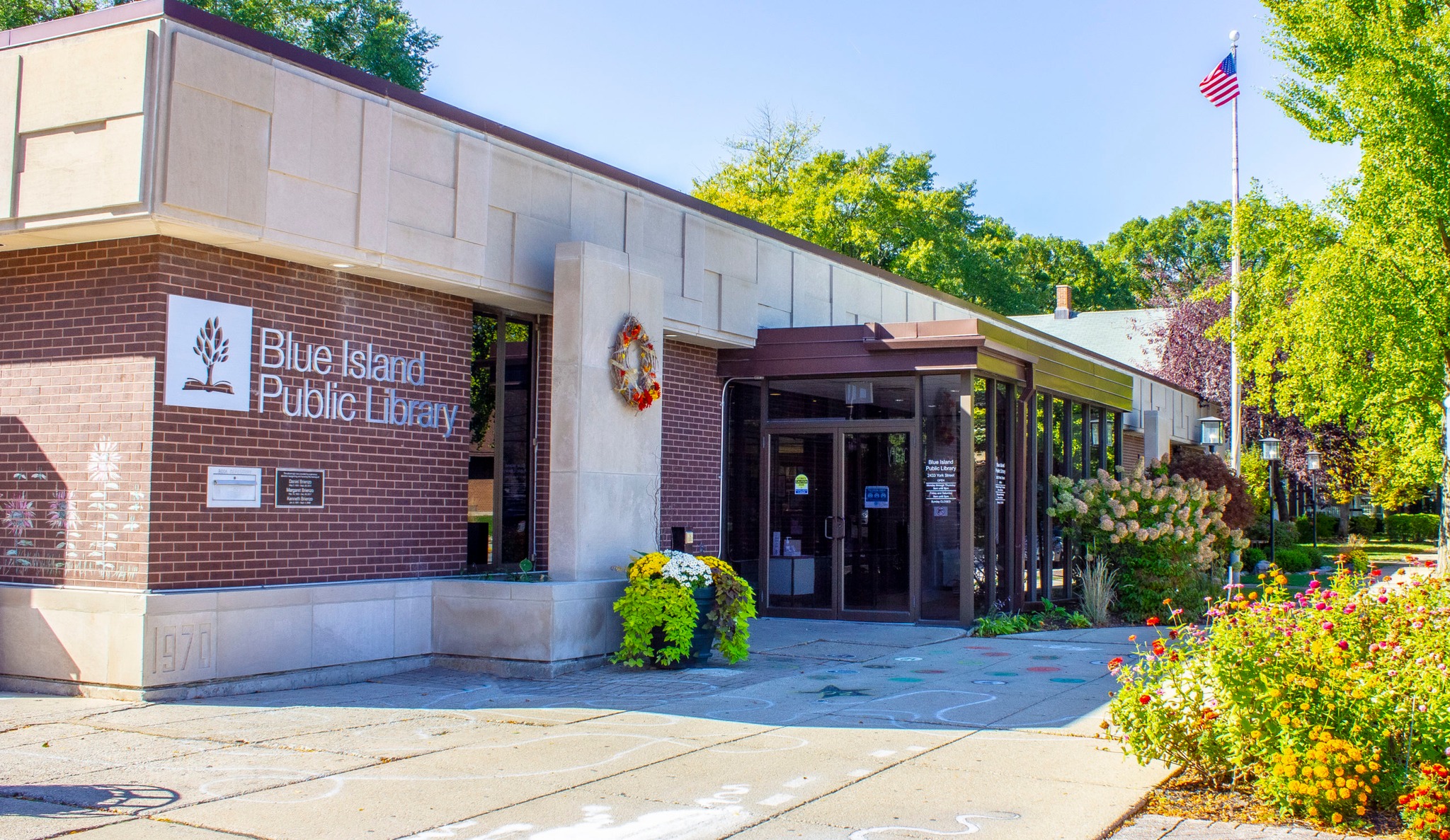
In 1902, the city purchased the property on the south side of York Street from J. P. Young for the site of a new public library. That is the site the Blue Island Public Library sits on today.
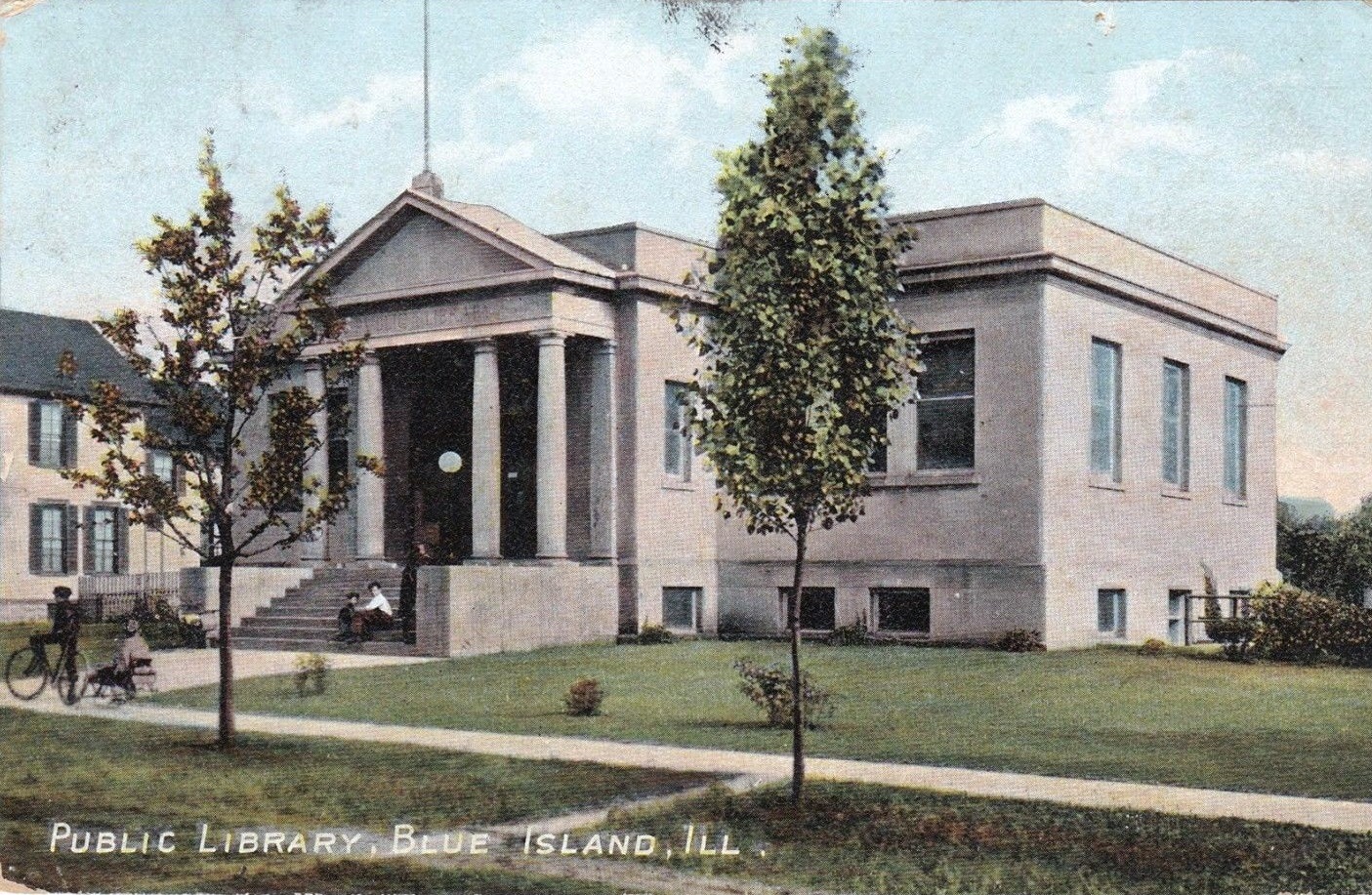
Andrew Carnegie, the wealthy industrialist and philanthropist, was financing the building of public libraries in municipalities that committed land and funding for this purpose. Blue Island accepted his offer to build a grand library of stone with marble accents and oak paneled walls on the York Street site. This building was referred to as the “Carnegie” by Blue Islanders.
This original “classical” library building was replaced by the current “modern” one in 1969.
Next post: The Walker Library is founded in Morgan Park.