
Explore the RHS Facebook Archives, a rich repository of local history written by Carol Flynn. For two decades, Carol brought a deeply dedicated voice to public education at RHS. Her role as Facebook administrator through mid-2025 naturally extended her prolific research into meticulously detailed articles, most notably her multi-part historical series posts. Today, Carol continues her local history writing for The Beverly Review and other outlets.
All Posts
Halloween history, part 3 – trick or treating.
Trick or treating also came to the U. S. with the Irish settlers. There are several old customs behind the practice. One is that people dressed up in costumes as deceased spirits (mumming or guising) around the time of the pagan harvest holiday Samhain, when the barrier between the spiritual and physical world was thinnest, and went door to door collecting gifts to appease and honor the dead.
Another old year-round custom is to leave out treats for the fairies so that this group of other worldly beings will not pull tricks on humans.
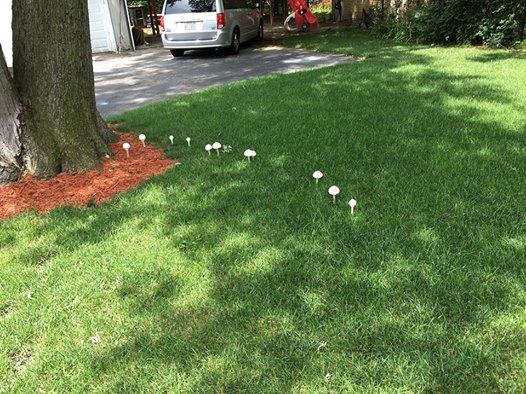
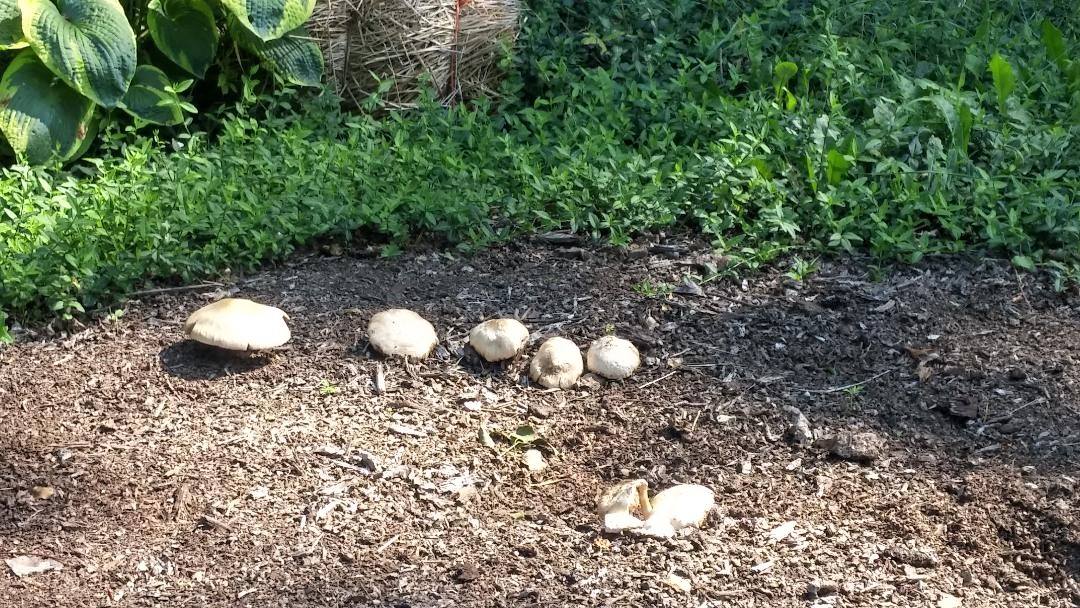
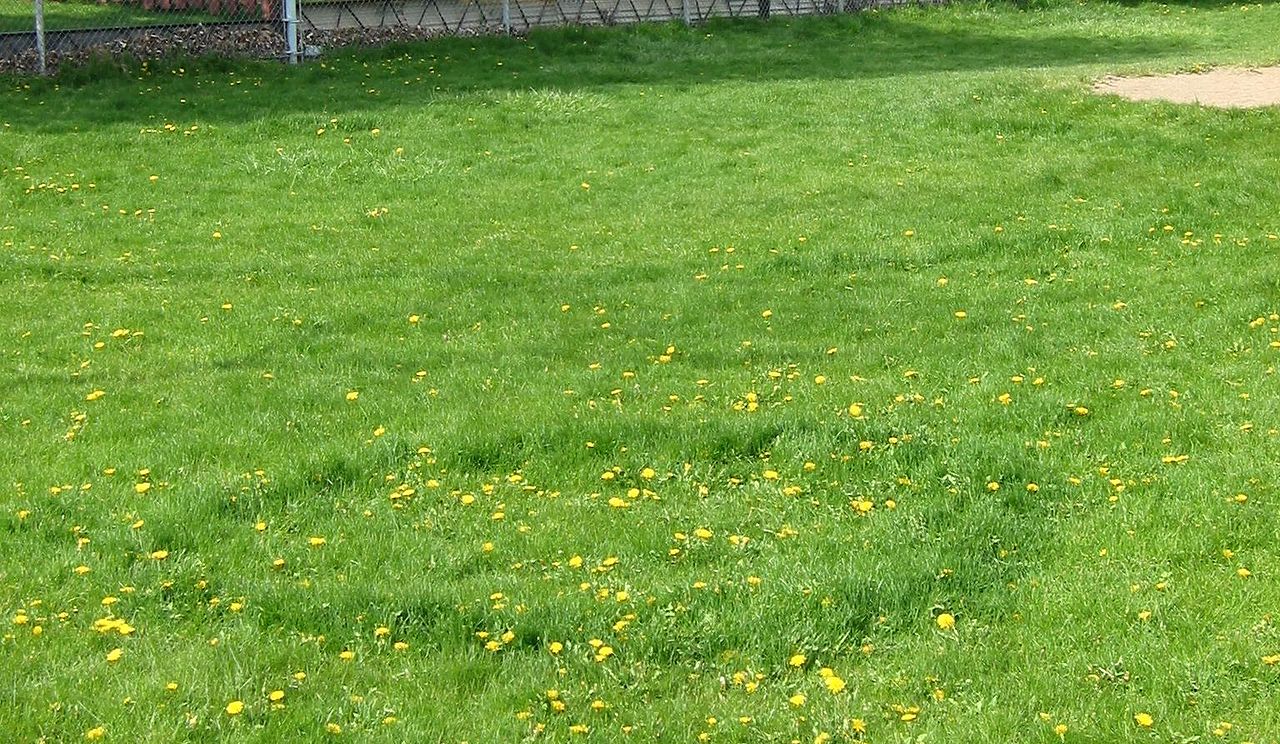
Fairy folklore is interesting. They are usually associated with England, Scotland and Ireland, but they occasionally make their way over to the U.S. One sign is fairy rings, mushrooms growing in an arc or circle. Sometimes they show up as a circle of unusually tall or thick grass, because the fungus is growing underground. Here are pictures of two fairy rings getting started in Beverly.
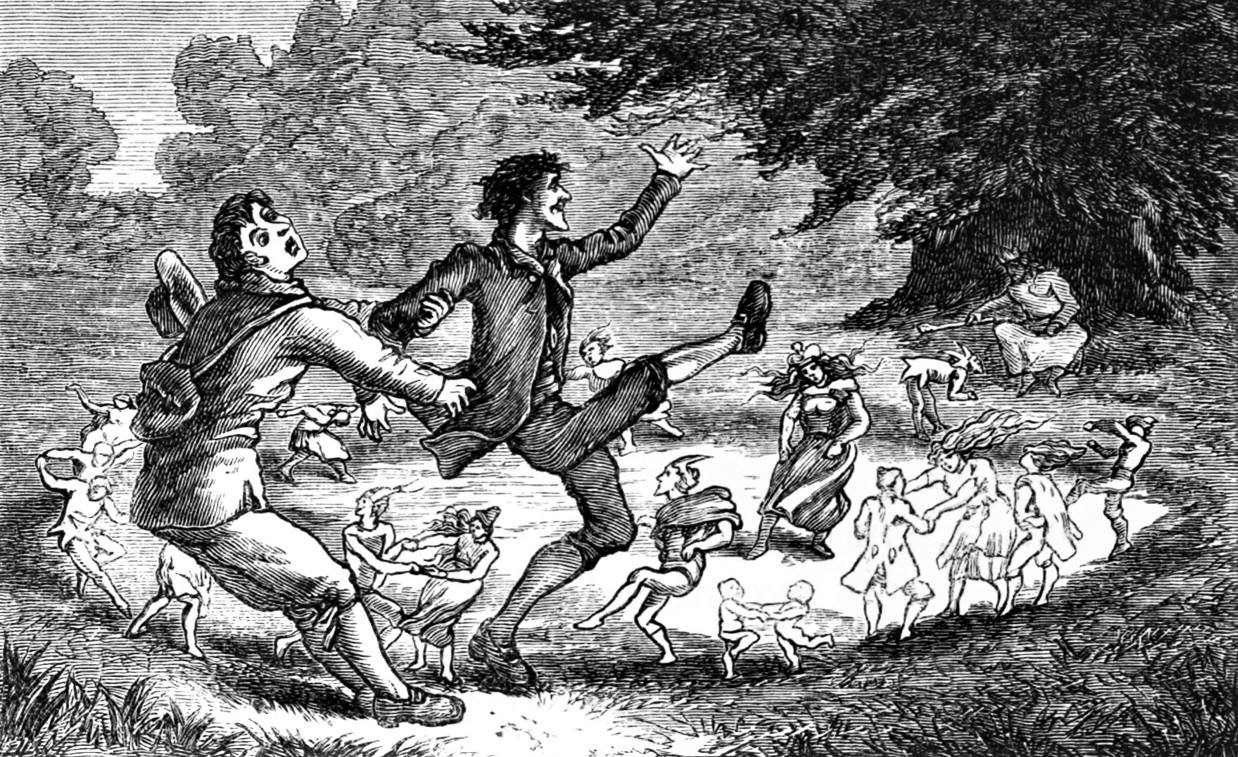
It is considered bad luck to destroy a fairy ring, believed to form by fairies dancing. Folklore says that if a human steps into a fairy ring, he/she could be caught forever, dancing.
History of Halloween customs, part 2. In part 1, we mentioned that Halloween is derived from old Celtic pagan customs and came to the U.S. with the Irish. We covered costumes.
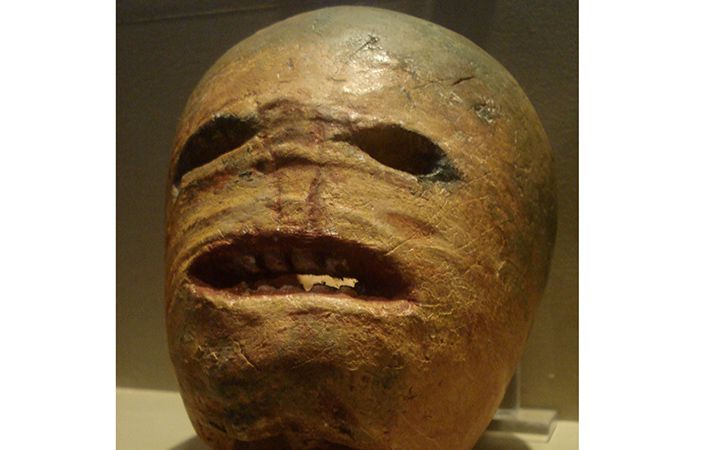
Another tradition is the Jack o' Lantern. According to Celtic folklore, Stingy Jack tried to cheat both the devil and God, and when he died, neither would take him. He was doomed to roam the earth forever at night, with a glowing coal in a carved out turnip to light his way. He became known as Jack of the Lantern.
The Celts carved hideous faces into turnips, beets, potatoes and gourds to frighten away Jack and other evil spirits. An example of an original carved turnip from Ireland is attached.
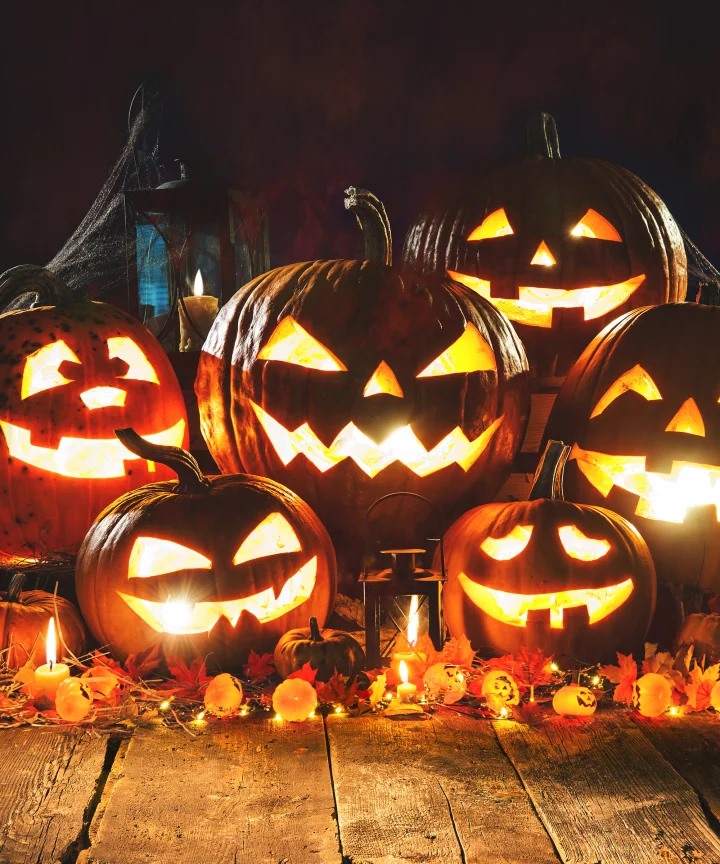
When the Irish came to the States, they discovered that pumpkins were plentiful and much easier to carve. Hence, today's American tradition of jack o' lanterns.
What is the role of a historical society? Should we not post information and pictures of actual historical events because they are "not politically correct" by today's standards? Sharing the information is not condoning it or approving of it. Does it help to have an accurate picture of history in order to understand the present and work for a better future, or is it simply inflammatory to bring up true past instances of behavior that would not be acceptable by today's standards? Comments on this are appreciated.
It's Halloween time of year. The next few days we'll share some Halloween history trivia.
Halloween is from an old Celtic tradition, the celebration of Samhaim, the pagan harvest festival. Halloween came over to America with the Irish. They believed this was one of the times of the year, in between the harvest and the coming of winter, when it was easiest for the spirits of the dead as well as other non-human spirits like demons and fairies to cross over into the living human world. The barrier between the two worlds was thinnest.
Now they actually welcomed the spirits of their deceased loved ones into their homes; they even set places at the dinner table for them.
But the non-human spirits, the demons and the fairies, were another matter. The Celts did things to keep these entities from bothering them and these became our American Halloween traditions.
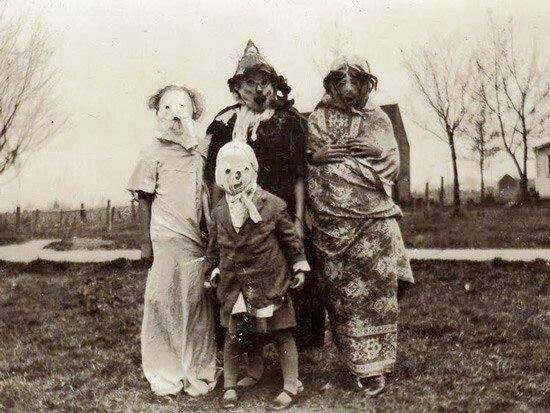
First, let's look at costumes. Going back for centuries, the Celts dressed up like frightful demons so the real spirits would be confused and leave them alone. They also dressed up like the spirits of the dead in order to appease them so they would look favorably upon them from the other world.
The attached picture shows costumes from the early 1900s. Costumes were homemade and pretty creepy. They were supposed to be. But with time, Halloween became more "domesticated" and lost much of its original meaning.
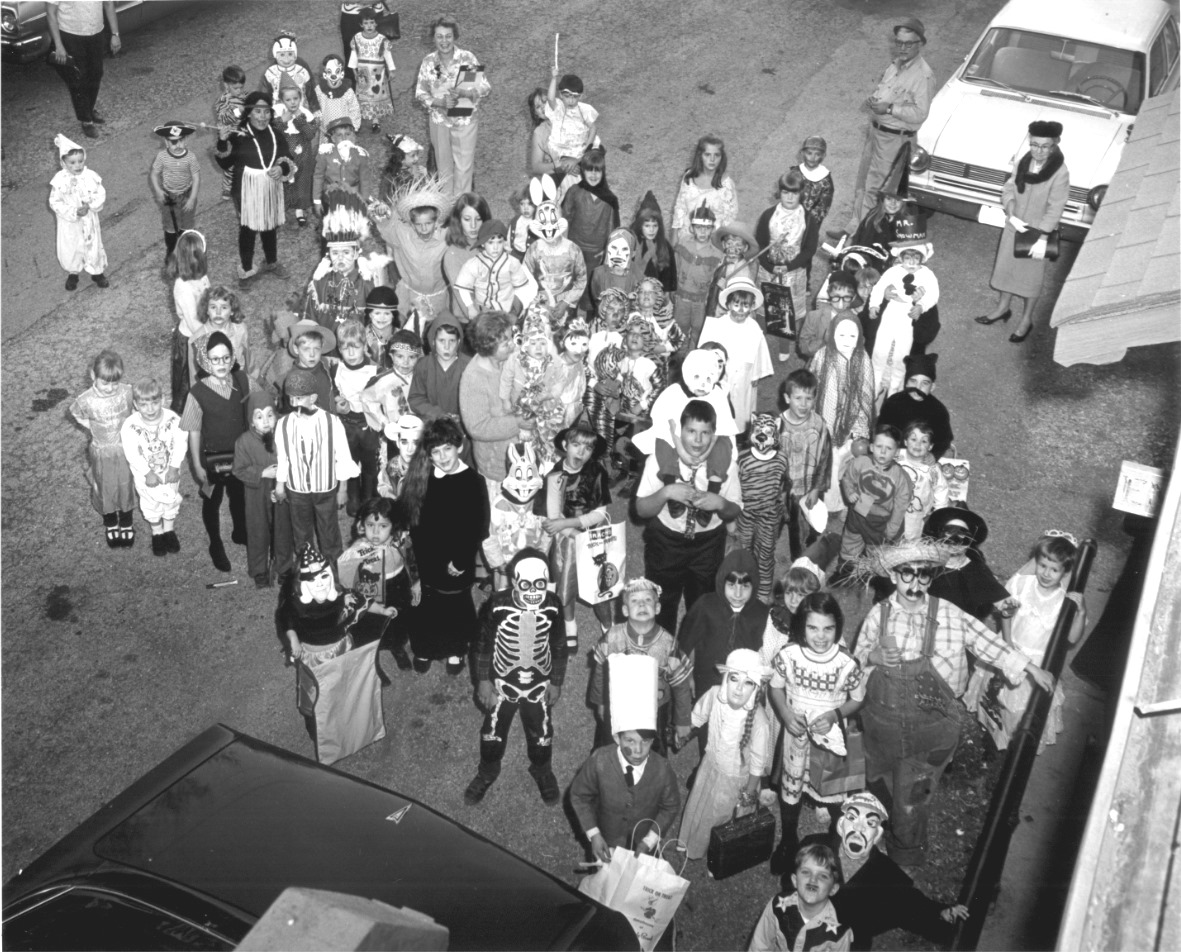
In the 1930s, companies began to produce commercially made costumes. In addition to the usual monsters and werewolves, they also started featuring characters from cartoons and movies. Today we have everything from princesses and superheroes to Frankenstein's creation.
Included is also a picture from the RHS collection of local children in costumes in 1968.
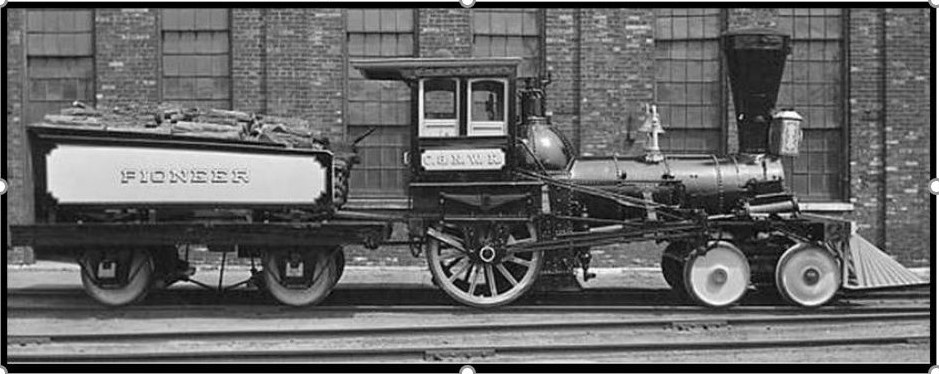
Mark your calendars for the next event – "From This Small Beginning Chicago’s Great Railroad Empire Was Born"
The railroads have played an important role in the growth of Chicago. They are, for better or worse, an integral part of the city's fabric. In 1848 the first train to operate in the city ran west pulled by the locomotive Pioneer, today on permanent display at the Chicago History Museum. This evening’s presentation will cover the history of Chicago's railroads and the efforts to honor that history with "Chicago Railroad History Month". This effort is dedicated to the goal of a greater celebration in 2023, the 175th Anniversary of the Pioneer's first run. This evening’s presenter, David Daruszka, is a retired locomotive engineer and Vice President of the Blackhawk Chapter of the National Railway Historical Society, the sponsor of Chicago Railroad History Month.
Friday November 15, 2019 – 7 PM
Ridge Historical Society
Graver-Driscoll House
10621 S. Seeley Avenue Chicago, IL
This program is free and open to the public
Reservations Recommended:
773-881-1675 or email at ridgehistory@hotmail.com
Light refreshments will be served.
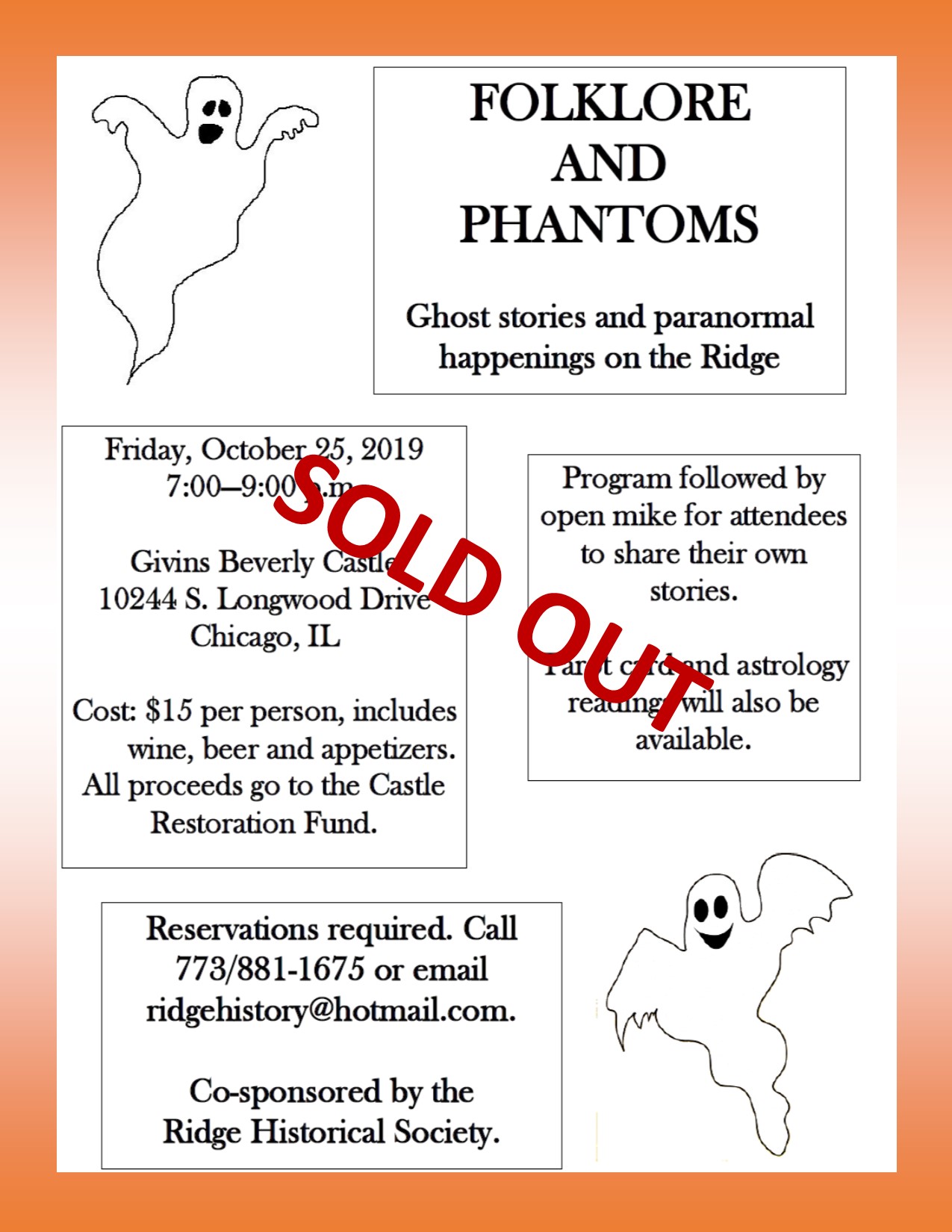
Thanks to everyone who came last night to this event. We had a good time exploring urban myth vs. what people really said they experienced at the Castle. We gathered at least five new "ghost stories" for the Ridge thanks to the brave souls who got up to share their experiences at their own houses. Thanks to the RHS volunteers for bringing the refreshments so the proceeds from the event could all go to the Castle restoration fund. Thanks to Janet and Susan for the astrology and tarot card readings. Stay tuned for next year's event!
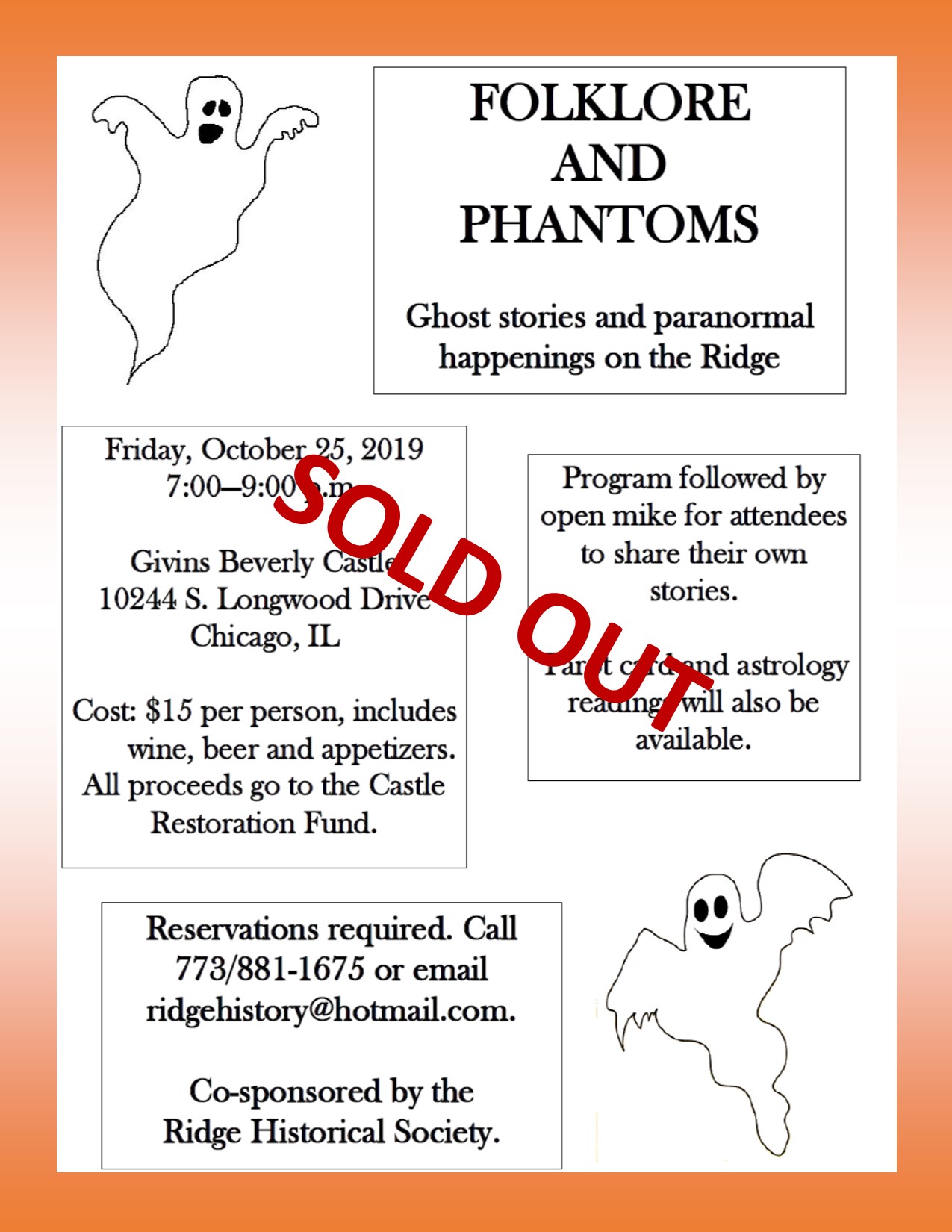
Folks, we are more than overbooked for tonight. If you did not make a reservation, chances are slim to zero there will be any extra seats. We'll do this again next year!!
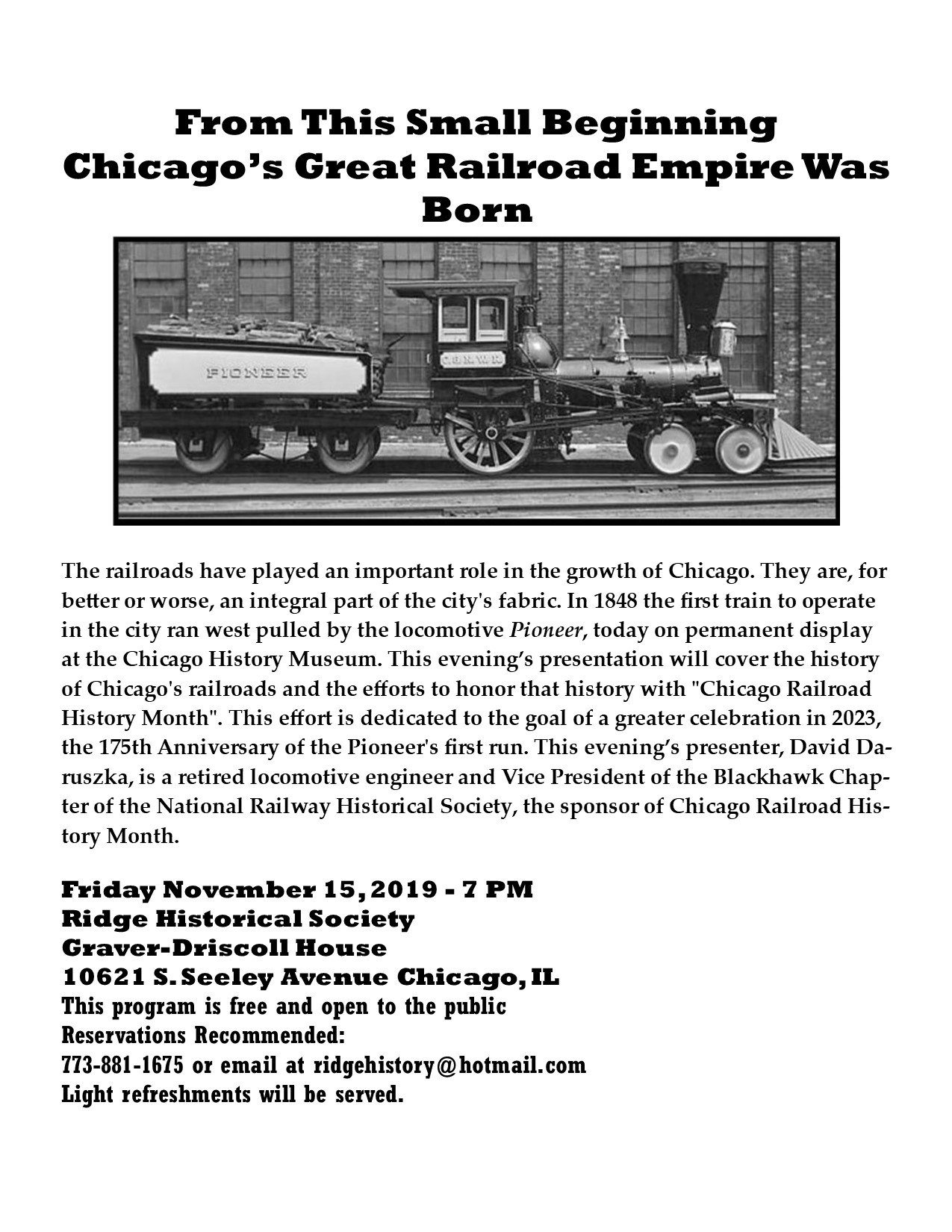
RHS is posting two new events/programs – be sure to add them to your calendar. The first is this one on the history of the railroads in Chicago on Friday, November 15 at 7:00 p.m.
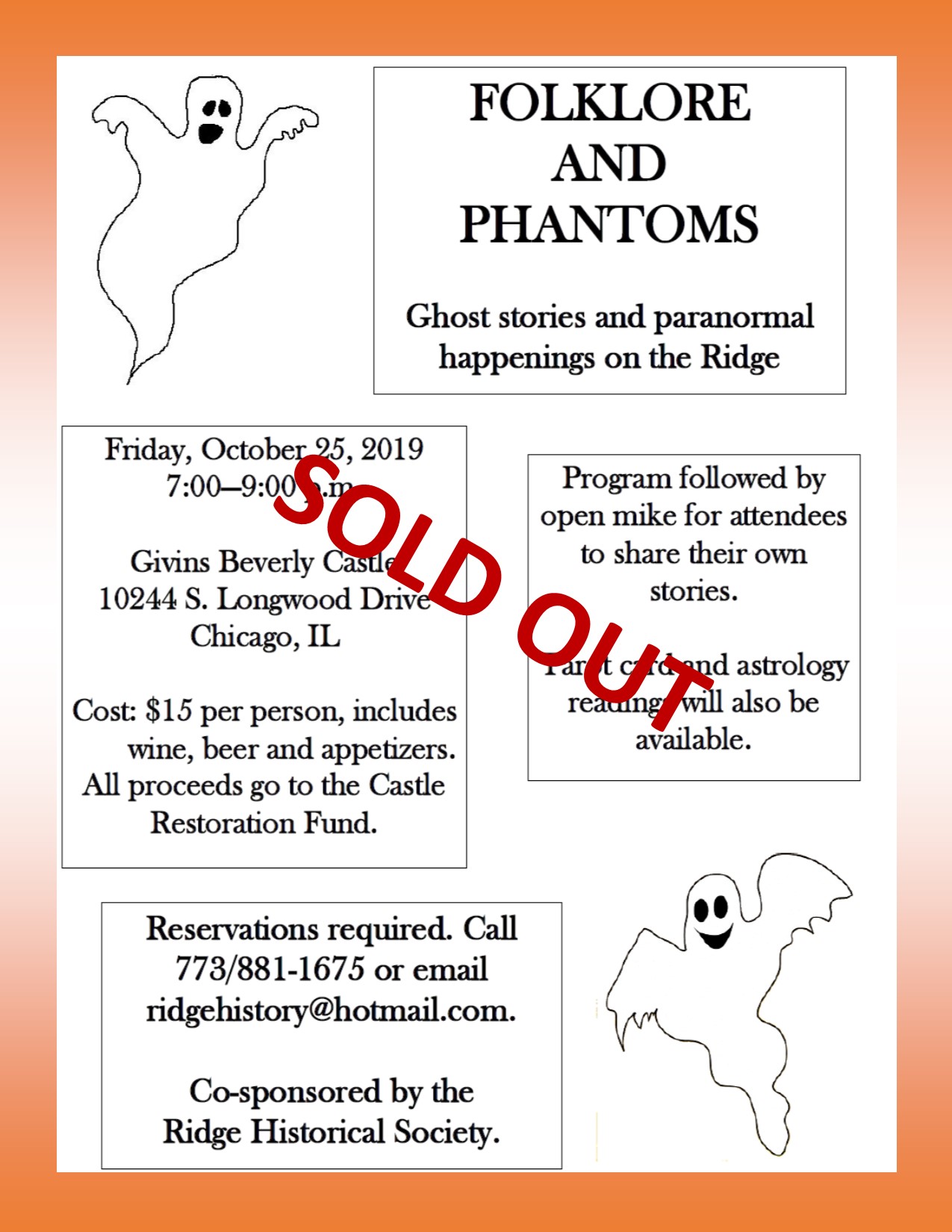
SOLD OUT! The reservation list is full for the "Folklore and Phantoms" event on Friday night. Thanks for your response – this will be loads of fun!!
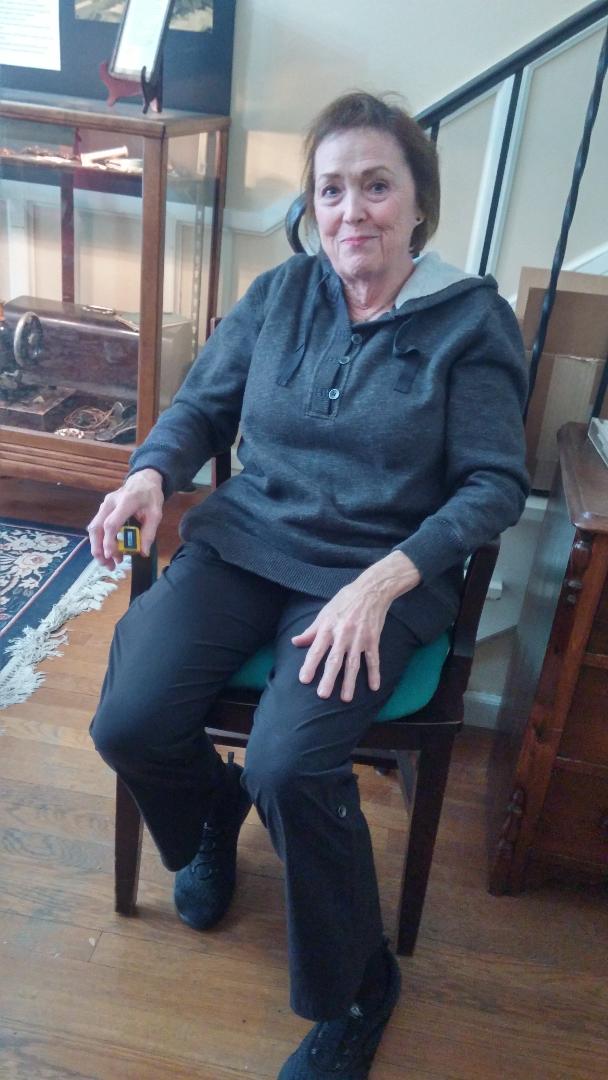
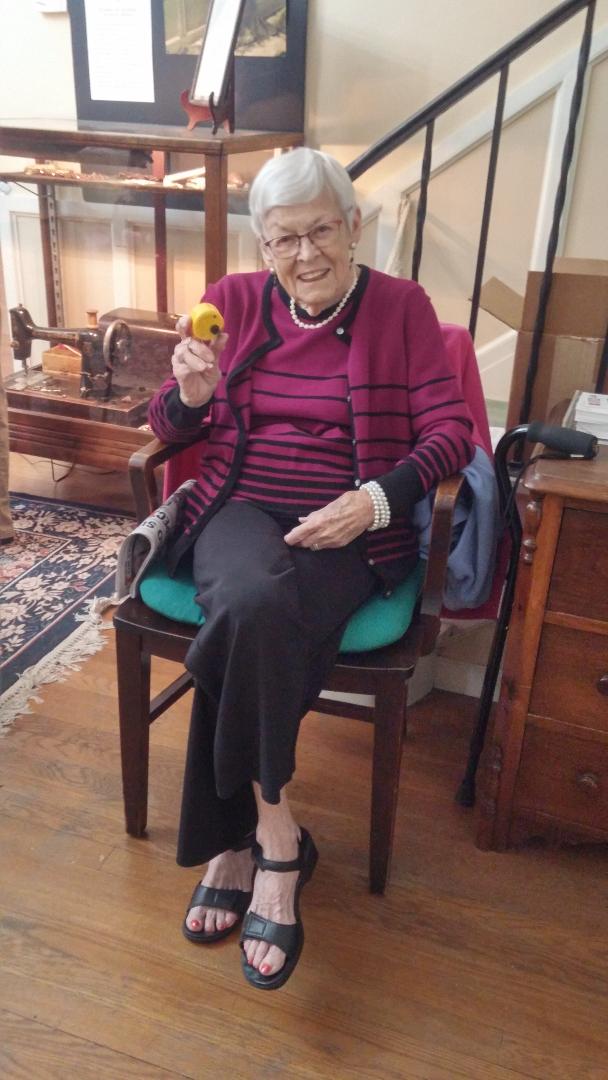
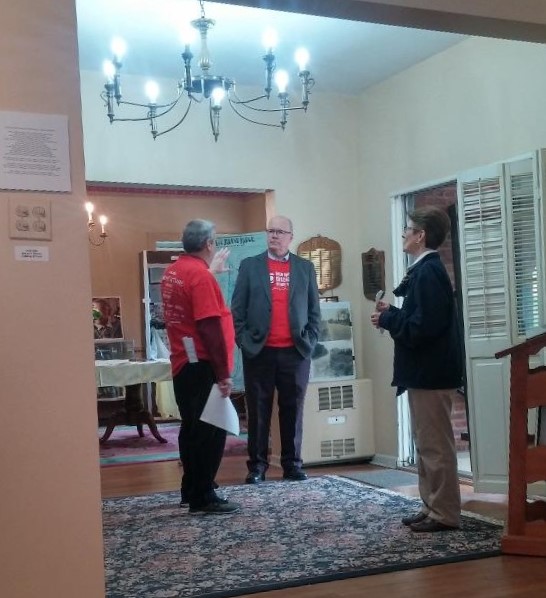
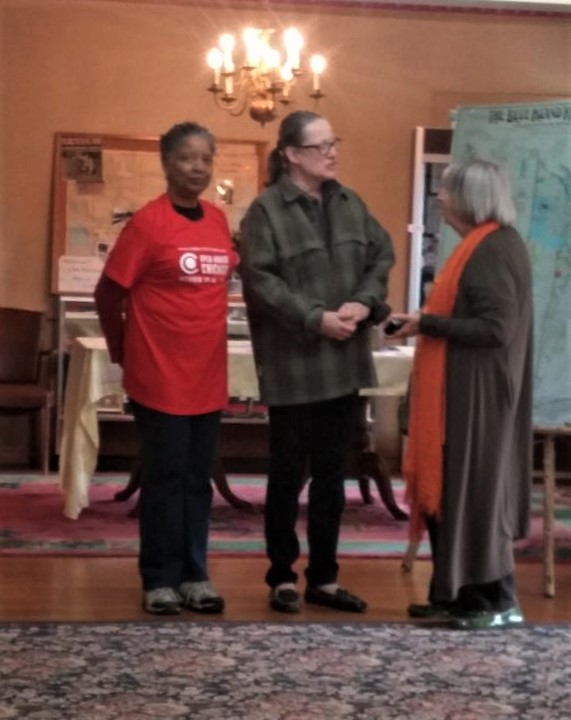
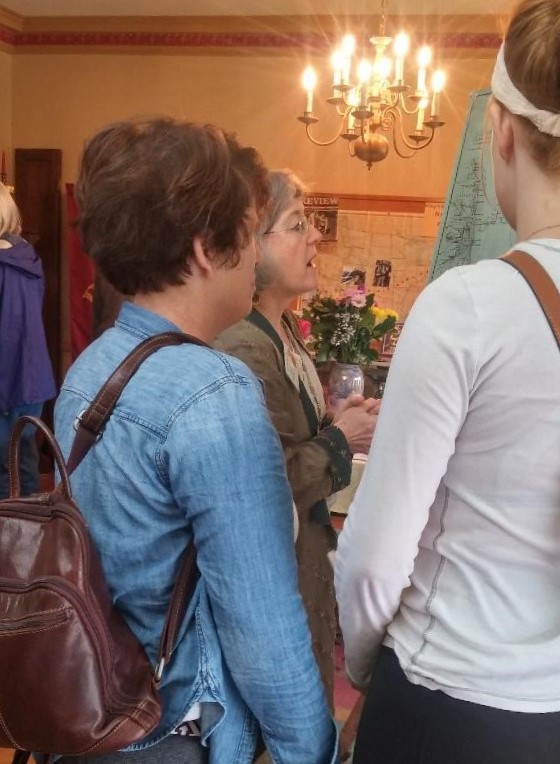
A second successful year for the Ridge Historical Society (RHS) as part of Open House Chicago this week-end just wrapped up. A big thank you to the RHS volunteers who staffed the event, greeting guests from all over the Chicago area, some of whom had never been to Beverly/Morgan Park before.
A stop at RHS gave visitors an introduction to the unique geography of the Blue Island Ridge and some history on the development of the communities, information on the Graver-Driscoll House (RHS headquarters), and the opportunity to tour the "Threads of Imagination" exhibit.
RHS volunteers also helped visitors figure out where to go next (everyone had favorite locations to send people to) and gave them some historical background on the other locations. And RHS volunteers helped visitors pick a spot for lunch (everyone had favorites there, too!).
Thanks to Fran Oehmen, Mike Wilk, Jarilyn Stavropoulos, Shirley Conley, Lisa Schmidt, Pat McGrail, Kevin Bourke, Linda Lamberty, Matt and Lisa Walsh, Stacey and Matt Patricoski, Carol Macola, Karen Truitt, Hannah and Mary Archambeau, Sandra Leonard, Judie Anderson and Carol Flynn. We managed to capture a few of the volunteers in pictures today before it got too busy.
RHS is always looking for members and volunteers. There are many opportunities at RHS, from history research to gardening to helping with special events. It's an interesting – and fun – place to be involved. For information, contact RHS at ridgehistory@hotmail.com, or call 773/881-1675, or leave a message through Facebook.