
Explore the RHS Facebook Archives, a rich repository of local history written by Carol Flynn. For two decades, Carol brought a deeply dedicated voice to public education at RHS. Her role as Facebook administrator through mid-2025 naturally extended her prolific research into meticulously detailed articles, most notably her multi-part historical series posts. Today, Carol continues her local history writing for The Beverly Review and other outlets.
2024
The Ridge Historical Society
Beverly Art Walk on Saturday
By Carol Flynn
Everyone is gearing up for the 11th Beverly Art Walk on Saturday, Sept. 28, 2024! Events will be set up all around Beverly and Morgan Park.
The Ridge Historical Society will be open from 12 noon to 5 p.m. that day, and featured will be:
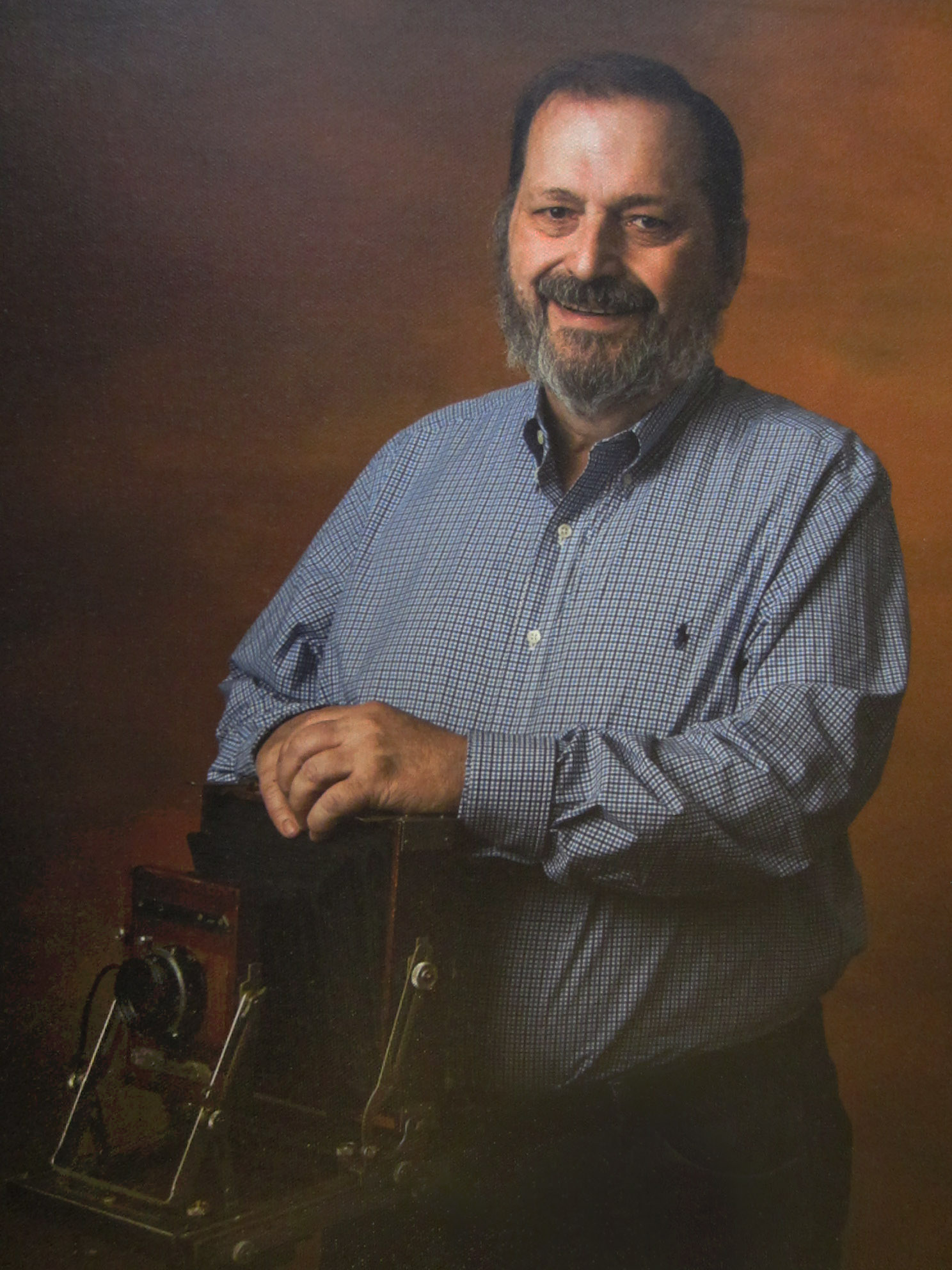
– Photographer Mati Maldre's collection of photographs of houses and buildings designed by architect H. H. Waterman. Mati will be there in person to demonstrate his Deardorff 4×5/5×7 view camera, which he used to take these photos.
Mati said, "The large format 4×5, 5×7 or 8×10 view cameras are the professional standard for architectural photography because of the clarity of image afforded by the use of large positive transparencies or negatives, utilizing less magnification when printing."
He would know – Mati is a retired Professor of Art/Photography from Chicago State University and has an extensive and impressive bio. He taught photography at the Beverly Arts Center for 35 years. He is on the RHS Board of Directors and chairs the Historic Buildings Committee.
This is an introduction to the new exhibit that RHS is mounting, "Harry Hale Waterman, Architect: Unique in Any Style," which will open for Open House Chicago on October 19 and 20.
In the meantime, visitors can also still catch the current exhibit, "Louise Barwick's Lost Ridge," which shows lovely water color paintings by Miss Barwick, an art teacher in the neighborhood, from around 1900.
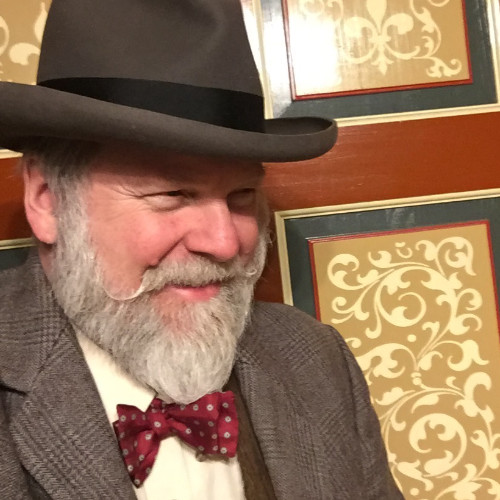
– Also at RHS for the Beverly Art Walk will be glass artist Sean Michael Felix, the owner of Illumination Art & Design in Humboldt Park.
Felix creates unique hand crafted architectural art glass, glass signs, and stained glass using 19th century techniques. For the Beverly Art Walk he will exhibit samples of his beautiful decorative work and demonstrate the nearly lost art of applying gold leaf to glass the way it was done by artisans in the Victorian Era.
RHS is located at 10621 S. Seeley Ave., in Chicago, and may be contacted at 773-881-1675 or ridgehistory@hotmail.com.
The Ridge Historical Society
More on the Beverly Art Walk – Irish Dancers
By Carol Flynn
Tomorrow, Saturday, September 28th, will be the Beverly Art Walk. The Ridge Historical Society (RHS) has a spectacular day planned for the public – it will be entertaining and informative, with a true "historical" flavor that will not be captured anywhere else!
In the previous post, the artists who will be at RHS from 12 p.m. to 5 p.m. were introduced – Photographer Mati Maldre, and glass artist Sean Michael Felix.
Dancing and musical acts will also go on all around the neighborhood, but the only place visitors will be able to experience traditional Irish dancing will be at RHS.
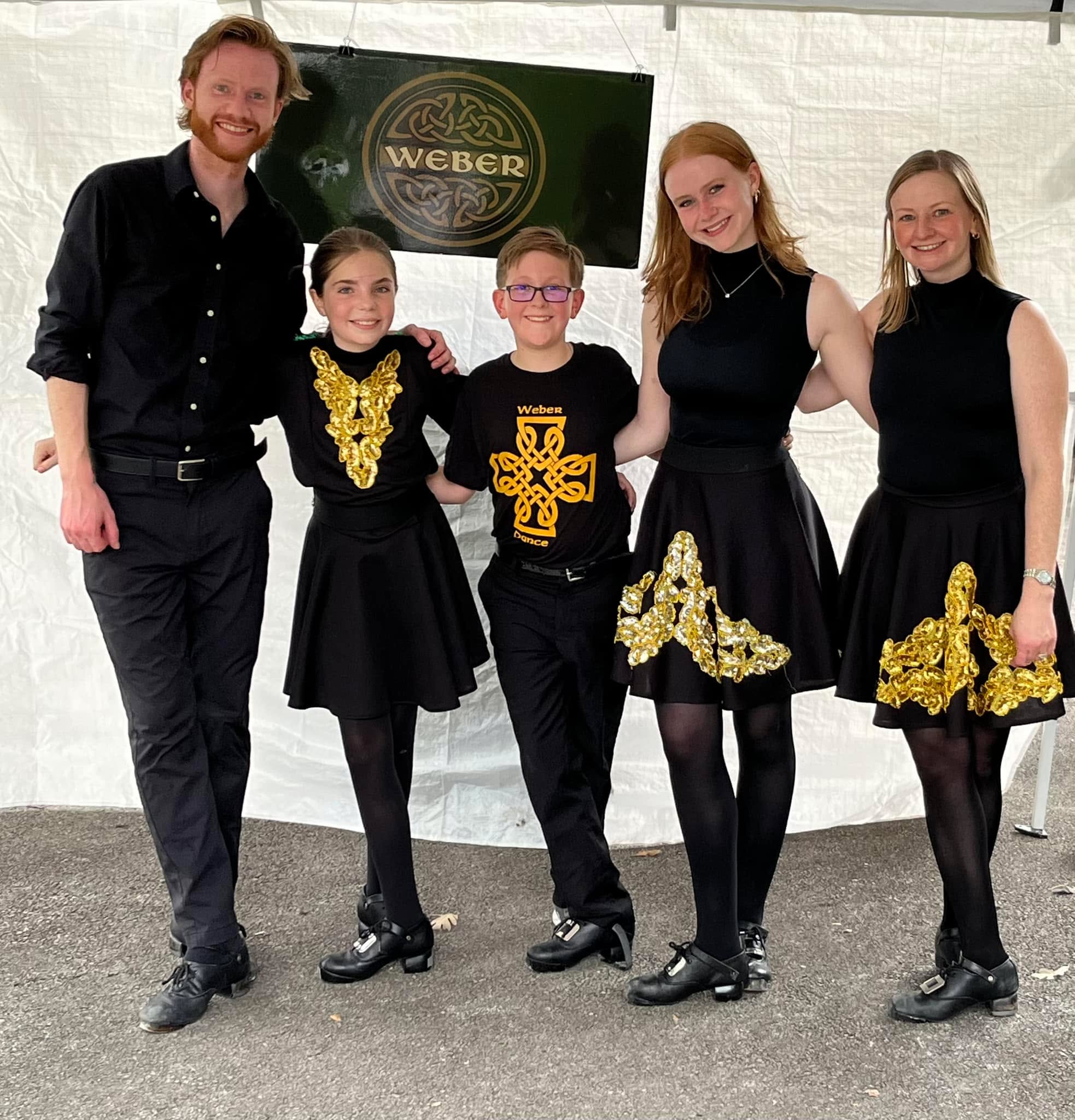
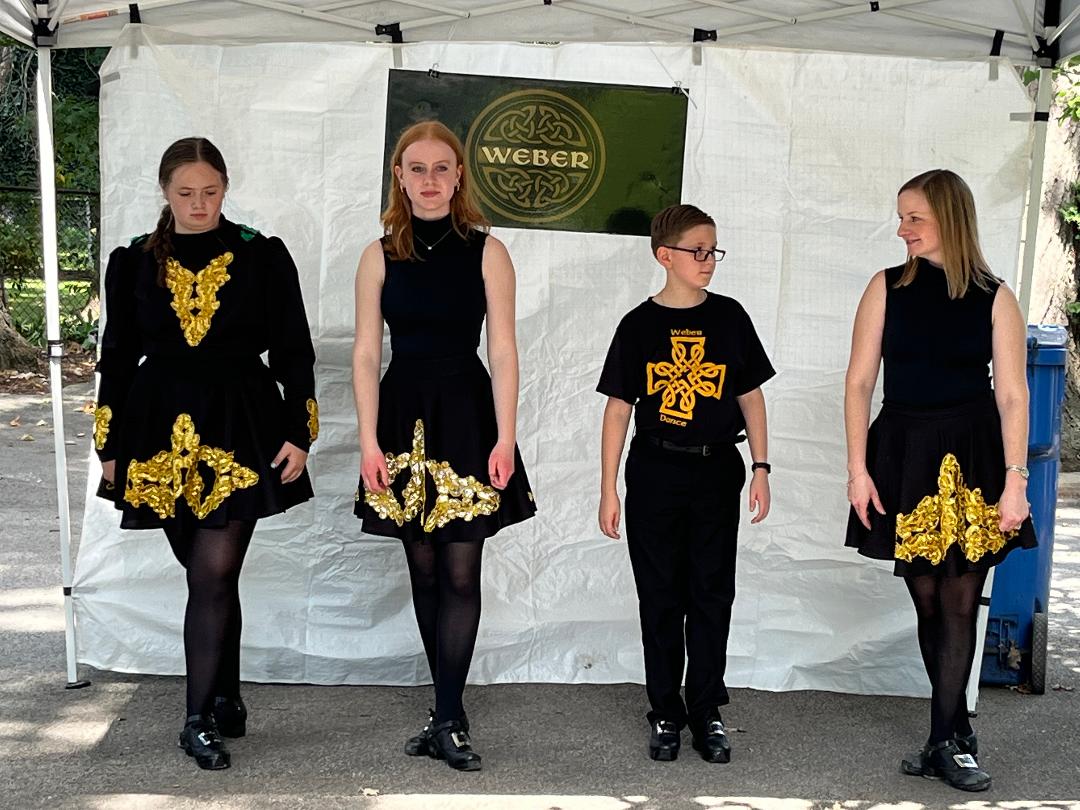
The Weber Irish Dance company will appear at RHS from 1:30 p.m. to 3:30 p.m., with regular, short performances every 10 minutes.
Weber Irish Dance has been a South Side Chicago presence for 60 years. Many people associate Irish dancing with St. Patrick's Day, but folk customs from all cultures should be shared and celebrated throughout the year.
RHS thanks Weber Irish Dance for participating in our event!
RHS is located at 10621 S. Seeley Avenue. Park on Seeley and walk up the driveway to the house.
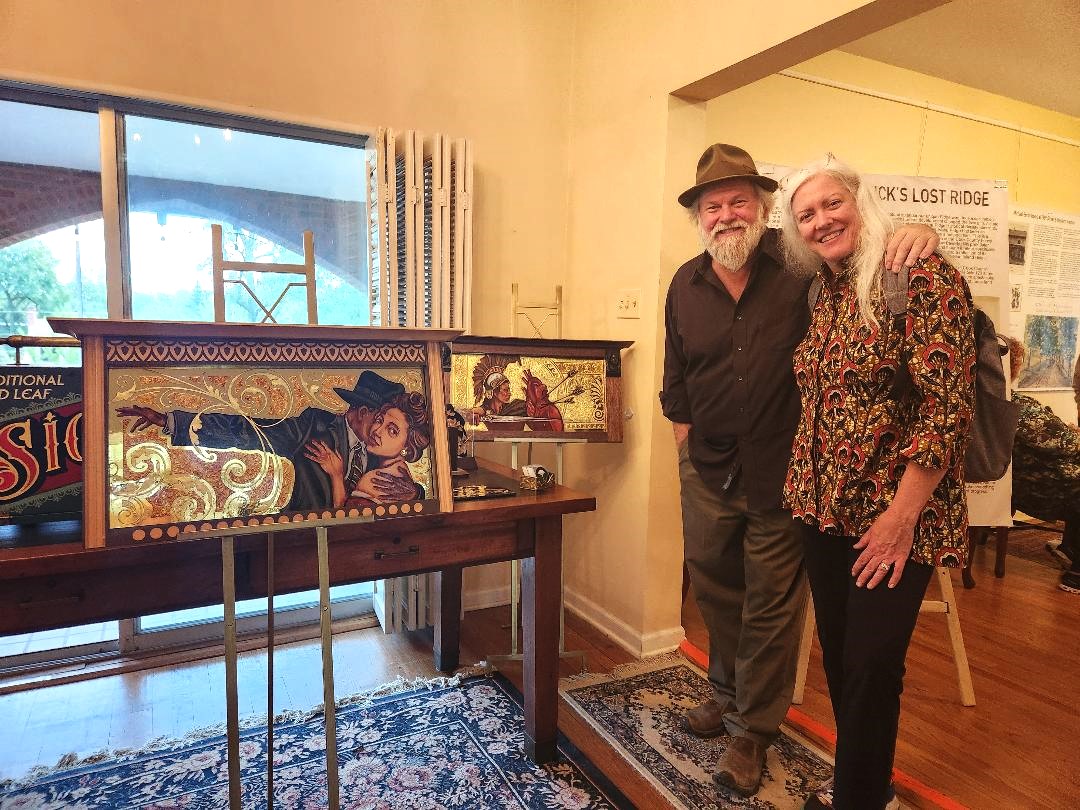
The Beverly Area Arts Alliance's annual Beverly Art Walk is about community, and yesterday's 11th Art Walk proved once again that the Alliance has done so much to revitalize the "modern" Beverly/Morgan Park.
Events went on all over the neighborhood, and the Ridge Historical Society (RHS) was fortunate to have glass artist Sean Michael Felix "assigned" to us by Alliance leader Sal Campbell.
Sal always does a great job of matching artists with venues, and this is a perfect example – an artist who uses old-world processes to create beautiful images on glass, using etching, paints, gold leaf and other techniques, matched up with the one place in the community you are able, even encouraged, to be "old school" and think about the past!
RHS also had its own Mati Maldre, photographer and RHS Board member, with a display of his award-winning architectural photos of buildings in the community designed by architect H. H. Waterman. The day was rounded out with entertainment by Weber Irish Dance company, a South Side Irish institution for 60 years!
Plus, a new term has entered the community's lexicon – several people said yesterday they were out and about "art walking." That's how language evolves.
Here is a picture of Sean and Sal together yesterday at RHS, with just some of Sean's wonderful work.
Now RHS is on to preparation of the new exhibit, "Harry Hale Waterman, Architect: Unique in Any Style," which will premiere for Open House Chicago on October 19 – 20.
The Ridge Historical Society
Living History: Brick Streets of Yesteryear
By Carol Flynn
"Seizing the educable moment:" For a wonderful opportunity to see what the brick streets were like, back in the late 1800s – early 1900s, visit our neighbor to the south, the City of Blue Island.
Blue Island, in its continuing efforts for revitalization, which are proving to be very successful, is redoing streets, curbs, and sidewalks.
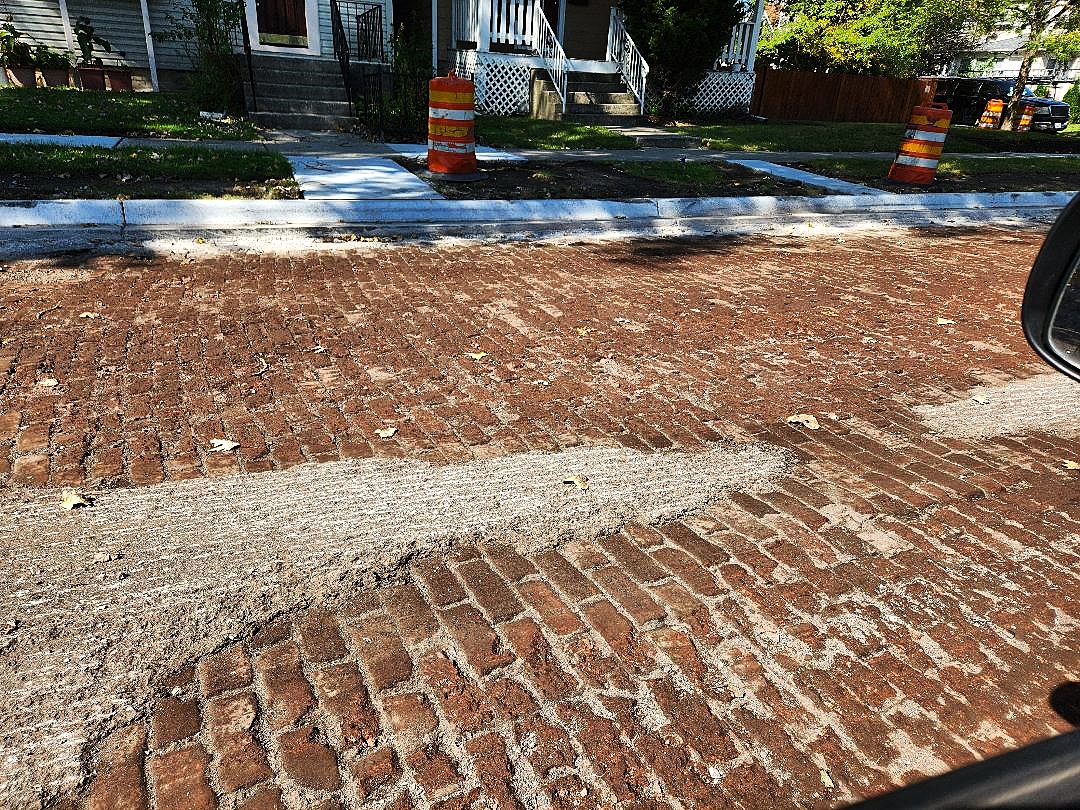
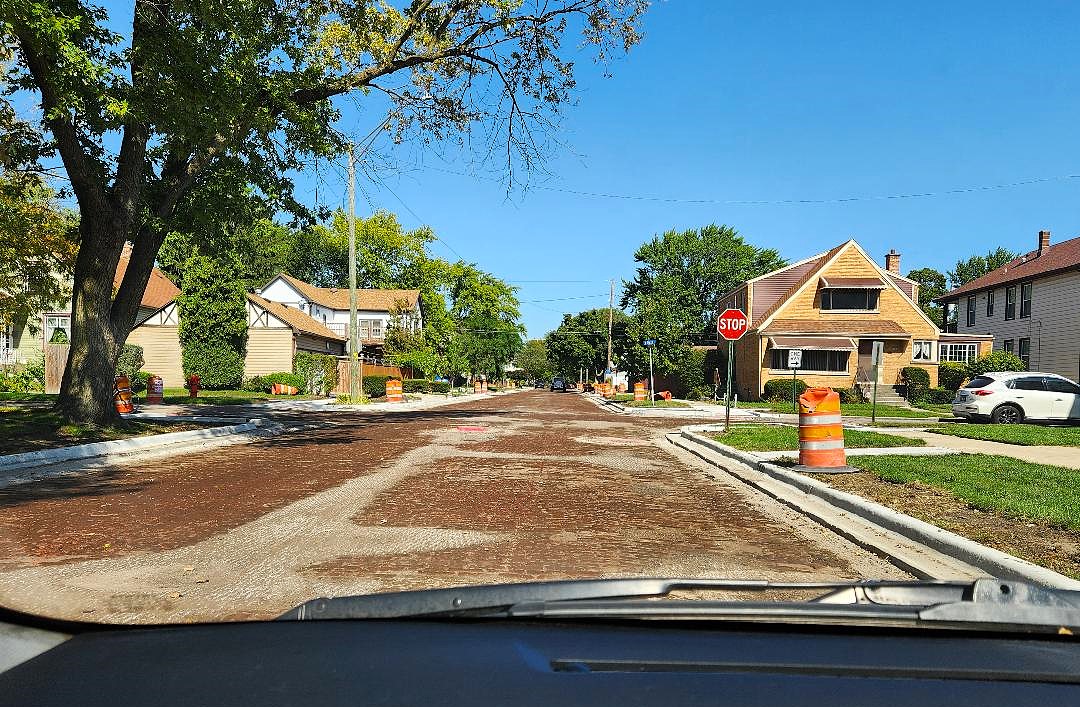
Right now, Greenwood Avenue, which is one block west of Western Avenue, between 123rd and 127th Streets, has been excavated down to the original brick street. Here are some views of the street.
In the next few days, the streets will be covered with concrete and blacktop, so if you want to see the old streets, do it now.
There are several isolated blocks of brick streets in Morgan Park, on 110th Place, but not a half mile stretch like this.
According to Preservation Chicago: "Originally, Chicago streets were packed dirt, which turned to thick mud when wet and were a constant source of frustration for
early Chicagoans. Dirt roads were initially paved with inexpensive wooden planks and later with wooden blocks; however, this
practice was largely phased out after the Chicago Fire of 1871. Between the 1880s and the 1910s, brick pavers were widely
used throughout Chicago’s highly traveled streets, as they were much stronger, highly durable, fire-proof, and remained functional when wet or snow-covered. These new brick paved streets proved up to the challenge of the wear and tear from steel
rimmed wagon wheels of pre-automobile street traffic.
Chicago’s street pavers were typically fired-clay bricks made from the tough clay abundant under the prairie grass."
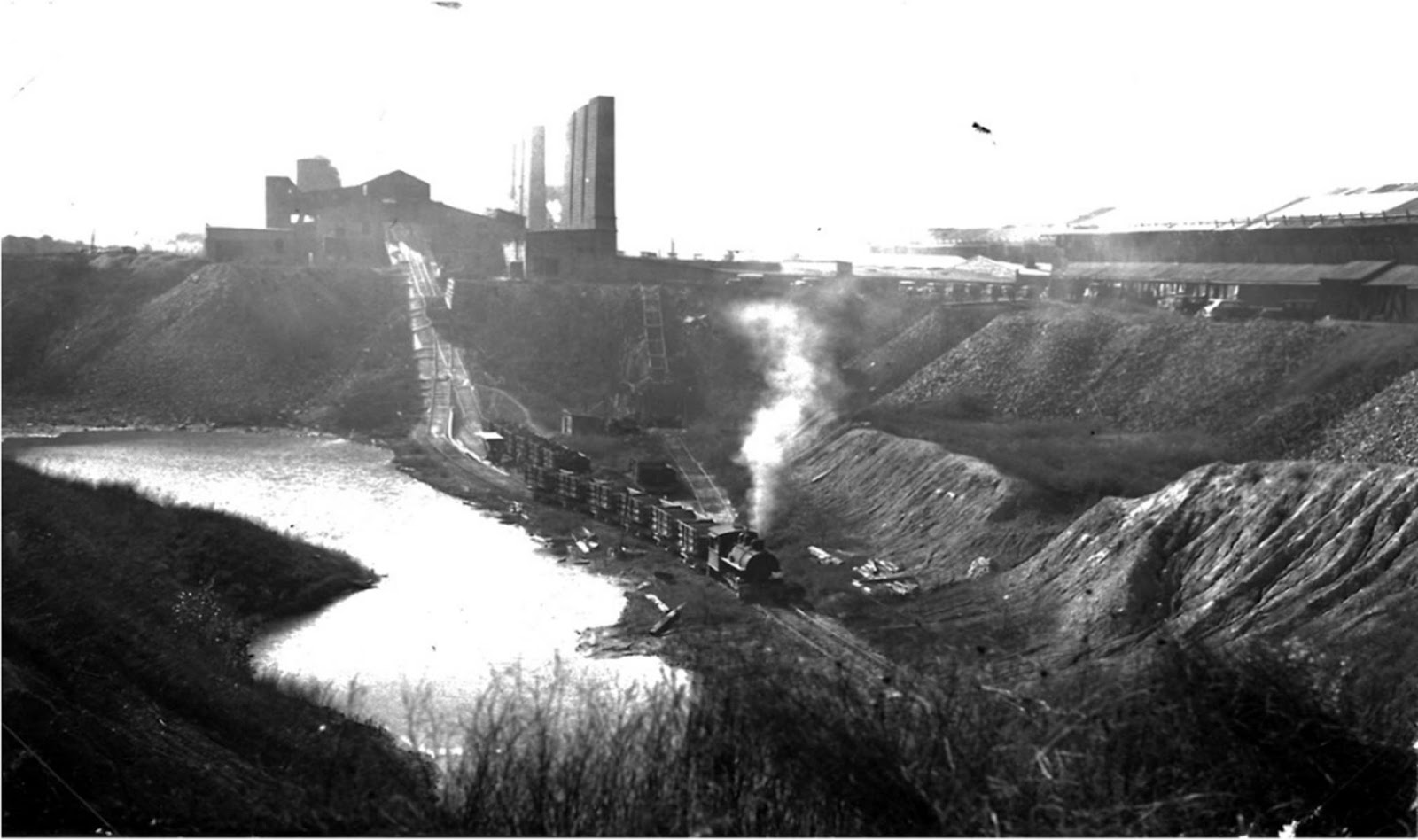
There were massive clay deposits around Blue Island, and brick making was an early industry here. From a history of Blue Island:
"After it was discovered in the early 1850s that rich deposits of clay surrounded the ridge, Blue Island became the center of a significant brick-making industry that lasted for over a century. In the early years, these efforts were small, with the bricks being made by hand and the turnout created mostly for local use, but by 1886 the Illinois Pressed Brick Company (organized in 1884) was employing about 80 men and using “steam power and the most approved machinery”, which allowed them to produce 50,000 bricks per day.] By 1900, the Clifton Brickyard alone—which had opened in 1883 under the name of Purington at the far northeast corner of the village was producing 150,000,000 bricks a year. In 1886, the Chicago architectural firm of Adler and Sullivan designed a large complex for the Wahl Brothers brickyard (the main building of which was 250 by 350 feet on the west side of the Grand Trunk tracks between 119th and 123rd streets. These buildings had been demolished by 1935, and all of Blue Island’s brickyards were re-purposed by the latter part of the mid-20th century. The larger ones for a while become landfills, and the Wahl Brothers location is now the site of the Meadows Golf Club."
There are still families in the area that worked at the brick yards. They are welcome to share their stories and pictures here.
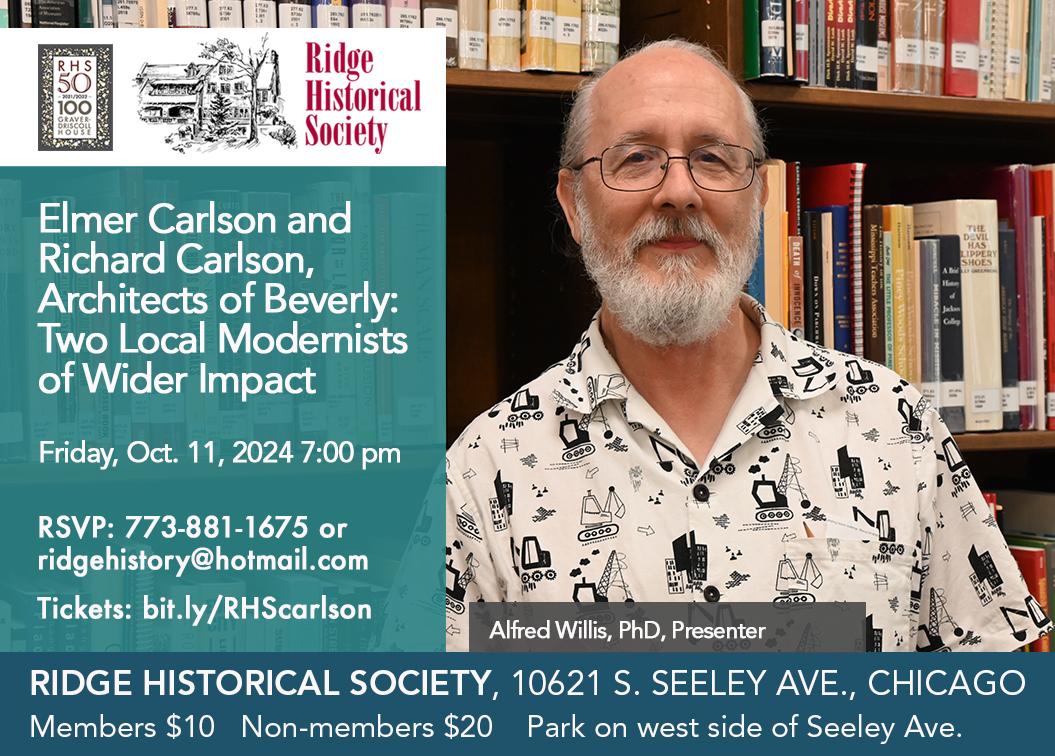
Friday, Oct. 11, 7:00 pm
Elmer Carlson and Richard Carlson, Architects, of Beverly: Two Local Modernists of Wider Impact
– Alfred Willis, PhD, Presenter
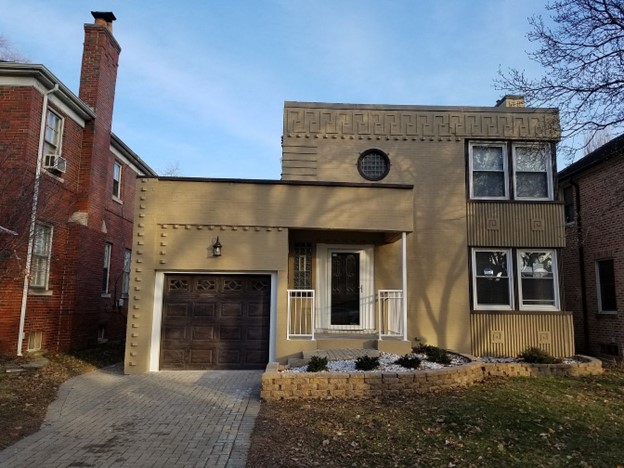
Elmer C. Carlson (1897-1956) was a Chicago architect of Swedish descent who settled in Beverly in the 1920s. Despite the depressed economic circumstances of the 1930s, he managed to prosper in that decade as a designer of residential, commercial, and institutional buildings in southern Chicago and several of its suburbs. While an accomplished creator of 'period' designs of striking charm, he simultaneously evinced a fine flair for Modernism.
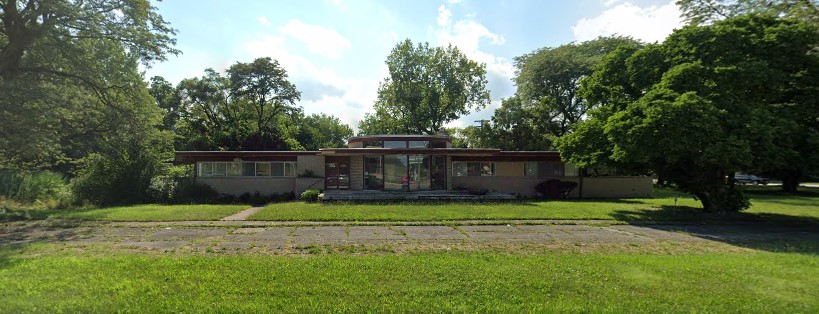
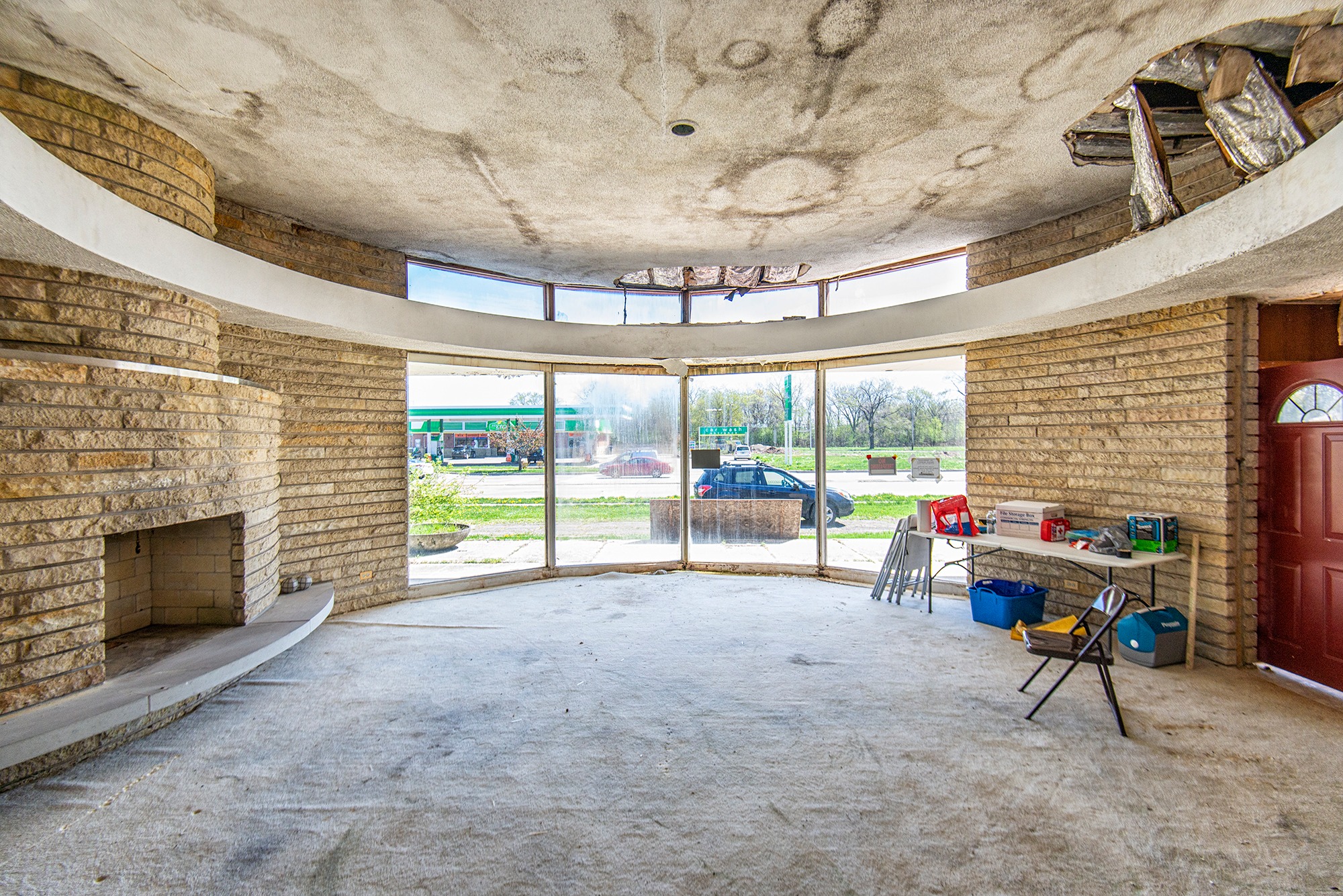
Working out of an ultramodern building on 95th Street, completed to his own design in 1946-47, he went on to even greater success after World War II as a prolific local architect of major projects sited both close to home and further afield. Elmer Carlson died in 1956 while developing a proposal for what should have been his greatest achievement in the residential sector, a villa in Robbins for the wealthy African-American entrepreneur S. B. Fuller.
Responsibility for refining the preliminary form of that interrupted project passed to his son, Richard E. Carlson (1930-2017) who had recently graduated in architecture form the University of Illinois and joined his father's Beverly practice. Thus making the most of a rare opportunity to begin his own career with what for his father (and mentor) had been the blank-check chance of a lifetime, Richard Carlson soon landed a wealthy clientele of his own that permitted a full display of his own unique taste and talent. His subsequent professional success unfolded first in Beverly but later in Colorado Springs.
About the Presenter: Alfred Willis, PhD is an architectural historian who grew up in Georgia. He was educated at Clemson University, Columbia University, and the University of Chicago. After retiring from a career in academic librarianship, he is now working as a consultant specializing in Modernism on nominations to the National Register. He is currently working as a contract librarian with the Historic Preservation Division of the Mississippi Department of Archives and History.
Ridge Historical Society
10621 S. Seeley Ave., Chicago, IL 60643
Limited Capacity. Get tickets here: https://bit.ly/RHScarlson
The Ridge Historical Society
The Great Chicago Fire and the Ridge
By Carol Flynn
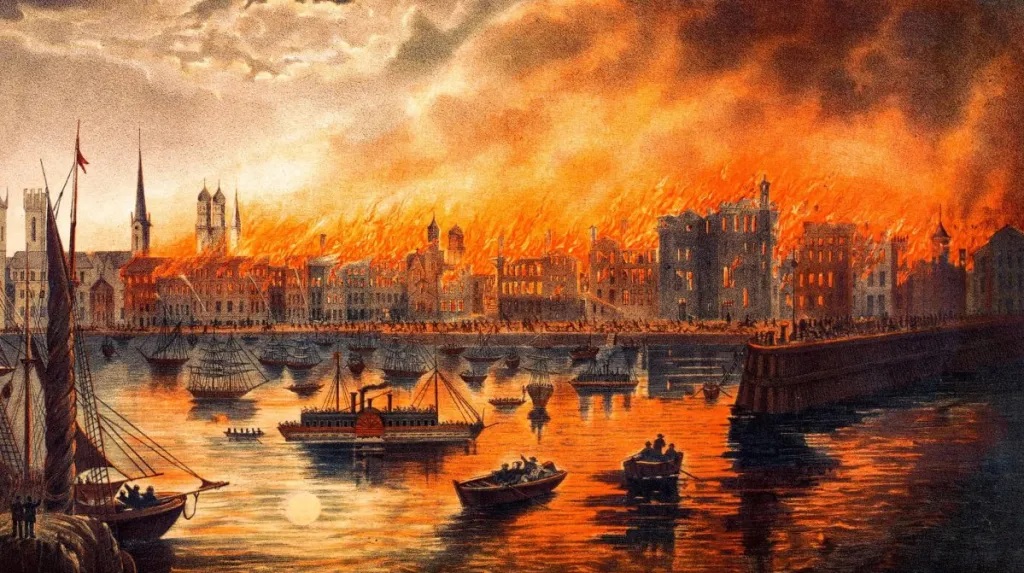
Today, October 8, is the anniversary of the beginning of the Great Chicago Fire in 1871. The fire burned until October 10 when rain finally squelched the flames.
The Great Chicago Fire had a profound effect on all the areas around the city, and the Blue Island Ridge was no exception.
In 1871, the Blue Island was still a distant suburb from the City of Chicago, and development was in the early stages.
A large part of the Morgan estate had been bought by a group of investors known as the Blue Island Land and Building Co. (BILBCo) in 1868 – 69. These men were also owners and investors in the railroads, and in 1870 had expanded the commuter railroad line west along today’s 99th Street, creating the Rock Island line, today’s Metra. This made the area much more accessible.
North of 107th Street was known as Washington Heights and plots of land were being sold. BILBCO was planning a new village south of that to be called Morgan Park.
On that October 8th night, the tip of the Ridge in today’s Dan Ryan Woods at 87th Street and Western Avenue offered a one-of-a-kind vantage point for the local residents to watch the vivid colors of the fire lighting up the northeast sky.
Jack Simmerling, the late artist who grew up on the Ridge, remembered his grandmother telling him how she watched the fire while sitting on the stoop of their family’s house on Vincennes Avenue.
Another story related to a man named Michael Smith, who came to Chicago after the U.S. Civil War and entered the hotel business, owning the National Hotel at Wells and Randolph. In 1869, he divested himself of those interests, purchased 40 acres of land just northwest of today’s 111th Street and Western Avenue, moved to the Ridge and started an orchard of apple and pear trees.
In 1871, Mr. Smith watched the sky over Chicago as all his former holdings went up in flames.
The biggest effect of the fire occurred after the fire, as people left their old neighborhoods and started to move to the suburbs. This led to a major building boom for idyllic places like the Blue Island Ridge.
The Barnard family first came to the Ridge in 1844. At the time of the fire, some of the family was living on Ontario Street, and were forced to flee, throwing their possessions out of windows and grabbing what they could as they ran down the street.
They escaped to the Ridge, and built a new home at the northeast corner of 103rd and Longwood, where the CVS is now, and the flower seed farm they started joined their other holdings in the area.
One unfortunate outcome of the fire was the destruction of loads of records and archives. The Morgan family lost all of their belongings stored in the city.
Right after the fire, pioneer families formed the Old Settlers’ Society, which started to recreate records of the past. People connected to the Ridge participated in this effort.
Out of the ashes of the Great Chicago Fire grew a new Chicago, one of “skyscrapers” and exciting new architecture. Many of the influential men from this period became connected to the Ridge.
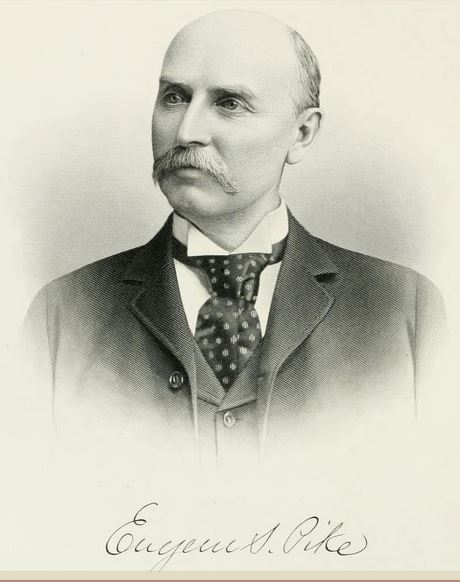
Just one example was Eugene S. Pike, the real estate developer who built major new buildings downtown. His primary residence was on Prairie Avenue, and he bought land in North Beverly for development. Some of the land he kept for himself, where he grew nursery plants for landscaping, and that land became part of the Forest Preserve District of Cook County.
The gardener’s cottage Pike had built there, designed by architect Harry Hale Waterman, is today’s Eugene S. Pike House, undergoing restoration into a community cultural center.
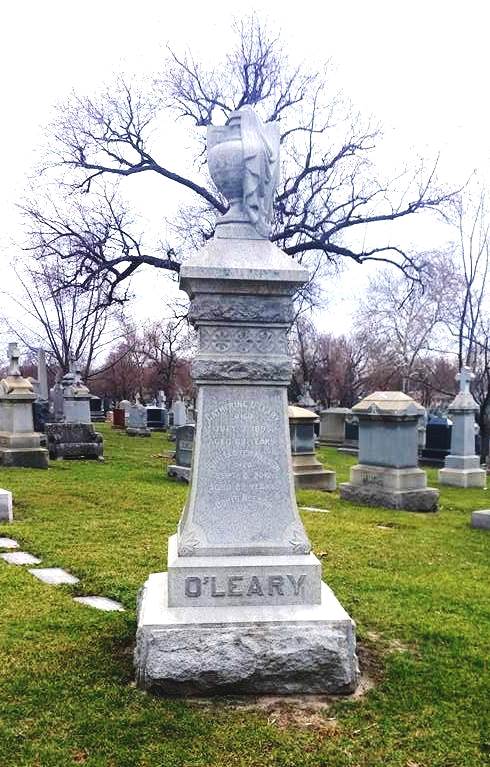
Of course, today, the most famous connection of the Ridge to the Great Chicago Fire is the gravesite of Mrs. Catherine O’Leary in Mount Olivet Cemetery on 111th Street.
Chicago folklore for years claimed that the fire originated from Mrs. O’Leary’s cow kicking over a lantern. Years later, newspaper reporters admitted they made that up.
Although the fire did start in the O’Leary barn, the cows were settled for the night and Mrs. O'Leary was in bed nursing an injured ankle at the time.
The exact cause of the fire was never determined. Theories included a stray spark from men smoking in the alley; the neighbors going into the barn with a lantern to get milk for “oyster stew,” an alcoholic punch they were making for a party; and even arson from a milk business competitor. Other theories included spontaneous combustion and a comet flying through the cosmos.
Big Jim O'Leary, the son, became a famous Chicago gambler. The people loved him – he was honest; he always paid off the bets people made at his (illegal) establishments. He was involved in gambling operations along 111th Street in the early days of Mt. Greenwood.
Big Jim was the nemesis of the famous Irish police chief, Francis O’Neill. Big Jim bought the grave sites in Mt Olivet and is buried there with his parents, right down the way from the mausoleum of Chief O’Neill.
Thanks to Linda Lamberty, past RHS Historian, for some of this information.
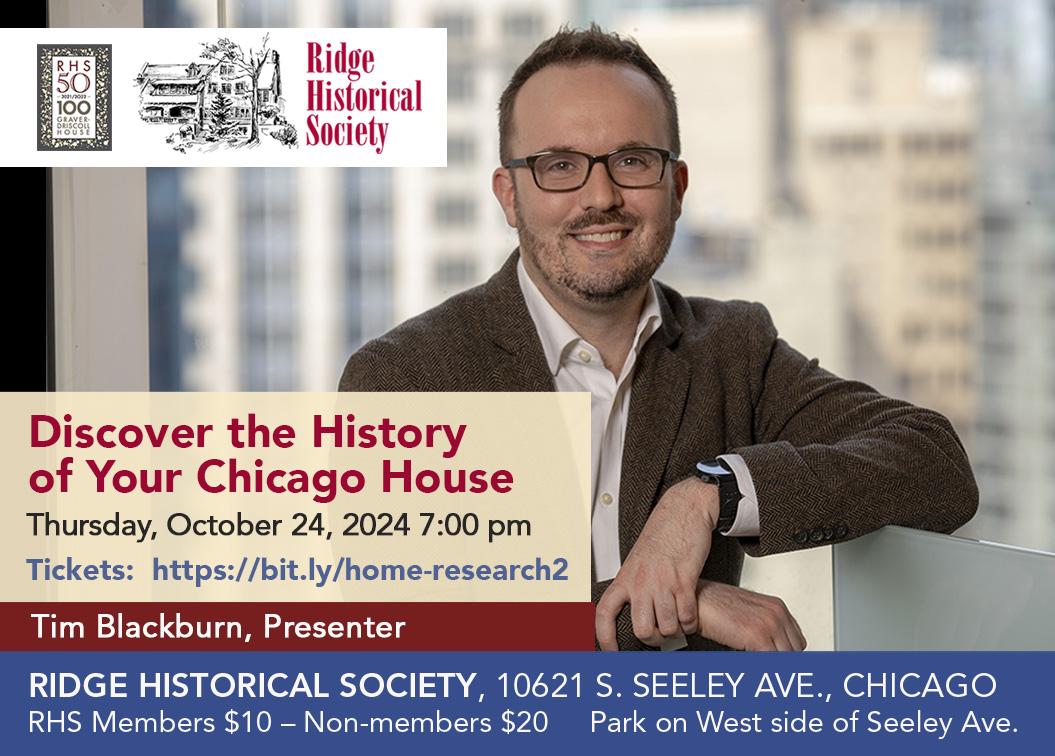
Back by popular demand, RHS Board member and house history guru Tim Blackburn will explain how to research the history of a Chicago house using a multitude of available resources.
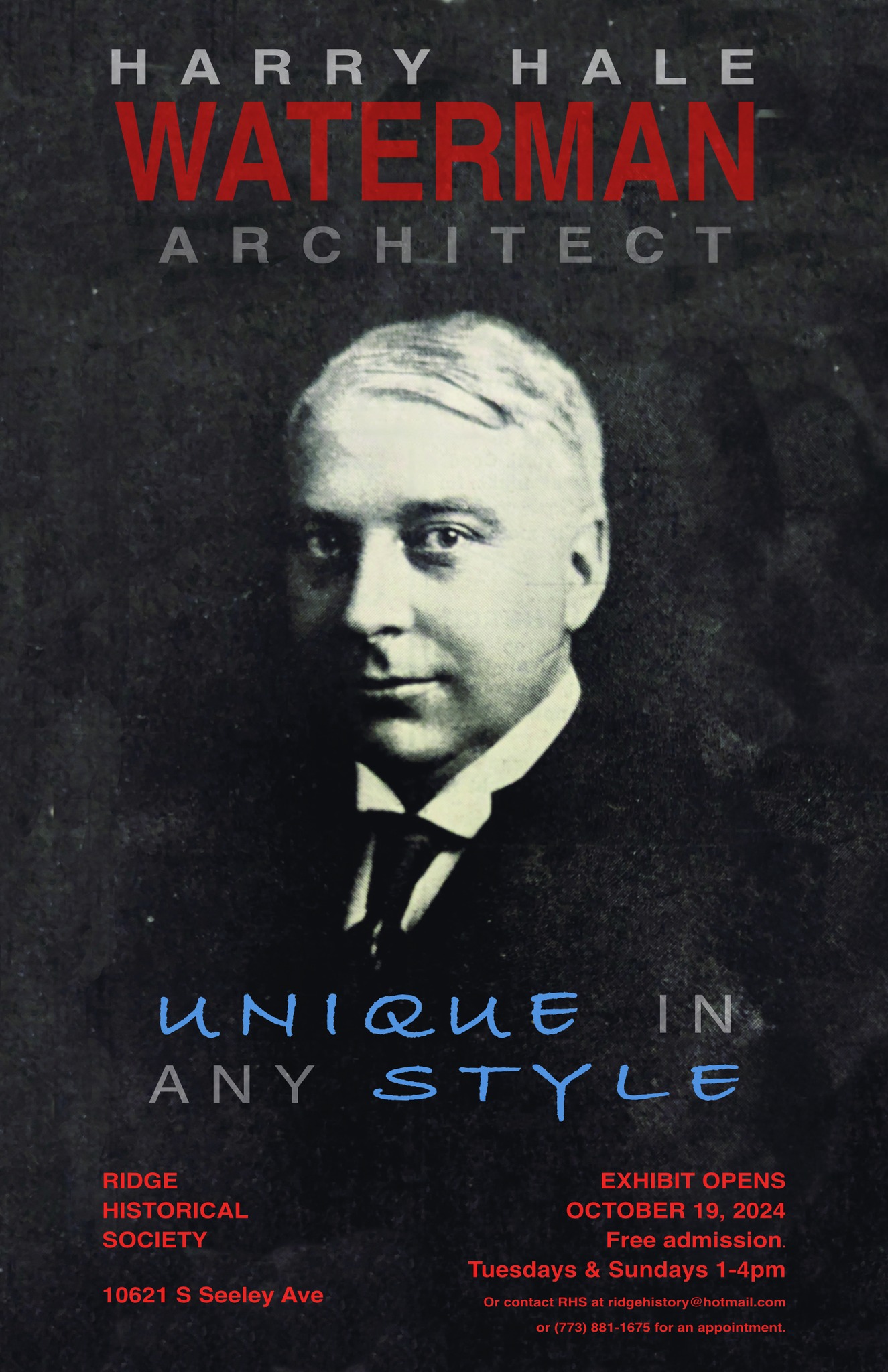
Open House Chicago takes place this coming week-end, October 19 and 20.
As one of the featured locations, the Ridge Historical Society (RHS) will be open both days from 10:00 a.m. to 5:00 p.m.
We are very excited about opening our new exhibit for this event: “Harry H. Waterman, Architect: Unique in Any Style.”
Waterman designed at least 40 buildings on the Ridge, including some well-known ones that go by popular names – the beloved “honeymoon cottage;” the “watchman’s residence” in Dan Ryan Woods; the “Walgreens’s mansion,” part of the Mercy Home for Girls; the “Beacon School;” and the “tombstone house.” All of these are covered in the exhibit.
This exhibit will focus on the contributions made by “the village architect,” as he was fondly known, as well as his personal life, and preservation of his work in the future. The exhibit will also look at some of his clients, like the Barker/Gregson and Pike families.
“Harry H. Waterman, Architect: Unique in Any Style” is curated by RHS Board member Tim Blackburn; with research and writing by Carol Flynn; architectural photography by Mati Maldre; research support by Linda Lamberty; and promotion by Grace Kuikman.
The exhibit will be up at least through the New Year. Admission is free.
RHS is located at 10621 S. Seeley Avenue. Regular open hours are Tuesday and Sunday from 1:00 p.m. to 4:00 p.m. or by appointment.
Look for the upcoming series about Waterman on the RHS Facebook page, written by Carol Flynn.
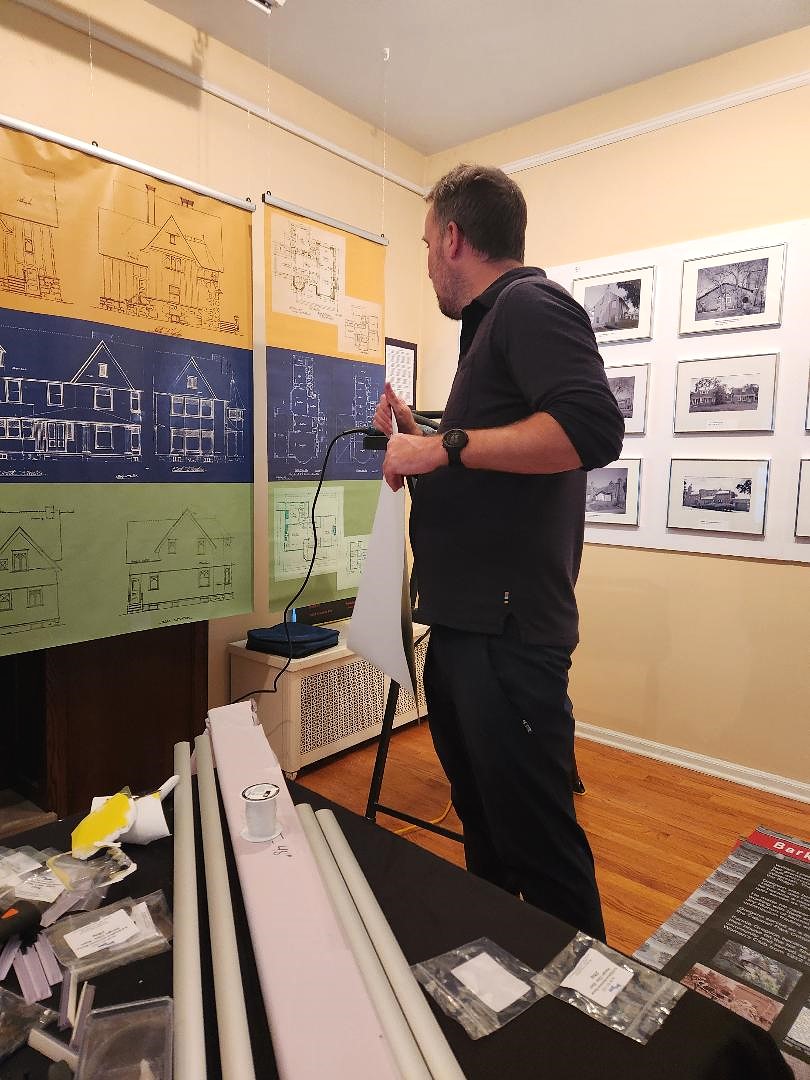
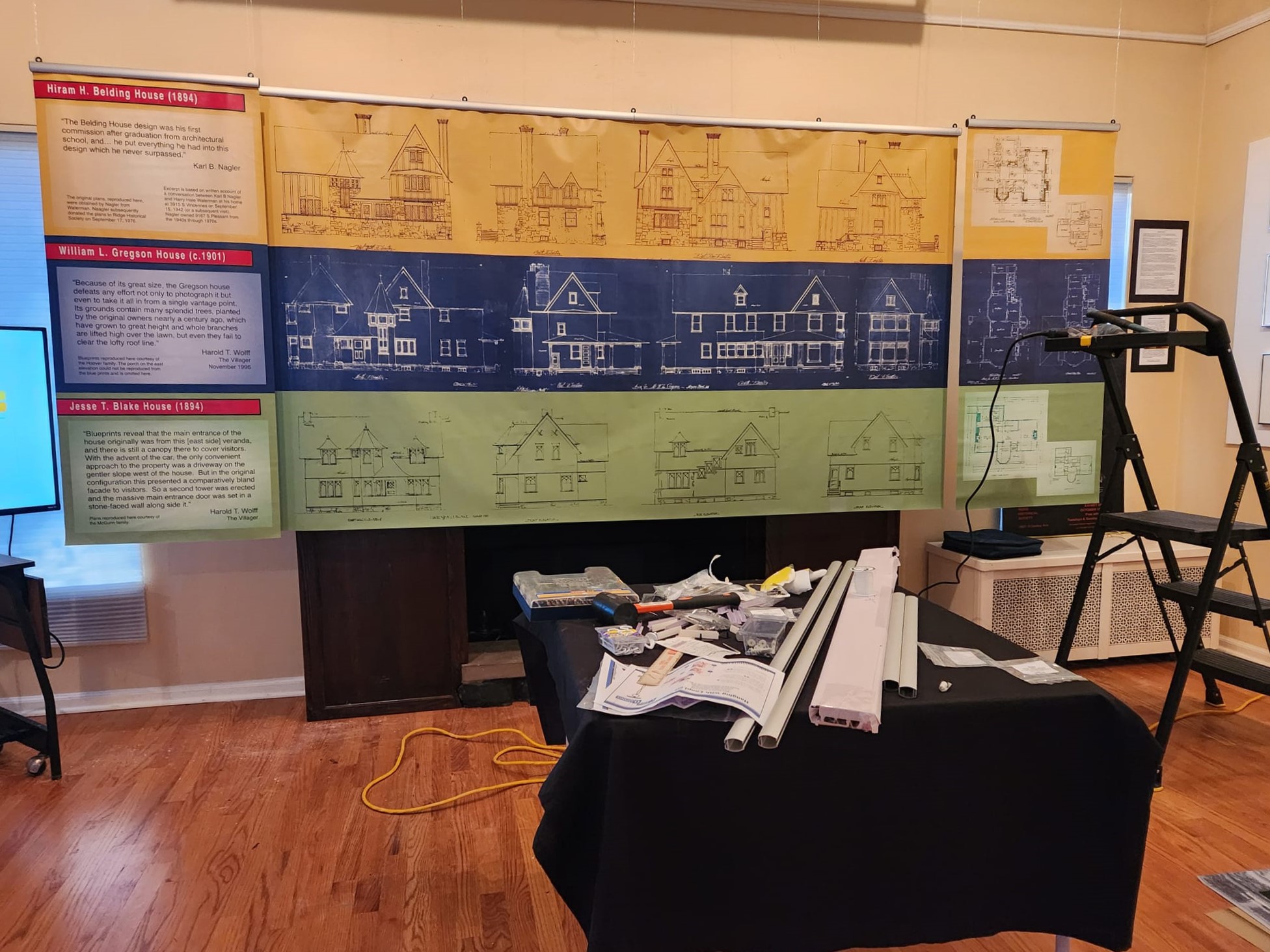
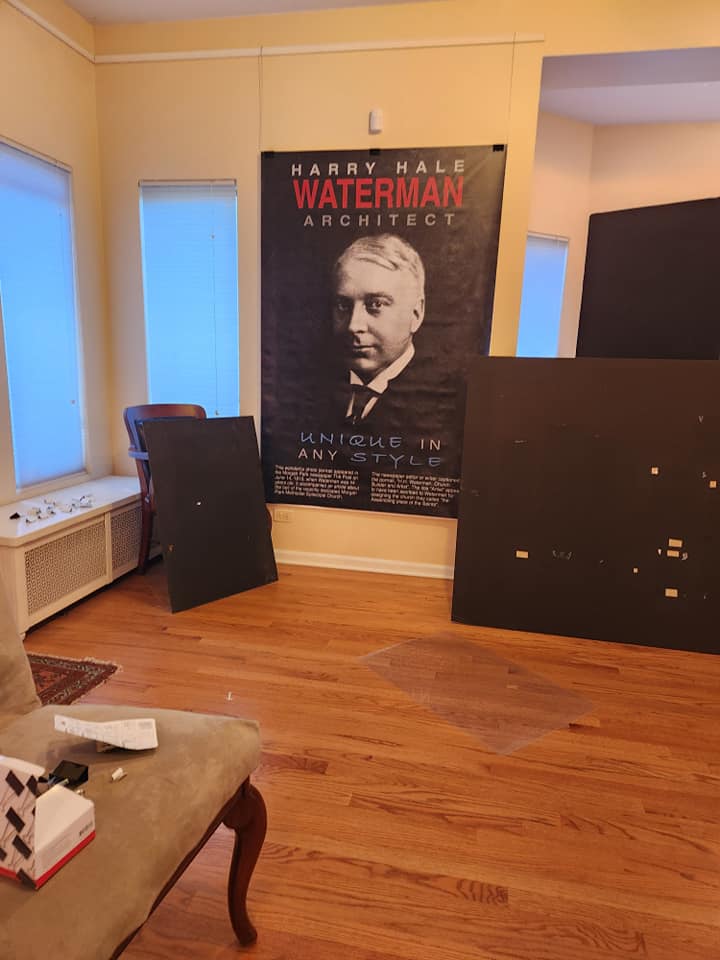
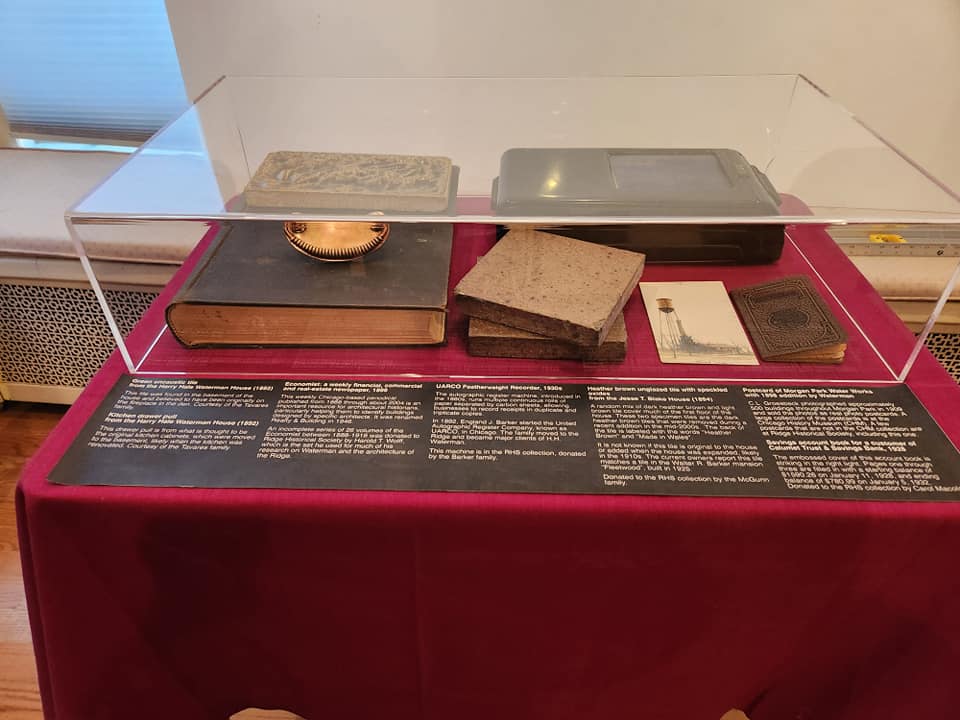
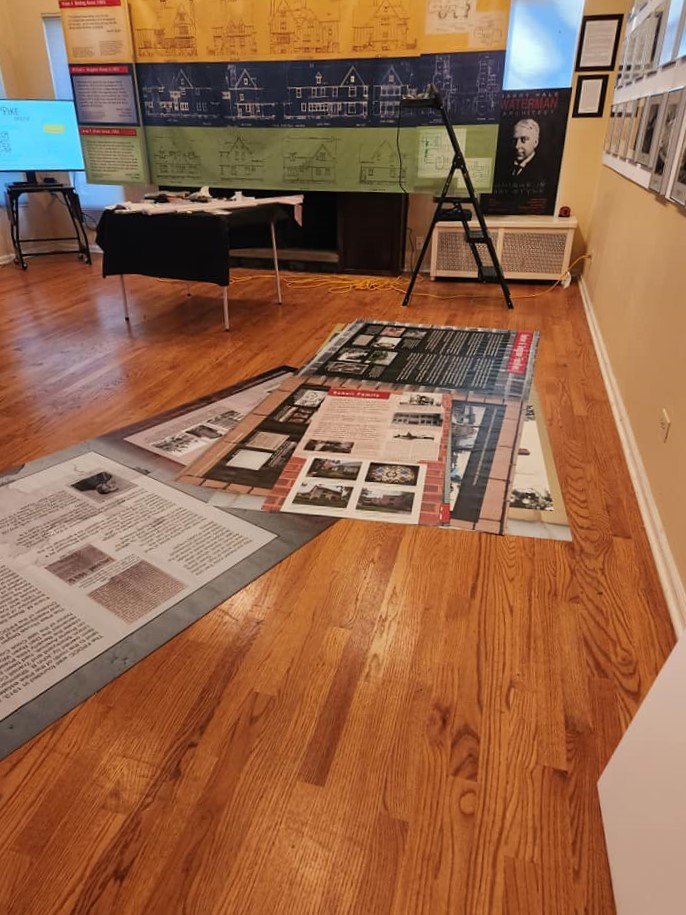
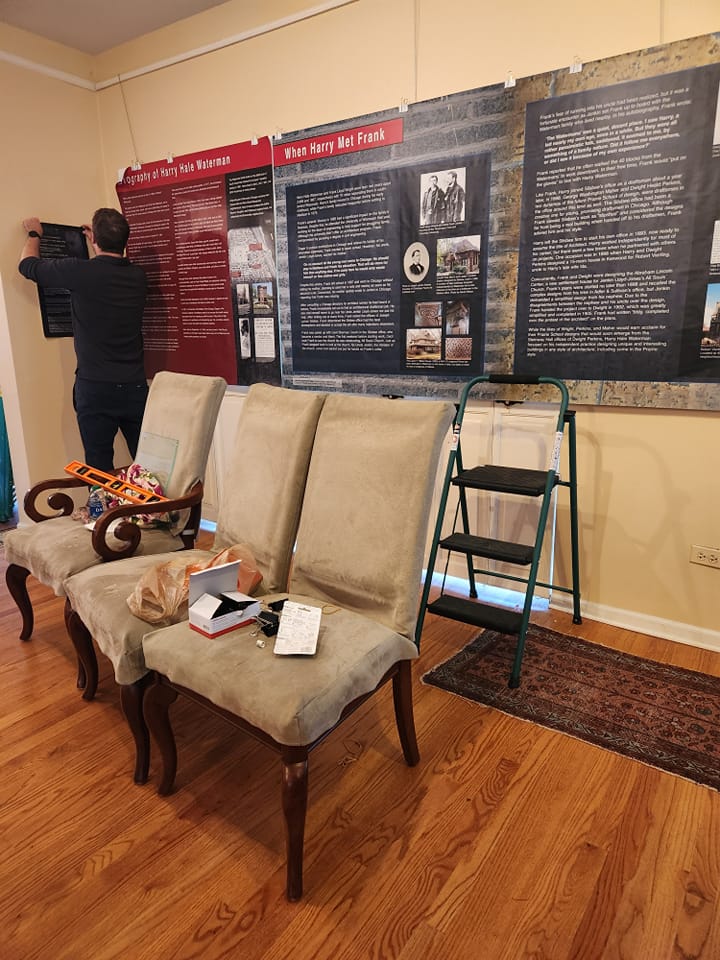
Exhibits don't happen by magic – it takes time, effort, brainpower, and physical work to put them together.
Here's RHS Board member and Curator of the new RHS exhibit "Harry Hale Waterman, Architect: Unique in Any Style," Tim Blackburn, at work today installing the exhibit to premier at Open House Chicago this week-end, October 19 – 20.
RHS will be open both days from 10 a.m. to 5 p.m. Address: 10621 S. Seeley Avenue, Chicago. Free admission.
Photos by C. Flynn
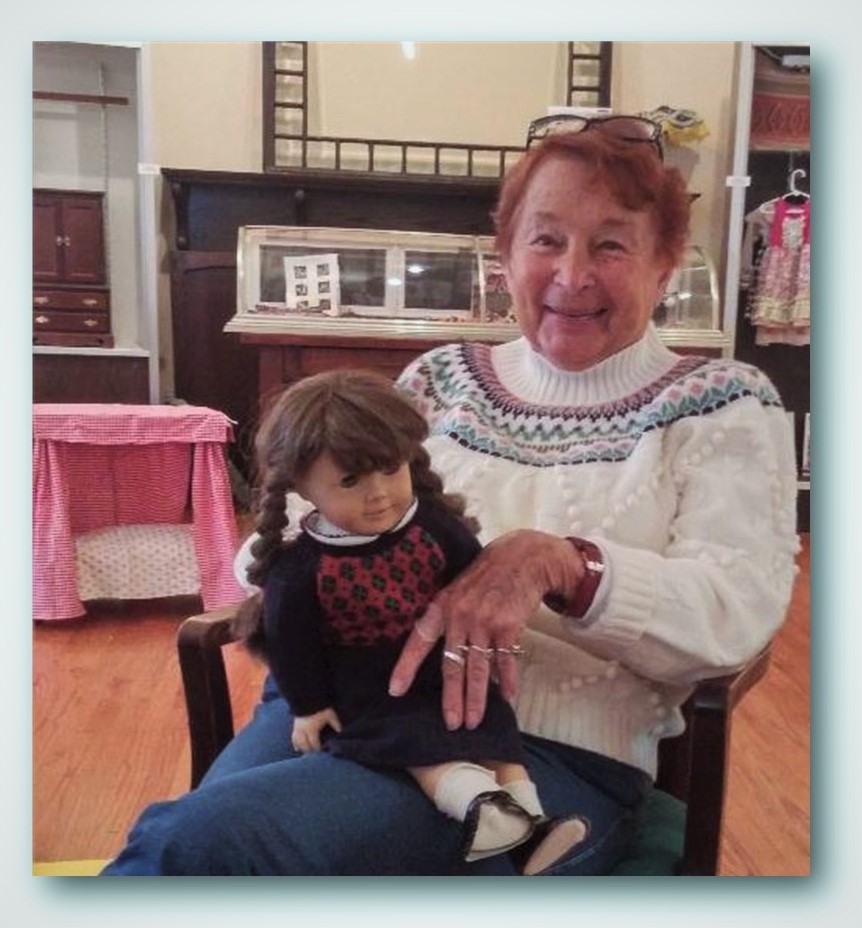
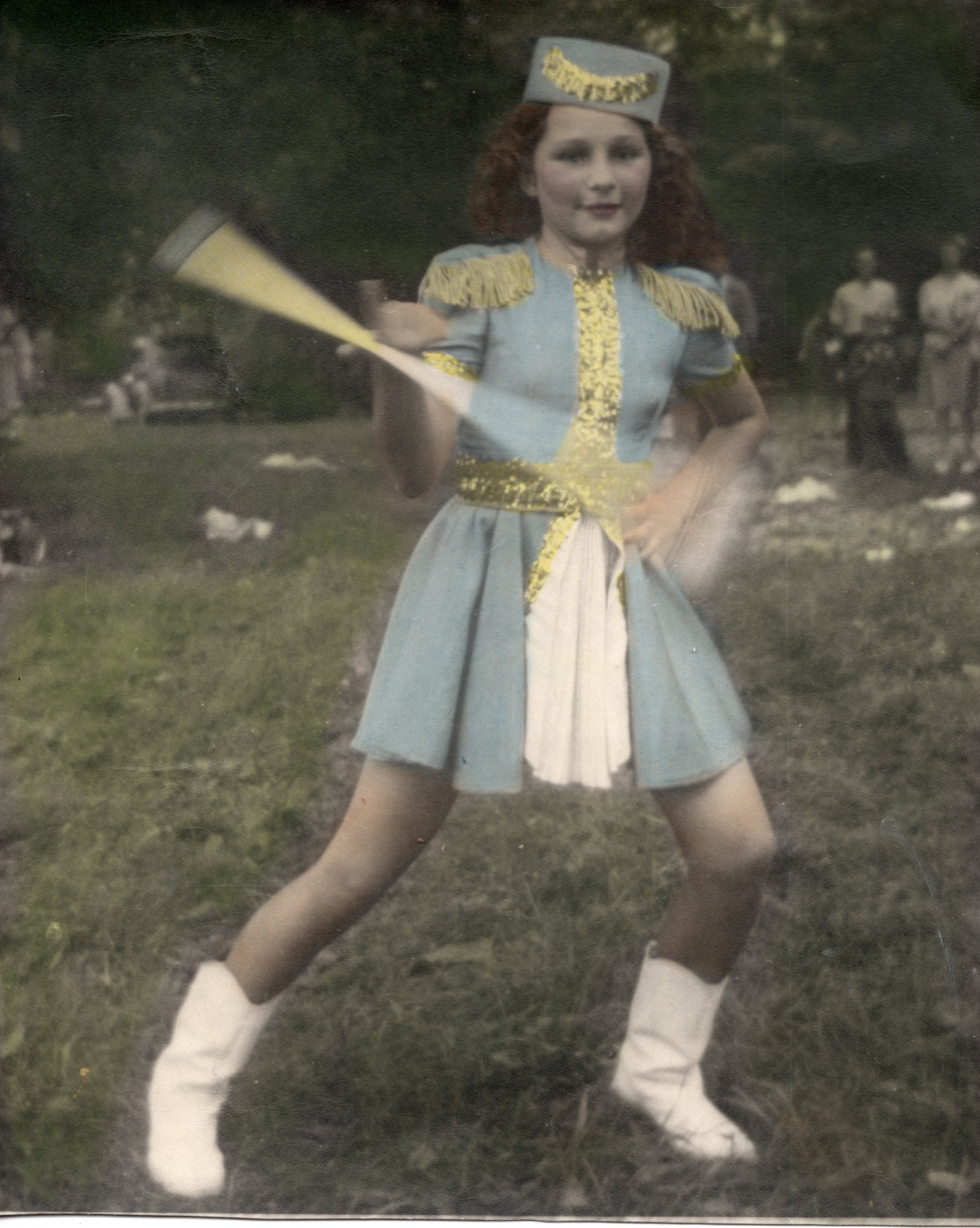
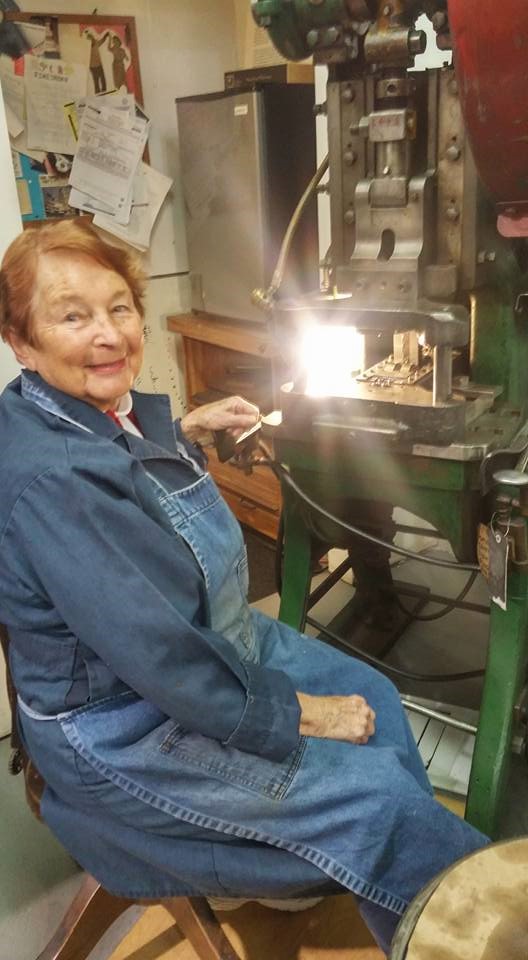
The Ridge Historical Society (RHS) is saddened to report the death of Elaine Spencer, RHS Board member and past RHS President.
Elaine had deep ties to the Ridge communities, having lived here for her 92 years of life, attending Barnard elementary school and Morgan Park High School, marrying (the late) Carl Spencer, and raising four sons here.
She was active in the Beverly Hills Junior Woman’s Club for many years, and loved performing on stage in their drama endeavors to raise money for nursing scholarships.
As RHS President, she supported restoring the RHS Facebook page to its original intent to increase communication and share more local history with the public. She led the society through the COVID pandemic. Elaine could always be counted on to volunteer her time to help at RHS events.
At 92, she was still taking trips around the world (most recently to the Panama Canal and Iceland) and spending time on the family’s island where she kayaked and painted docks and used an outhouse and outdoor shower. She was an avid book reader and a whiz at Scrabble.
Elaine had a favorite saying, “If you’ve made it this long, you’ve already won all the marbles.” She was a vibrant and alive person, and her presence will be missed.
Elaine Spencer’s story is the history of this community.