
Explore the RHS Facebook Archives, a rich repository of local history written by Carol Flynn. For two decades, Carol brought a deeply dedicated voice to public education at RHS. Her role as Facebook administrator through mid-2025 naturally extended her prolific research into meticulously detailed articles, most notably her multi-part historical series posts. Today, Carol continues her local history writing for The Beverly Review and other outlets.
2025
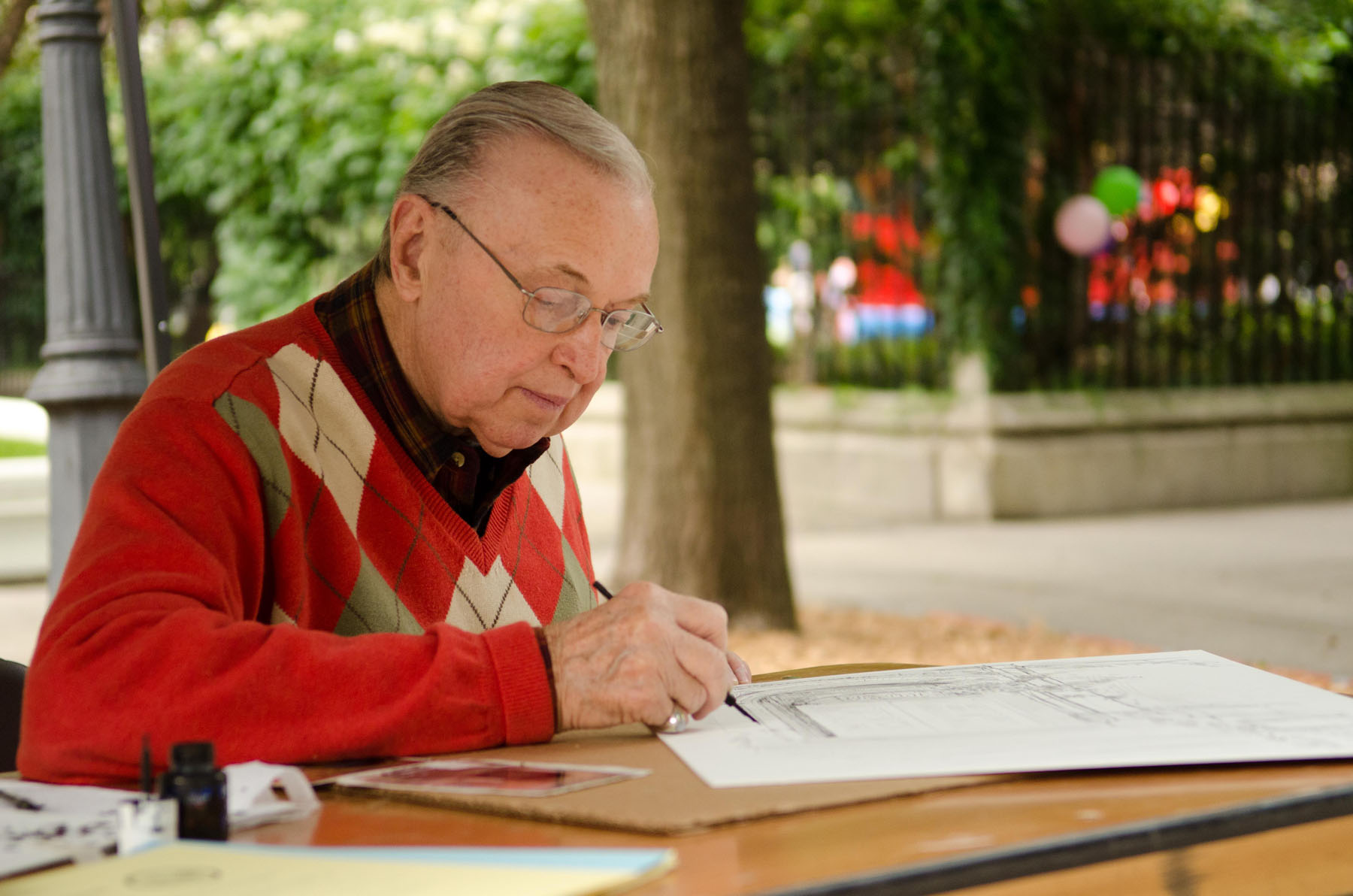
Today, we celebrate what would have been the 90th birthday of Jack Simmerling (1935–2013). A beloved artist, historian, and preservationist, Jack holds a special place in our history as a founding board member of the Ridge Historical Society in 1971.
From his start as a teenager preserving and documenting the vanishing grandeur of Victorian-era residences on Prairie Avenue to his long career capturing the architecture of Chicago through his art, Simmerling was nothing short of prolific. His paintings and drawings of his own neighborhood of Beverly Hills-Morgan Park continue to be a cherished visual identity of the community he loved.
Join us in celebrating Jack’s legacy. What is your favorite artwork or memory of Jack? Are you fortunate to have a Simmerling drawing or painting of your home? Did you take art classes from Jack? We’d love to hear some of your memories.
How well do you know Jack? Try these trivia questions:
1. In college at Notre Dame, Simmerling was known for his passion for Victorian-era design. As a result, a professor referred to him by what affectionate nickname?
Answer: "The last Victorian."
2. Which famous Chicago landmark did Simmerling document in a series of five paintings after his mother took him to see it being prepared for demolition in 1949, around the time of his 14th birthday?
Answer: The Potter Palmer Castle on the 1300 block of N. Lake Shore Drive. It was this visit that particularly piqued his interest in Chicago's vanishing Victorian-era architecture.
3. Jack once received criticism from a professor about his drawing of hands, which was likened to a bunch of what vegetable?
Answer: Carrots. After this, he focused on buildings and landscapes.
4. Where did Jack Simmerling first open The Heritage Gallery in January 1959?
Answer: 1973 W. 111th Street in Morgan Park. The gallery moved to 1913 W. 103rd Street in 1977 and 1907 W. 103rd Street in 2013. Today, Victoria Simmerling carries on the family legacy at the 1907 W. 103rd Street address.
5. What Morgan Park building did Simmerling restore in 1970 and rename "Heritage House," which was featured on the very first BAPA Home Tour in 1971?
Answer: His own home, the Ingersoll-Blackwelder house at 10910 S. Prospect Avenue. BAPA’s executive secretary at the time credited a large part of the success of the first home tour to the inclusion of the house, which had been rescued from demolition a year prior.
6. In 2001, Simmerling had two large sandstone bollards installed in front of the Ingersoll-Blackwelder house. From what Prairie Avenue mansion site did he recover them?
Answer: The site of the demolished Hanford House (2008 S. Calumet Avenue), which was destroyed by fire in 1953. The bollards were unearthed when the site was being redeveloped in 2001. Jack was fascinated by the "cursed" history of the Hanford House. You can view items he salvaged following the fire in the current exhibit at Ridge Historical Society.
7. Jack Simmerling was known for his love of music and owned a collection of nearly a dozen of what type of instrument?
Answer: Pianos. Inspired by his mother (a church organist at Sacred Heart Mission Church) and his grandmother (a silent movie pianist), he was passionate about music perhaps even more than art and architecture.
8. Jack was forced to switch his primary painting medium from oil to which other medium due to a skin allergy?
Answer: Watercolors. He increasingly worked in pen-and-ink as well.
9. Simmerling frequently included two specific details in his watercolors because the colors and light “beguiled” him. What were they?
Answer: Snow and puddles.
—-
If you haven't visited yet, now is the perfect time to experience "Jack Simmerling: Through His Eyes."
Produced in partnership with Glessner House, this exhibit traces Jack's artistic evolution and preservation efforts from his teenage years through his long career. The collection features rare artifacts, including the Hanford House items mentioned above, plus many artworks and artifacts from the Glessner House Jack Simmerling Collection.
Exhibit on view through February 2026 at Ridge Historical Society, 10621 S. Seeley Ave. Open Tuesdays and Sundays from 1 PM – 4 PM, or by appointment.