
Explore the RHS Facebook Archives, a rich repository of local history written by Carol Flynn. For two decades, Carol brought a deeply dedicated voice to public education at RHS. Her role as Facebook administrator through mid-2025 naturally extended her prolific research into meticulously detailed articles, most notably her multi-part historical series posts. Today, Carol continues her local history writing for The Beverly Review and other outlets.
Local History
The Ridge Historical Society
Bessie Sutherland
By Carol Flynn
Happy Belated Birthday to Bessie Sutherland, the namesake of the Elizabeth H. Sutherland Elementary School at 10015 S. Leavitt Street in Beverly, Chicago.
Bessie was born as Elizabeth Bingle Huntington in Blue Island on September 27, 1851. Her father, Samuel D. Huntington, farmed and raised livestock, was involved in the railroads, and was Constable and Sheriff for a number of years.
Her mother, Maria Robinson Huntington, was possibly the first schoolteacher on the Ridge. In 1842, at the age of 14, Maria was making $1 per week to teach school. No record of any school earlier than that has been found.
Bessie graduated from the Cook County Normal School in 1869. “Normal” schools trained teachers in the “norms” of education standards of the day. That school evolved into Chicago State University.
She taught in Blue Island, Hyde Park, and Washington Heights. She took additional coursework at the University of Chicago. Along the way, she moved north on the Ridge to 107th Street and Prospect Avenue.
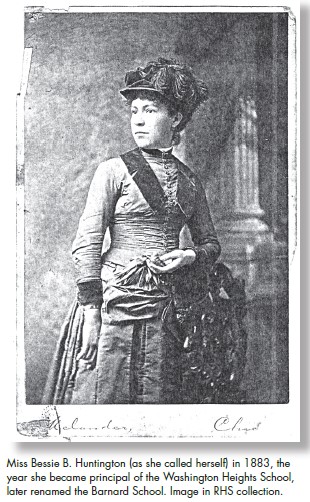
In 1883, she was named Principal of the Washington Heights School. This was before Washington Heights was annexed to the City of Chicago in 1890. She was the first woman to be named principal of a Cook County school. The school was renamed the Alice L. Barnard School in the 1890s in honor of another pioneering Ridge educator. Alice was the one of the first women to be named a principal of a Chicago public school.
Bessie was a Progressive Era educator and a suffragist. That period was marked by great reforms in all areas. Education saw a major shift from learning by lecture and memorization to learning by doing and experimentation.
One example of Bessie as an educator illustrated the new thinking. When she learned that a camel had escaped from a traveling show and was roaming freely in the local woods, she rounded up the entire school body and took them on an impromptu field trip to observe the animal in a natural setting.
Back then, women teachers were not allowed to marry and keep their jobs. Bessie put off marriage to her “intended,” David Sutherland, until her 43rd birthday in 1894. David, seventeen years her senior, was in real estate with considerable holdings on the south and west sides of Chicago.
David died in 1904, and Bessie continued with Barnard School until she retired in 1923. She died in 1924 and was buried in Mount Greenwood Cemetery. In 1925, the new school built at 100th and Leavitt Streets was named in Bessie’s honor.
RHS Historian Linda Lamberty is related to Bessie Sutherland. In 1974, a 96-year-old mutual cousin of Linda’s and Bessie’s told Linda that Bessie was “a truly wonderful person.” This cousin had known Bessie personally. According to Linda, Bessie was “one of the rare stalwart women” who forged paths for other women.
The current exhibit at the Ridge Historical Society (RHS) offers glimpses into how the Beverly Hills and Morgan Park neighborhoods appeared over 100 years ago, through the watercolor paintings of artist Louise Barwick and other media.
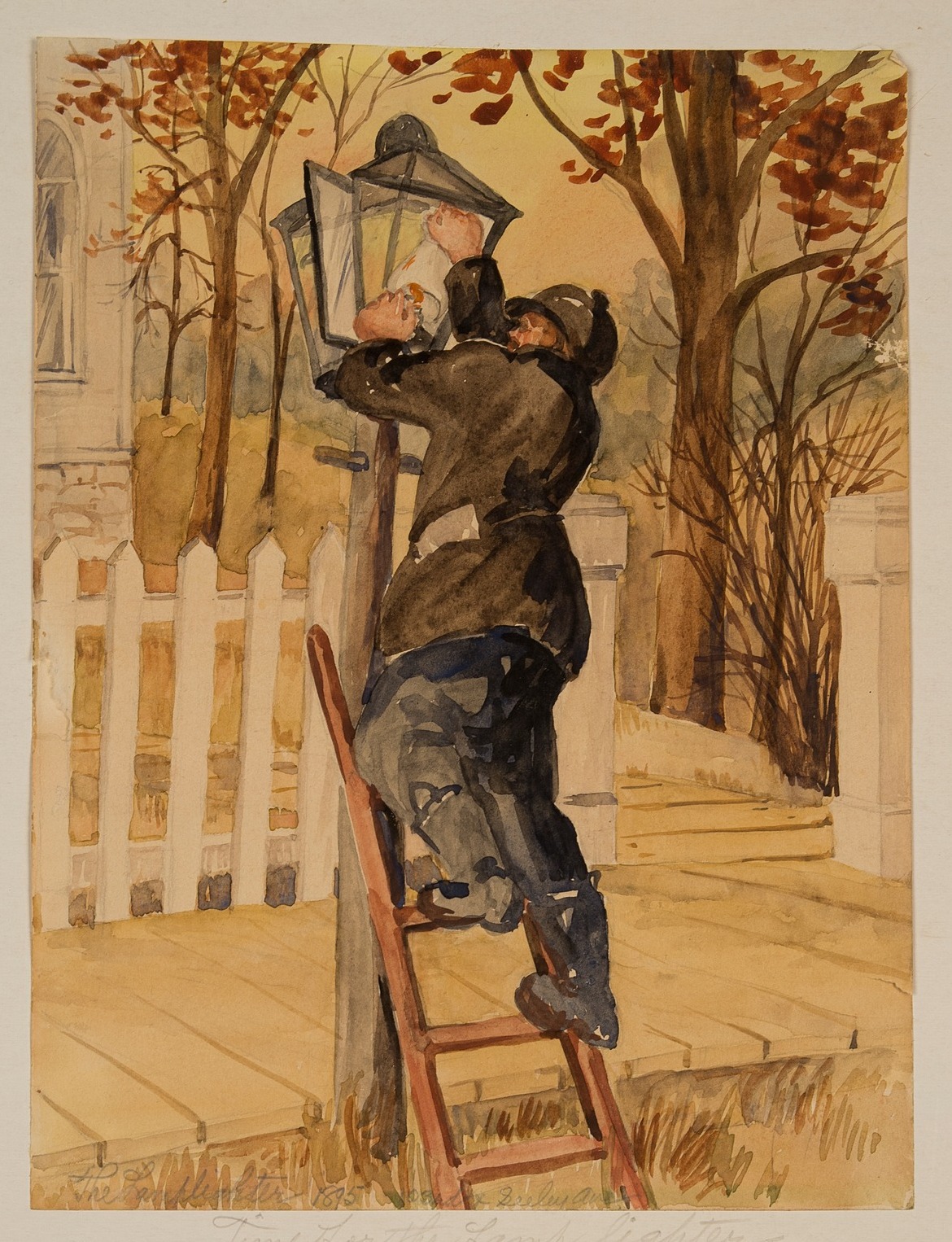
Today the street lights come on automatically thanks to electrical wiring, but just envision how once the lamplighter rode his bicycle around the neighborhood, lighting the gas lamps by hand.
This painting is “Lamplighter” painted in 1895.
The scene occurred on Belmont Avenue (now Seeley) south of 103rd Street. The partial view is of the house at 10330 Seeley, where the Barwick family lived.
The caption for the painting: The lamp lighter rode on his bicycle, carrying his short ladder and the gaslight taper.
Here are a few comments on the current Ridge Historical Society exhibit, “Louise Barwick’s Lost Ridge”:
Linda Lamberty, RHS Historian and Exhibit Co-Curator:
“It’s a visual experience …. I’m hoping people will sit with their coffee in the morning, looking out on their yards, and try to picture it the way it once was – and the way it was so loved by people in the community. We LOVE this neighborhood today, but 100+ years ago our predecessors loved a vastly different landscape just as much. This place is just uniquely special and has always been cherished.”
M.M., college educator, exhibit visitor:
“I have enjoyed lingering & lingering over the panels from the Louise Barwick exhibit; I can't stop gazing at them & rereading them, over & over.
“The relationship between the text and the images that the viewer's imagination feels enraptured by, is really an education unto itself. I love the experience of flowing back and forth, between the words and the visuals. It triggers the exhilaration of REAL learning."
“Louise Barwick’s Lost Ridge” is open to the public on Tuesday and Sunday afternoons from 1:00 to 4:00 p.m. or by appointment (call 773/881-1675 or email ridgehistory@hotmail.com). Admission is free. RHS is located at 10621 S. Seeley Avenue in Chicago.
Tomorrow is clean-up day at the PIKE HOUSE!
Details are in the attached Patch article. Thank you, Patch and editor Lorraine Swanson for the coverage!
https://patch.com/illinois/beverly-mtgreenwood/volunteers-needed-fall-clean-saturday-eugene-s-pike-house?utm_term=article-slot-1&utm_source=newsletter-daily&utm_medium=email&utm_campaign=newsletter&user_email=746a8077f303b55eeca8959339fdbbedc6c3a0a6819429e815ae3ffc647bc238
The Ridge Historical Society is open today, Tuesday, December 12, from 1:00 p.m. to 4:00 p.m., and people may stop by to see the current exhibit “Louise Barwick’s Lost Ridge” for free.
This exhibit gives fascinating glimpses into how the community appeared around 1900, through the watercolor paintings of Miss Barwick, an educator and artist.
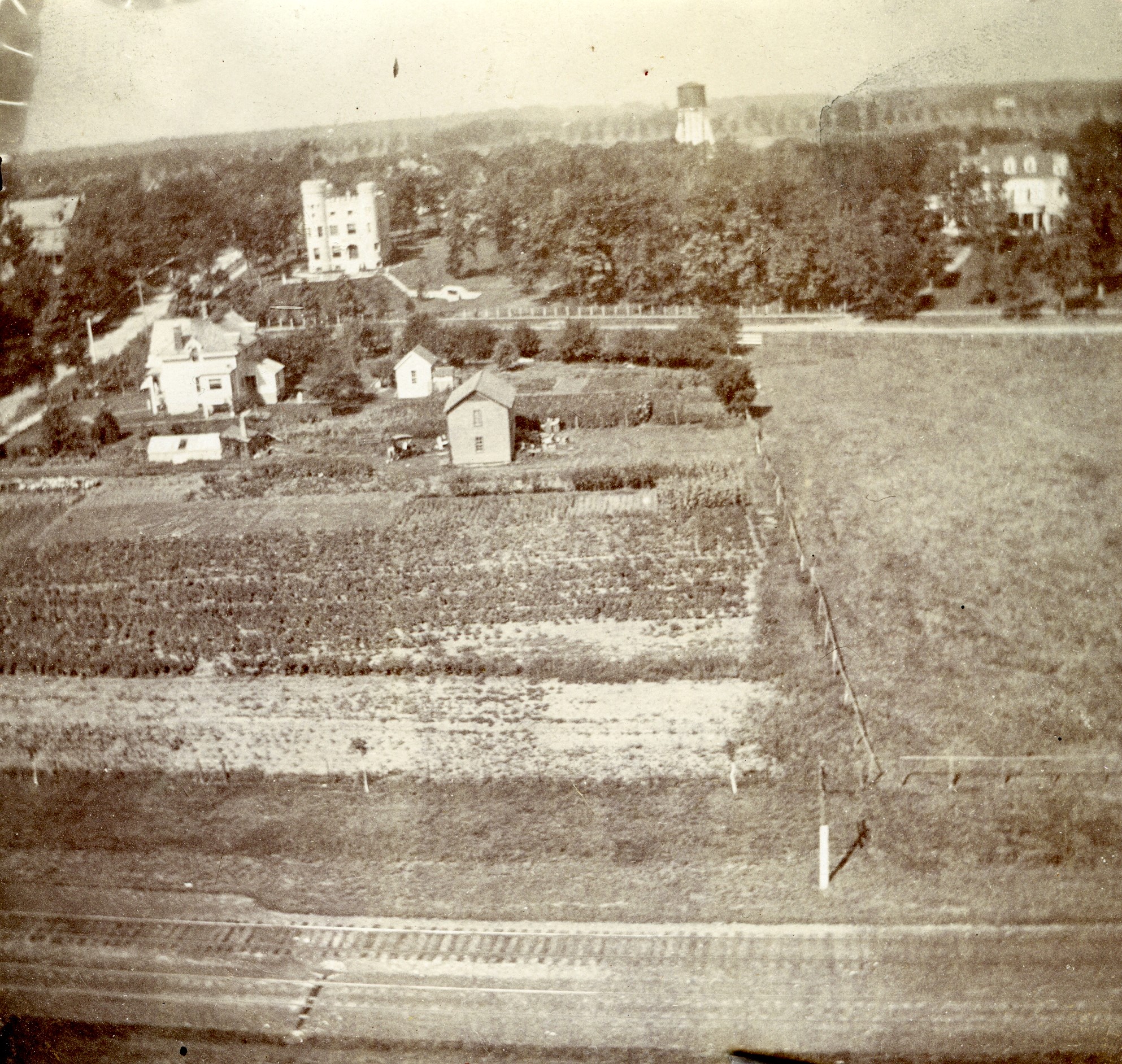
Also included in the exhibit is aerial photography of the Ridge taken from a camera attached to a kite from the same time period.
This is one of the iconic aerial shots.
Do you recognize the location?
Tomorrow’s post will describe in detail what is viewed here.
If you can’t wait that long, go over to RHS today. RHS is located at 10621 S. Seeley Avenue, Chicago.
Robert Heffron Murray, Kite and Aerial Photography Experiments, 1899
The Ridge Historical Society
The New Year Approaches One Hundred Years Ago
By Carol Flynn
Prohibition was in full swing in 1923, having begun with the Eighteenth Amendment to the U.S. Constitution in 1920, as New Year’s Eve approached one hundred years ago.
Federal law prohibited the production, importation, transportation, and sale of alcoholic beverages, but private ownership and consumption of alcohol were not illegal under federal law, and some uses, for example, religious use of wine, were permitted.
Within a week after Prohibition began, illegal production and bootlegging, the smuggling of alcoholic beverages, also began. In the larger cities, such as Chicago, rival crime syndicates fought for control of the illegal alcohol markets.
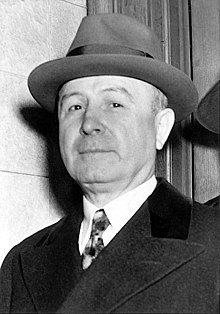
John Torrio rose to the top in Chicago organized crime. Historically, he is considered “unsurpassed in the annals of American crime; he was probably the nearest thing to a real mastermind that this country produced,” according to author and historian Hal Asbury.
In 1909, Torrio was invited to Chicago from New York by “Big Jim” Colosimo to help eliminate extortionists, which Torrio quite ably accomplished. He stayed in Chicago to help manage Colosimo’s 100+ brothels. In 1919, Torrio brought a young man named Al Capone from New York to Chicago to join their operation.
When Prohibition started, Torrio encouraged Colosimo to go into the bootlegging business, but Colosimo refused. Colosimo was gunned down at his restaurant in 1920 and Torrio, with Capone’s assistance, took over as Chicago’s organized crime boss. They soon became the leaders of the illegal alcohol operations in the city and suburbs.
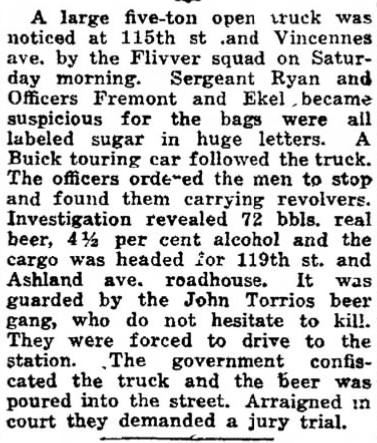
This story appeared in the Englewood Times on December 28, 1923.
A truck carrying a substantial amount of illegal beer was stopped at 115th Street and Vincennes Ave. It was reported to be under the protection of John Torrio’s “beer gang.” The members of the beer gang were not identified, but there was always the possibility that a young Al Capone was there that day.
The truck was on its’ way to a roadhouse at 119th Street and Ashland Ave., no doubt delivering supplies for New Year’s Eve celebrations.
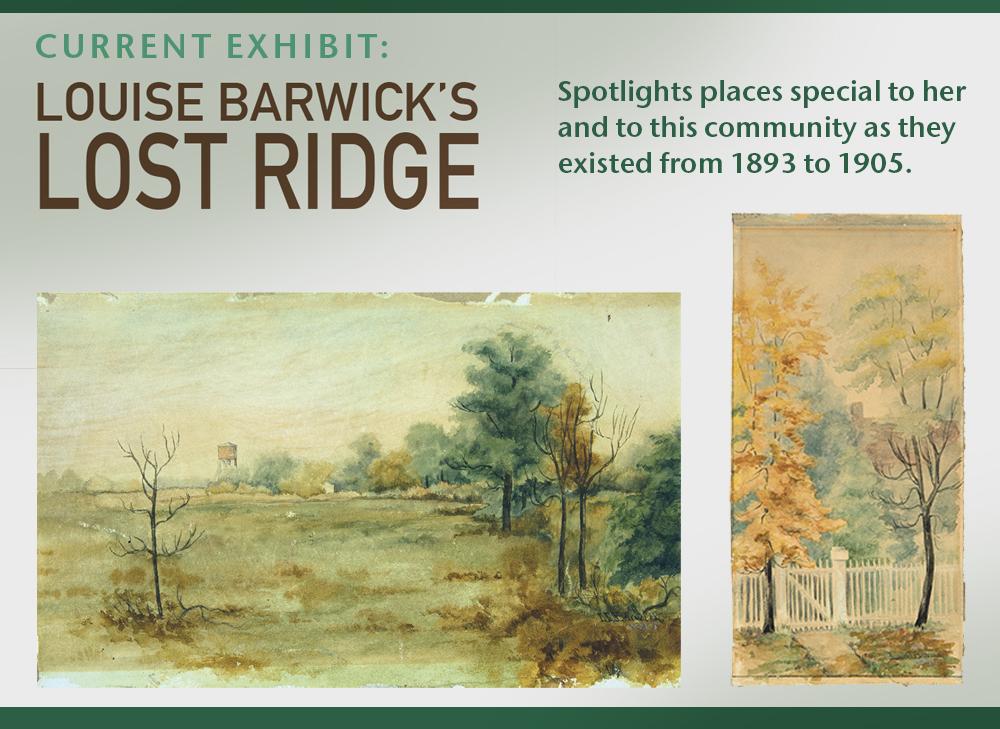
The Ridge Historical Society will be open today, Tuesday, January 2, 2024, for visitors to view the current exhibit, "Louise Barwick's Lost Ridge."
This exhibit emphasizes the visual and needs to be seen in person to be appreciated. Images of the Ridge from the late 1800s – early 1900s are captured through various media of the time, including watercolor paintings and aerial photography, creating a unique historical record of the actual appearance of the area around 103rd Street and Longwood Drive in days gone by.
RHS is located at 10621 S. Seeley Avenue, the hours are 1:00 p.m. to 4:00 p.m., and admission is free. There is some limited parking at the building, or on Seeley Avenue. The building is not handicapped accessible.
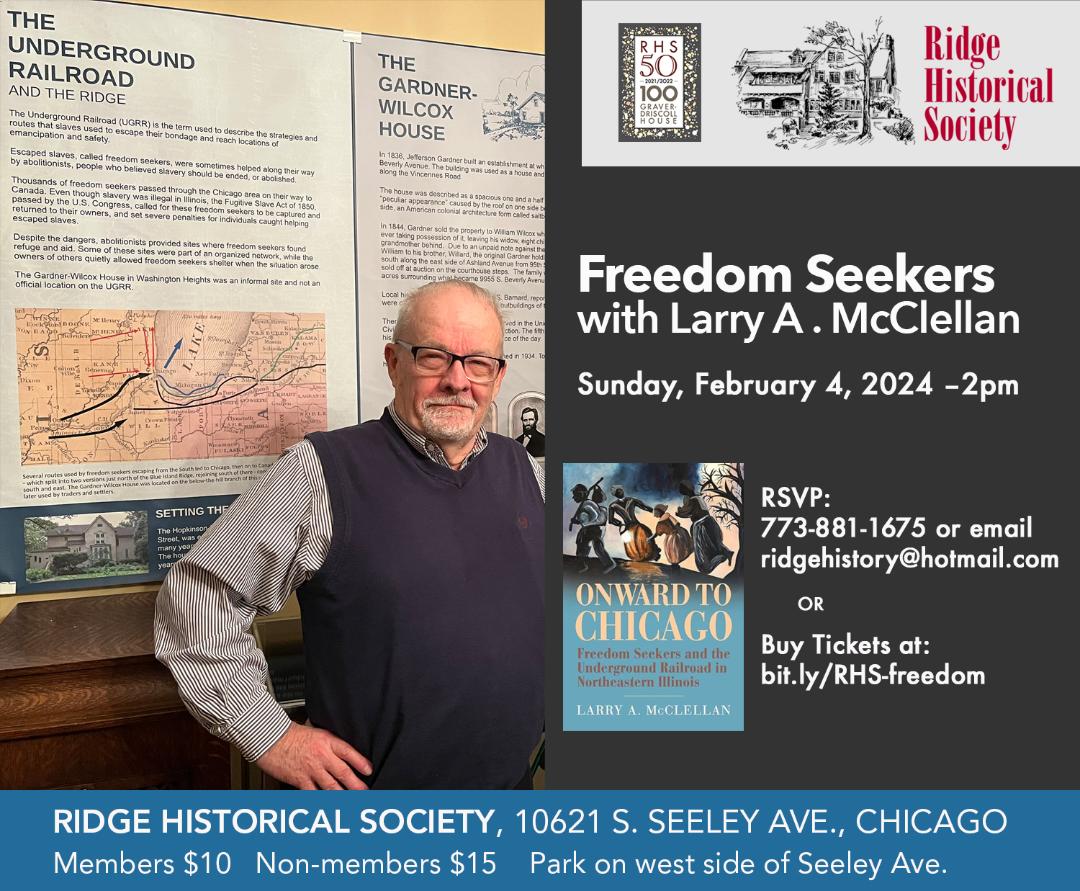
Freedom Seekers with Larry A. McClellan
Black History Month Program Focus is the Underground Railroad in Northeastern Illinois
Larry A. McClellan, emeritus professor of sociology and community studies at Governors State University, will present a program on his book, “Onward to Chicago,” which uncovers stories of the Underground Railroad freedom network in northeastern Illinois, Sun., Feb. 4, 2 p.m., Ridge Historical Society, 10621 S. Seeley Ave.
McClellan will share his work and personal experiences in developing a deeper, broader insight into the freedom seekers and their impact on local history.
“Onward to Chicago” was published by Southern Illinois University Press and released last summer. According to the press website, Illinois’s status as a free state beckoned enslaved people decades before the Civil War, and traditional histories of the Underground Railroad in Illinois start in 1839.
Larry A. McClellan reframes the story, not only introducing readers to earlier freedom seekers, but also illustrating that those who bravely aided them were Black and white, men and women. McClellan features dozens of individuals who made dangerous journeys to reach freedom as well as residents in Chicago and across northeastern Illinois who made a deliberate choice to break the law to help.
“Onward to Chicago” shows how Chicago emerged as a point of refuge for freedom seekers, and how the I & M Canal created opportunities for Black men, women, and children to escape slavery. “From eluding authorities to confronting kidnapping bands working out of St. Louis and southern Illinois, these stories of valor are inherently personal. Through deep research into local sources, McClellan presents the engrossing, entwined journeys of freedom seekers and the activists in Chicagoland who supported them,” the website says.
McClellan’s book won the 2023 Underground Railroad Free Press Hortense Simmons Memorial Prize for Advancement of Knowledge.
McClellan has been instrumental in adding listings to the National Park Service Network to Freedom register of the Underground Railroad, and is President of the Little Calumet Underground Railroad Project. He is the author of “The Underground Railroad South of Chicago” and “To the River: The Remarkable Journey of Caroline Quarlls, a Freedom Seeker on the Underground Railroad.”
McClellan will have his book, “Onward to Chicago” available for purchase at the event.
Admission to the presentation is $10 for members and $15 for non-members. Space is limited and tickets or reservations are required. Info and RSVP at: 773-881-1675 or ridgehistory@hotmail.com. Get tickets at bit.ly/RHS-freedom.
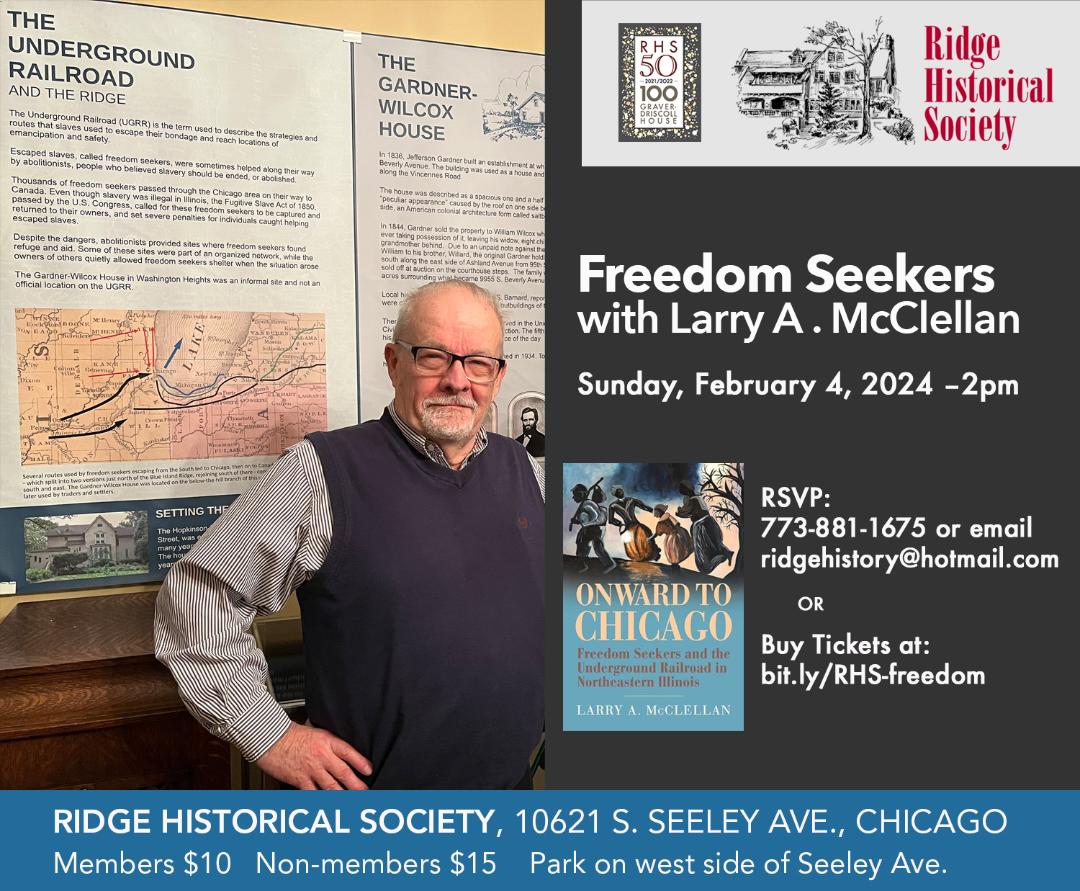
Freedom Seekers with Larry A. McClellan
Black History Month Program Focus is the Underground Railroad in Northeastern Illinois
Larry A. McClellan, emeritus professor of sociology and community studies at Governors State University, will present a program on his book, “Onward to Chicago,” which uncovers stories of the Underground Railroad freedom network in northeastern Illinois, Sun., Feb. 4, 2 p.m., Ridge Historical Society, 10621 S. Seeley Ave.
McClellan will share his work and personal experiences in developing a deeper, broader insight into the freedom seekers and their impact on local history.
“Onward to Chicago” was published by Southern Illinois University Press and released last summer. According to the press website, Illinois’s status as a free state beckoned enslaved people decades before the Civil War, and traditional histories of the Underground Railroad in Illinois start in 1839.
Larry A. McClellan reframes the story, not only introducing readers to earlier freedom seekers, but also illustrating that those who bravely aided them were Black and white, men and women. McClellan features dozens of individuals who made dangerous journeys to reach freedom as well as residents in Chicago and across northeastern Illinois who made a deliberate choice to break the law to help.
“Onward to Chicago” shows how Chicago emerged as a point of refuge for freedom seekers, and how the I & M Canal created opportunities for Black men, women, and children to escape slavery. “From eluding authorities to confronting kidnapping bands working out of St. Louis and southern Illinois, these stories of valor are inherently personal. Through deep research into local sources, McClellan presents the engrossing, entwined journeys of freedom seekers and the activists in Chicagoland who supported them,” the website says.
McClellan’s book won the 2023 Underground Railroad Free Press Hortense Simmons Memorial Prize for Advancement of Knowledge.
McClellan has been instrumental in adding listings to the National Park Service Network to Freedom register of the Underground Railroad, and is President of the Little Calumet Underground Railroad Project. He is the author of “The Underground Railroad South of Chicago” and “To the River: The Remarkable Journey of Caroline Quarlls, a Freedom Seeker on the Underground Railroad.”
McClellan will have his book, “Onward to Chicago” available for purchase at the event.
Admission to the presentation is $10 for members and $15 for non-members. Space is limited and tickets or reservations are required. Info and RSVP at: 773-881-1675 or ridgehistory@hotmail.com. Get tickets at bit.ly/RHS-freedom.
The Ridge Historical Society
The Parade and the Weather
By Carol Flynn
“Don't bring around a cloud to rain on my parade” is a memorable line from a song in the musical “Funny Girl.”
While in the song the line is a metaphor about not interfering in another person’s life, it is a reminder that the weather always plays a part in any outdoor event like a parade.
Springtime weather in Chicago is especially unpredictable and changeable, and St. Patrick’s Day parade plans always factor in the weather. Uncooperative weather doesn’t mean the parade will be canceled; in fact, that would be a very unlikely occurrence. It just means some adjustments may have to be made.
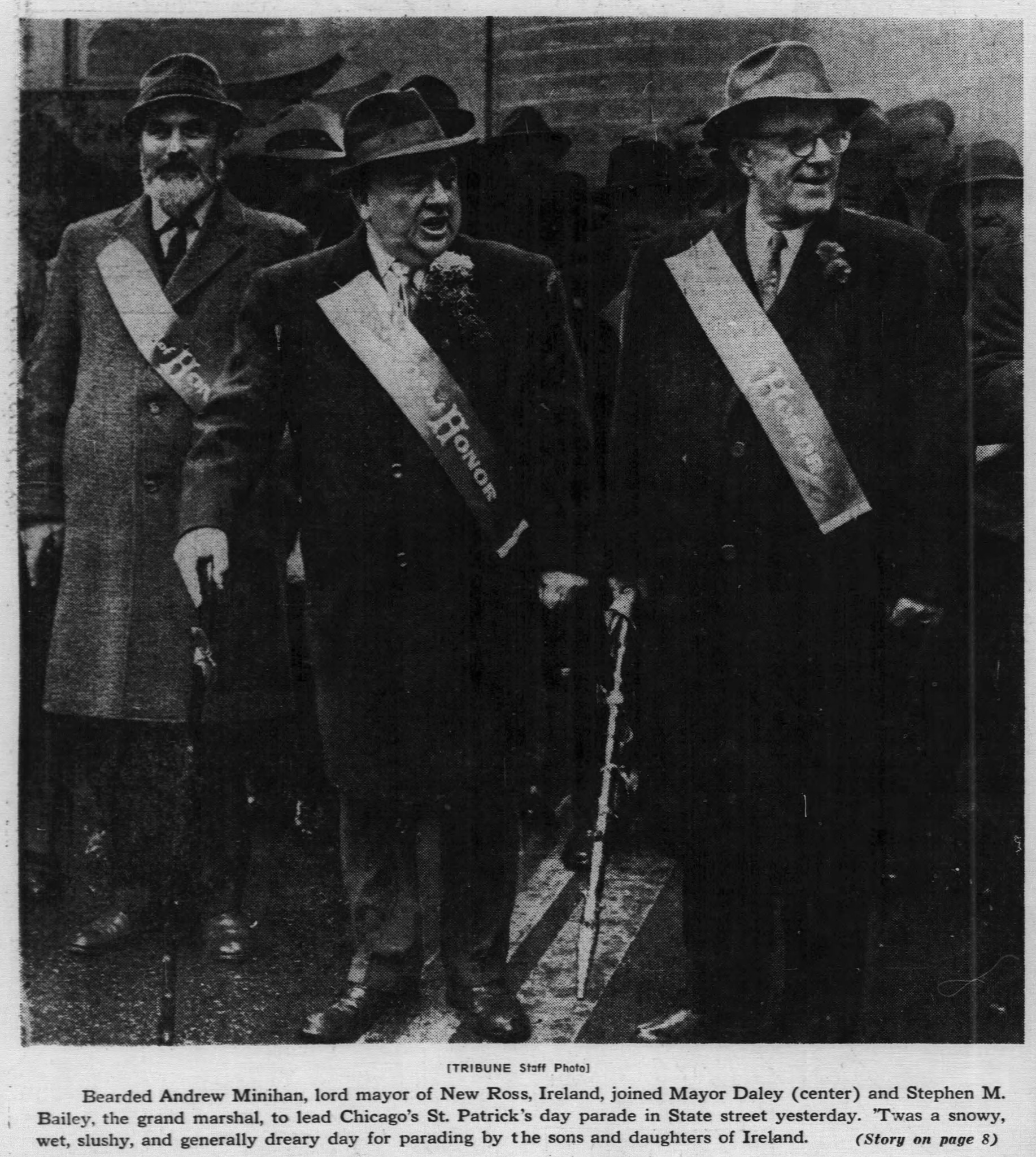
The most rain that ever fell on St. Patrick’s Day when a parade was held downtown was recorded as 1.42 inches in 1965. The Chicago Tribune described the precipitation that Wednesday as a mixture of snow, sleet, and freezing rain.
City crews worked from the early morning on to clear the parade route, and despite gusts of wind up to 52 miles per hour, the parade went on as scheduled.
Thousands of people lined State Street to watch. Entries in the parade included 60 floats and 41 marching bands.
The mayor of New Ross, Wexford, Ireland, a guest of Chicago’s Mayor Richard J. Daley, recorded the entire parade with his “motion picture camera.”
Other extreme weather days for parades when they were held right on March 17th include coldest and hottest.
The coldest St. Patrick’s Day on record in Chicago occurred on a Saturday in 1900, when the overnight temperature was one degree below zero. The newspapers reported the parade took place with a daytime temperature of sixteen degrees in blinding whirlwinds of snow and biting wind blasts. The streets were slippery frozen mud.
Despite the weather, or maybe partly due to it, enthusiasm was high on parade day. More than 3,000 people marched or rode in the parade, and many more lined the streets and cheered them on.
Irish and American flags and organization banners whipped wildly in the wind and musicians played with numb fingers. An Irish jaunting car, a special feature of the parade, “bounced and pitched and rolled and slid” through the frozen mud but made it to the parade’s end.
The parade lasted for two hours in that freezing cold.
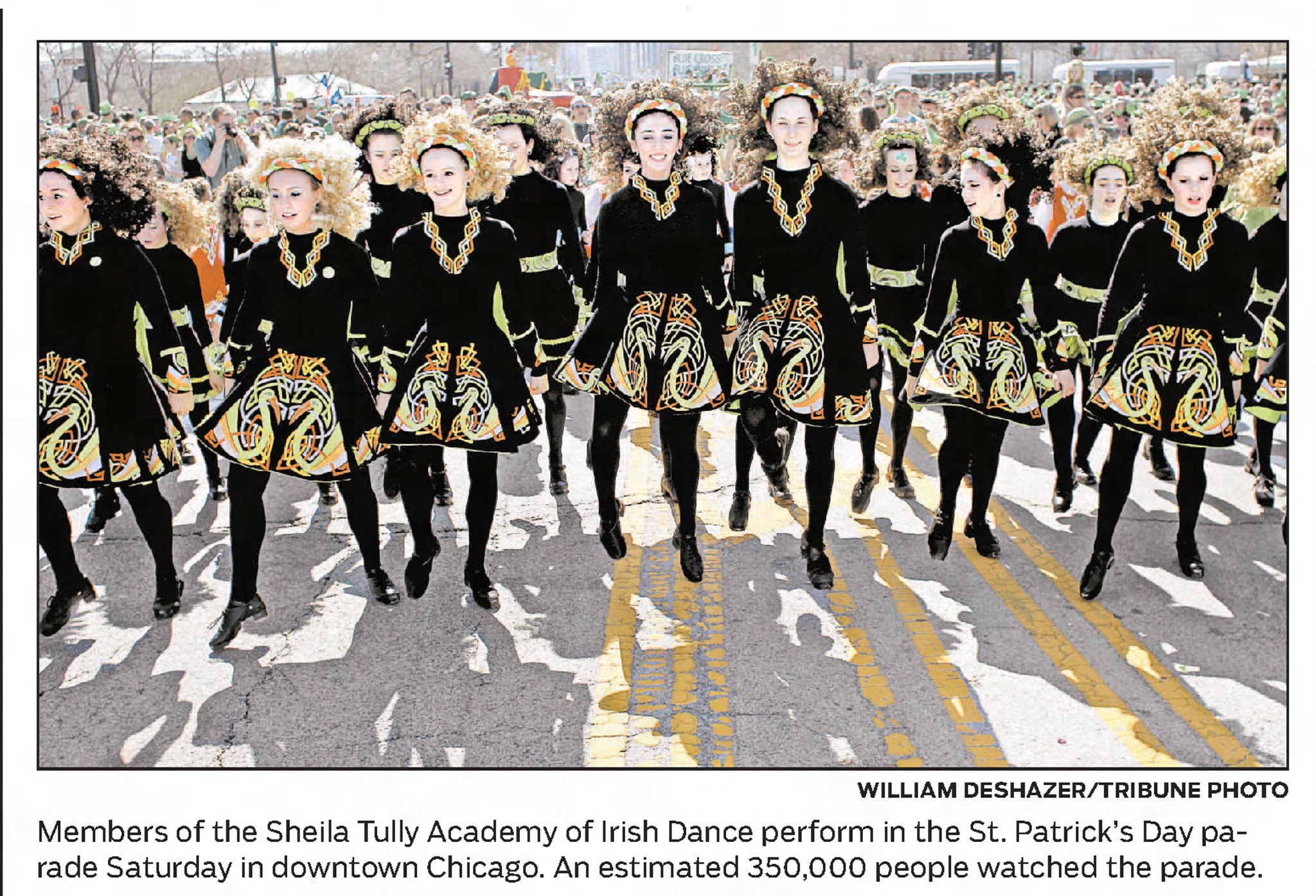
The record high temperature for St. Patrick’s Day was 82 degrees in 2012.
Over 350,000 parade goers that day enjoyed the warm weather so much, reported the Tribune, that two men jumped into the Chicago River, which was dyed green for the day per custom. After they were fished out, one ran away and the other was ticketed by the police.
A visitor from Georgia lamented there was no snow; she was hoping to experience some Chicago winter weather. Chicagoans were not sorry to disappoint her. If she had been here 112 years earlier, she could have experienced the worst there was to have.
This year, the weather for St. Patrick’s Day and the South Side Irish Parade is expected to be 40 degrees with no rain, which actually fits right into the norm for this time of year.
Happy St. Patrick's Day!
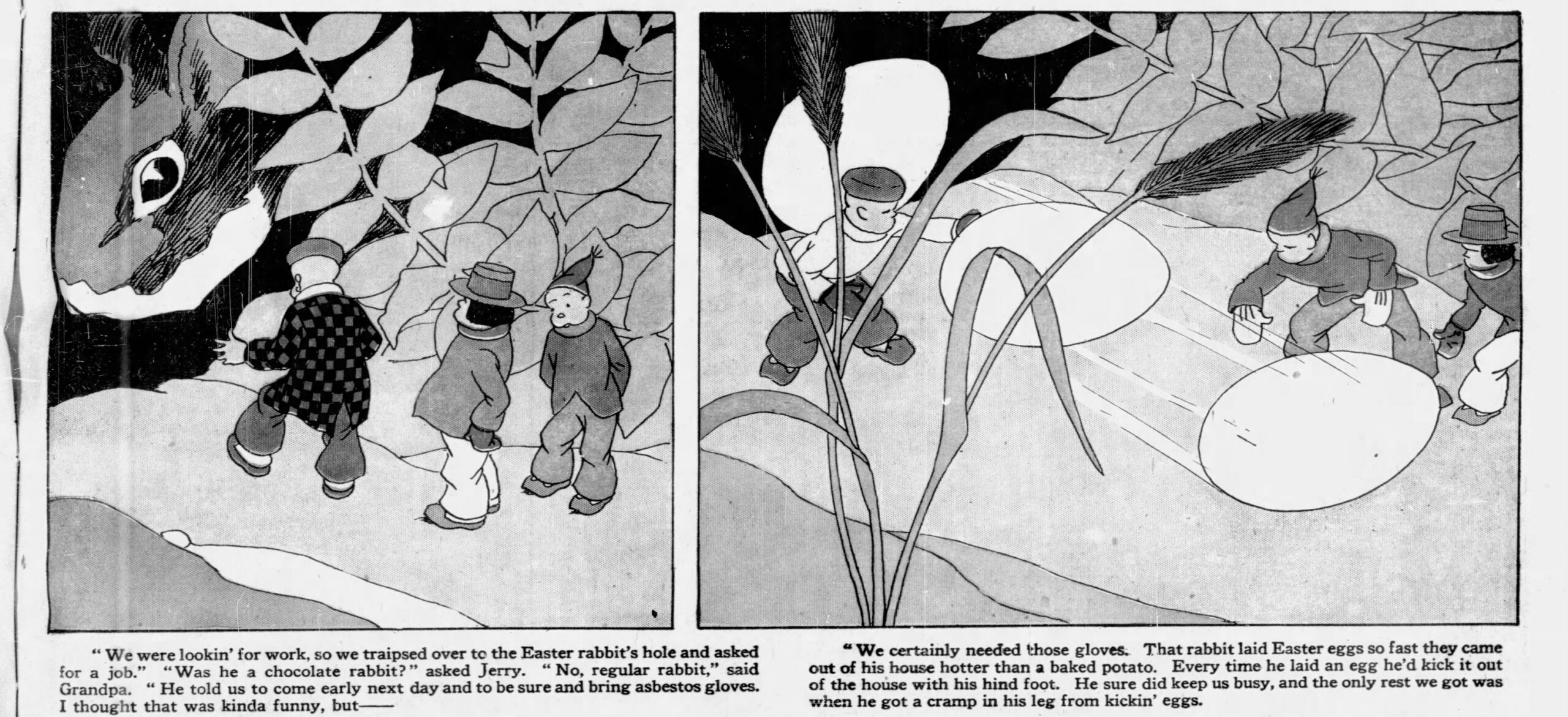
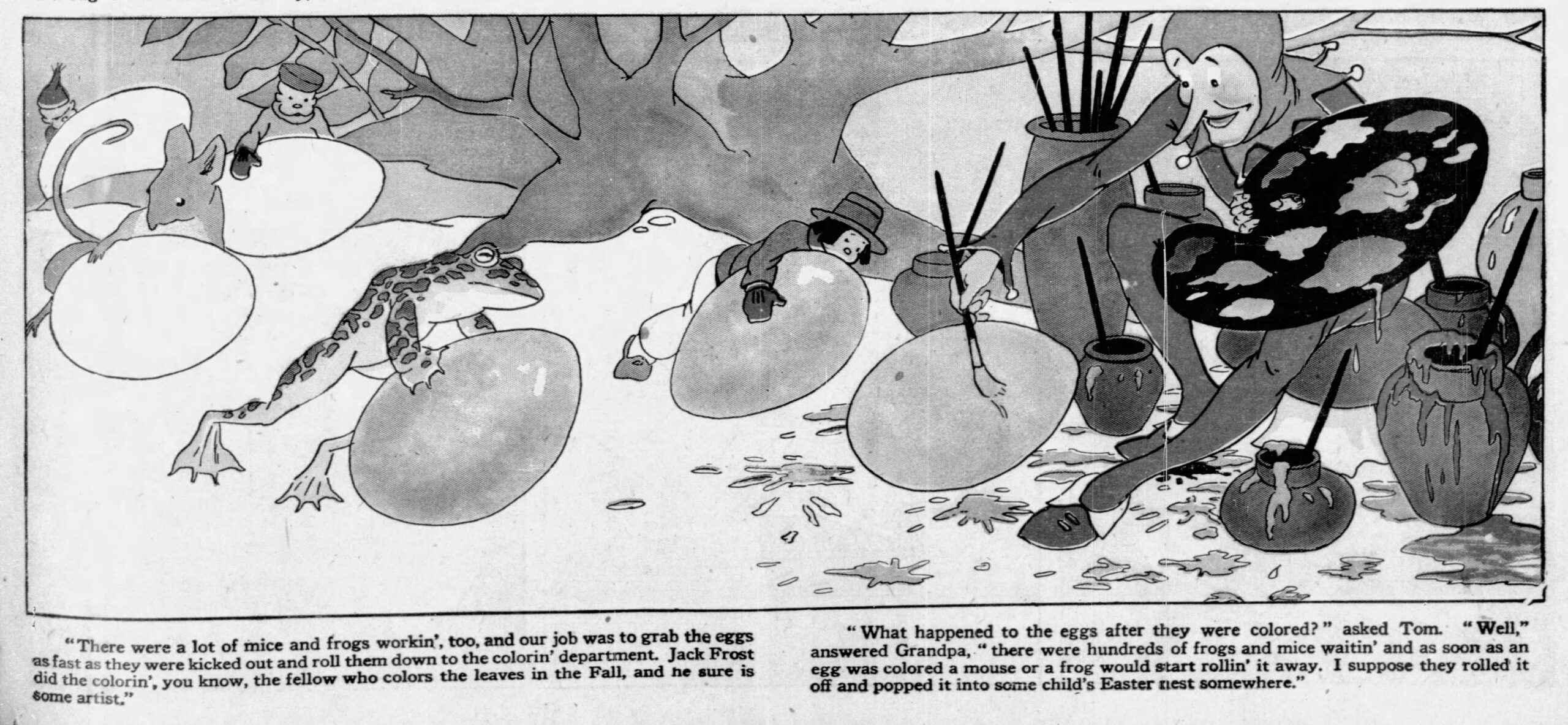
Happy Easter from the Ridge Historical Society!
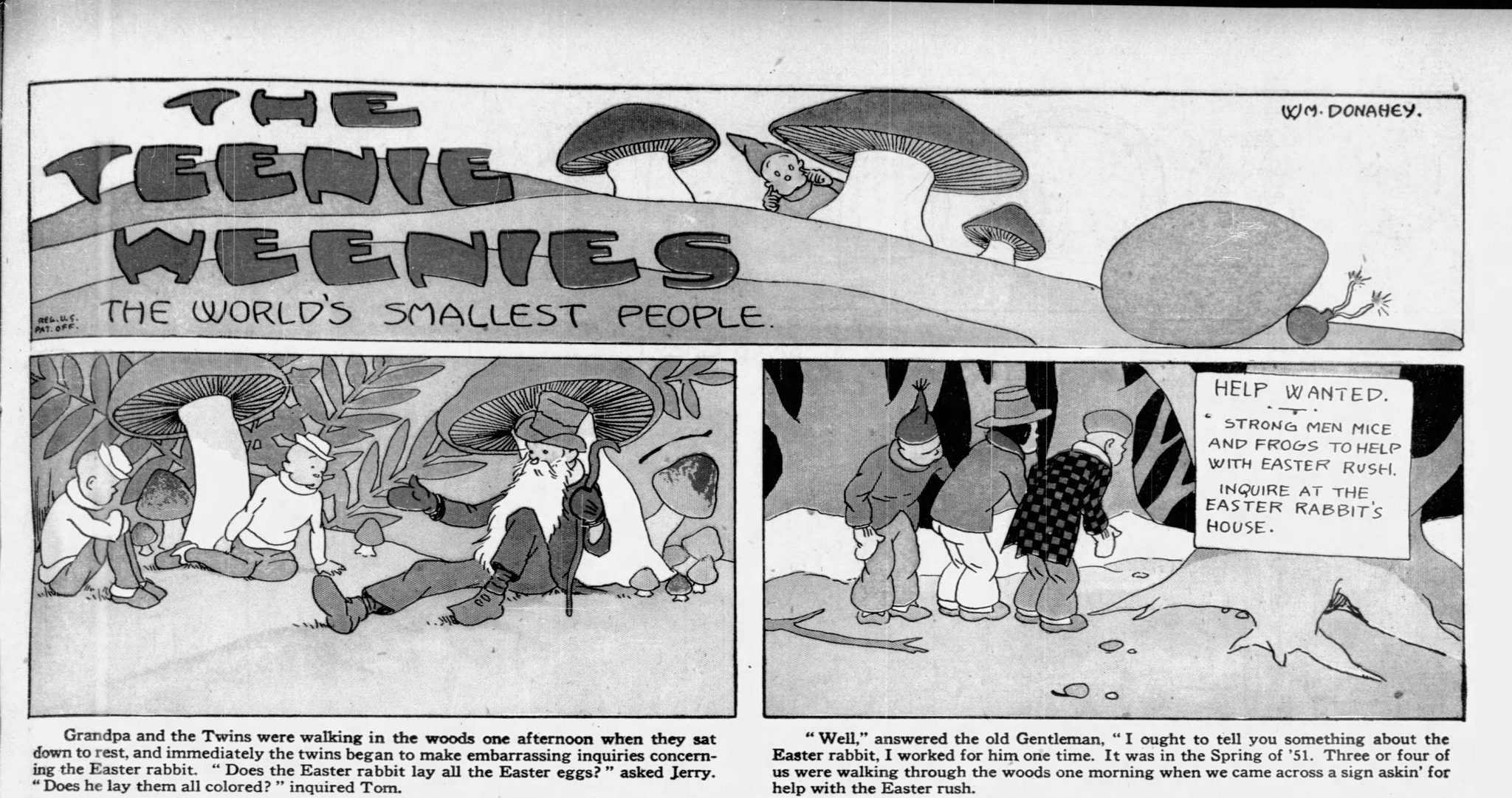
Here's something a little different – a cartoon from Easter 1924 that appeared in the Chicago Tribune. This is how Easter eggs get painted.
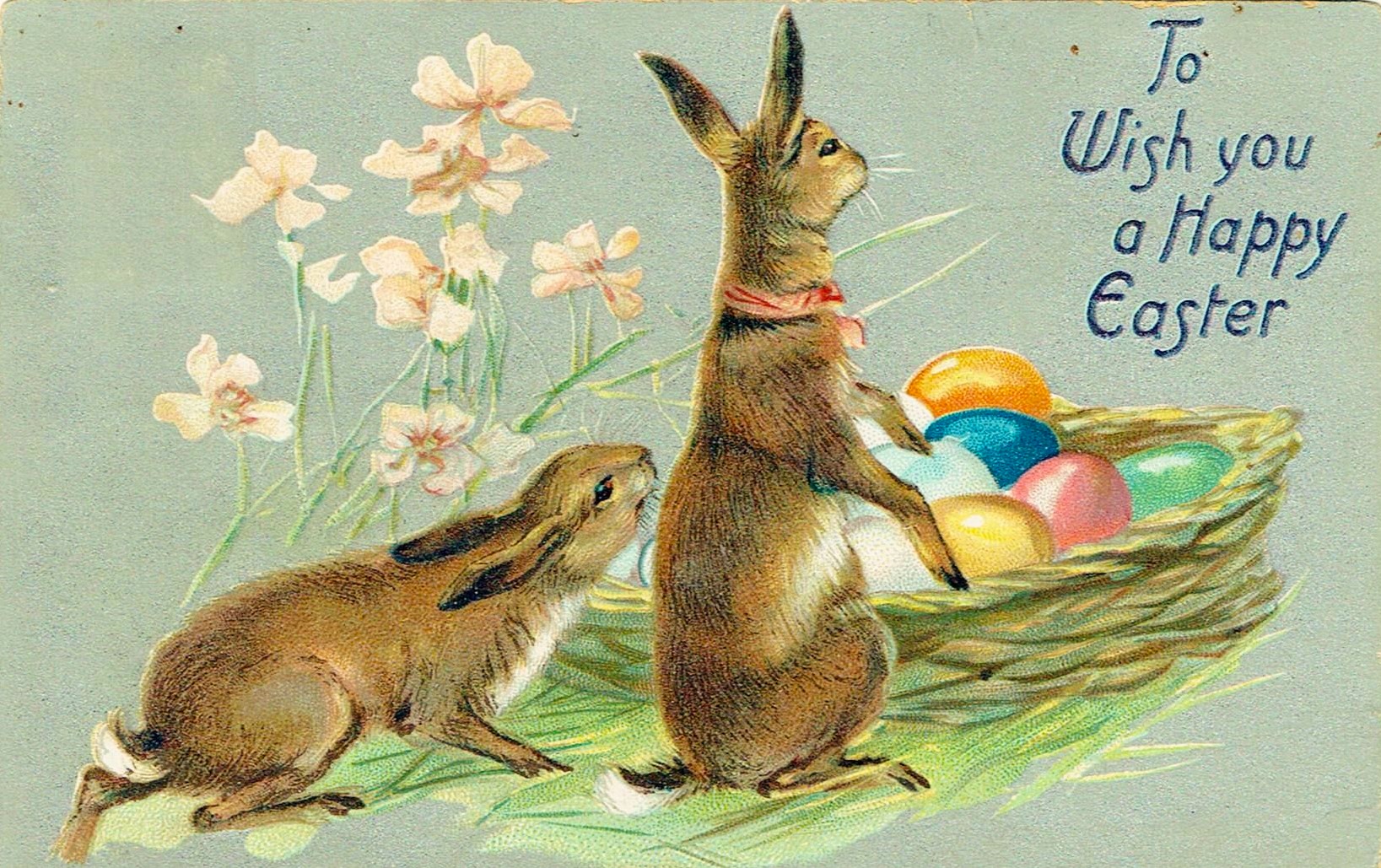
And a vintage postcard greeting.