Explore the RHS Facebook Archives, a rich repository of local history written by Carol Flynn. For two decades, Carol brought a deeply dedicated voice to public education at RHS. Her role as Facebook administrator through mid-2025 naturally extended her prolific research into meticulously detailed articles, most notably her multi-part historical series posts. Today, Carol continues her local history writing for The Beverly Review and other outlets.
2023
The Ridge Historical Society
Memorial Day 2023 – Part 2
By Carol Flynn, with a thank you to Barry Kritzberg for sharing his historical research
Memorial Day – Part 1 listed many of the military-related markers and monuments in the community. While researching these, the only one that could be connected to the Morgan Park Academy (MPA) was the Memorial Triangle, a small piece of land at 112th Street and Lothair Avenue that contains a marker installed by the cadets of MPA in the 1920s in honor of those who fought in World War I.
MPA started as the Mount Vernon English, Classical, and Military Academy for boys in 1873, when the village of Morgan Park was planned and developed by the Blue Island Land and Building Company. In addition to training for military service, the school promised thorough preparation for business and college.
The name of the school was changed to the Morgan Park Military Academy (MPMA) in 1906. Changes beginning in the 1950s led to today’s school, the MPA that is no longer a military training school and is now a co-educational school from pre-kindergarten through 12th grade.
It stood to reason that a military academy would include memorials to alumni who served and died in armed conflicts that involved the United States, but none were in evidence now. RHS reached out to Barry Kritzberg, renowned educator and author who, among many accomplishments, taught at MPA for thirty-six years and authored “Morgan Park Academy: A History (Volume I),” published in 2007.
Kritzberg shared some of his history research and writing with RHS. As expected, there were memorials at MPA at one time.
Records show that 1,389 MPA students served in World War I, World War II, and Korea. There are no records for the numbers who served in the Spanish American War, the first conflict after MPA was founded, or the Viet Nam War, the last conflict before MPA discontinued military training.
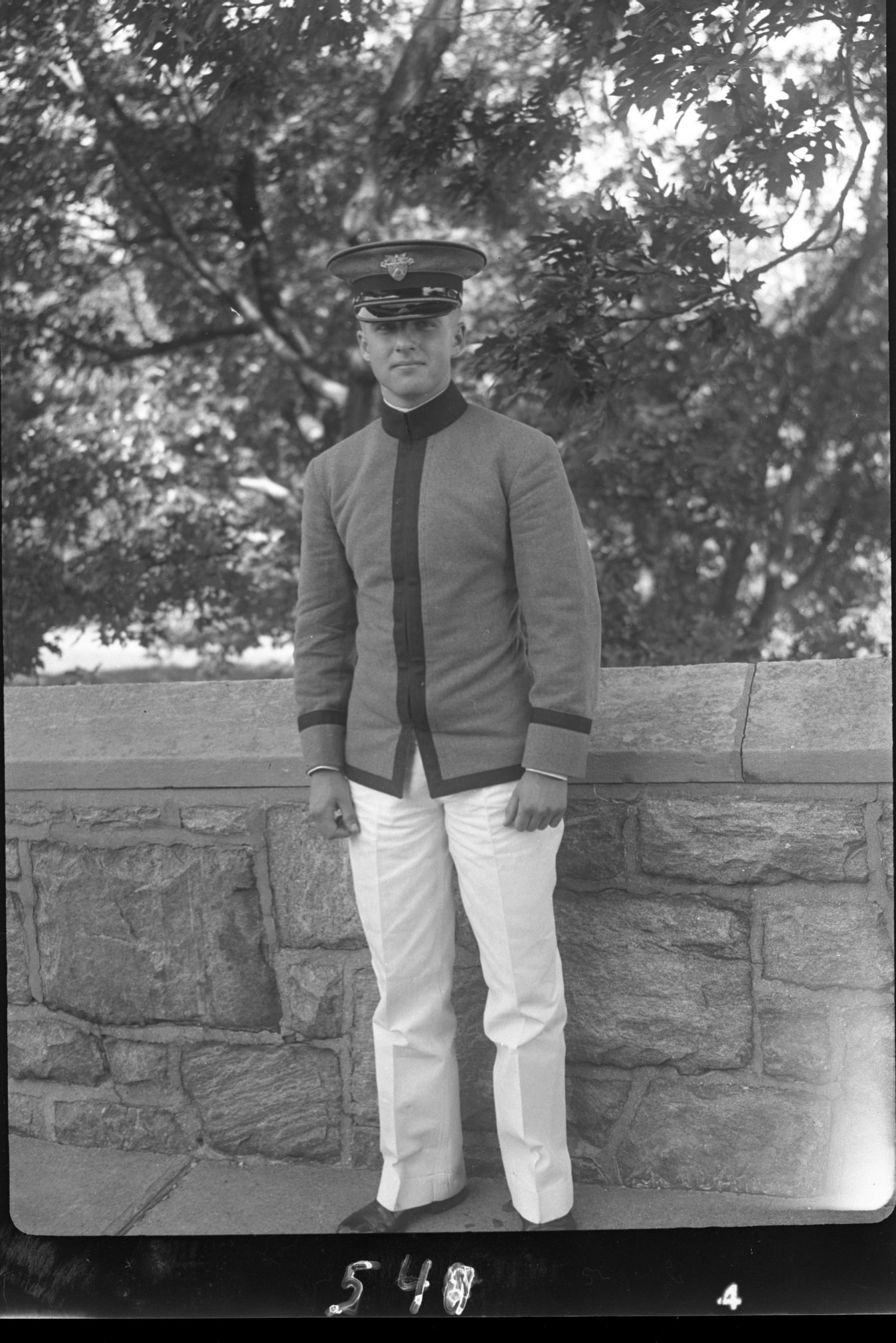
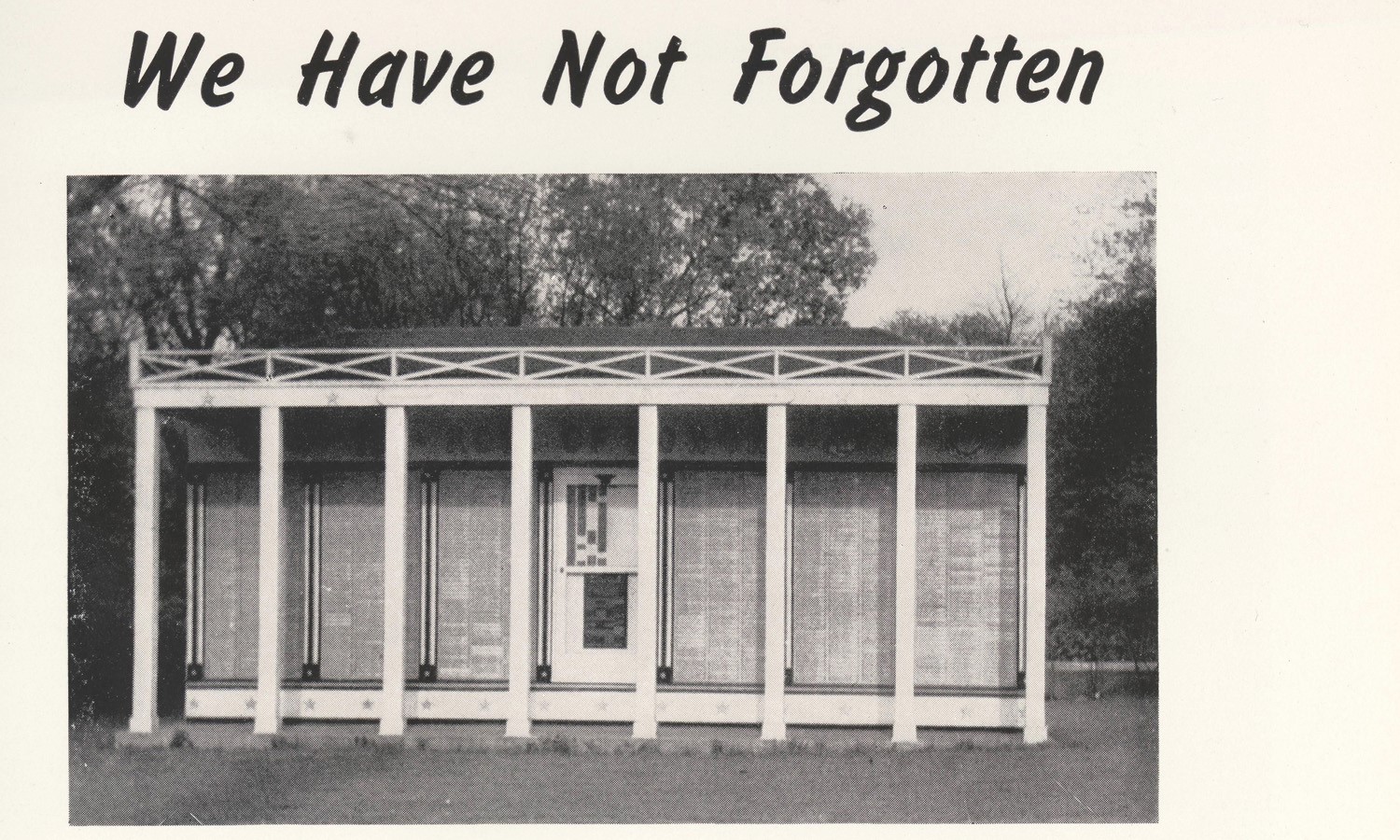
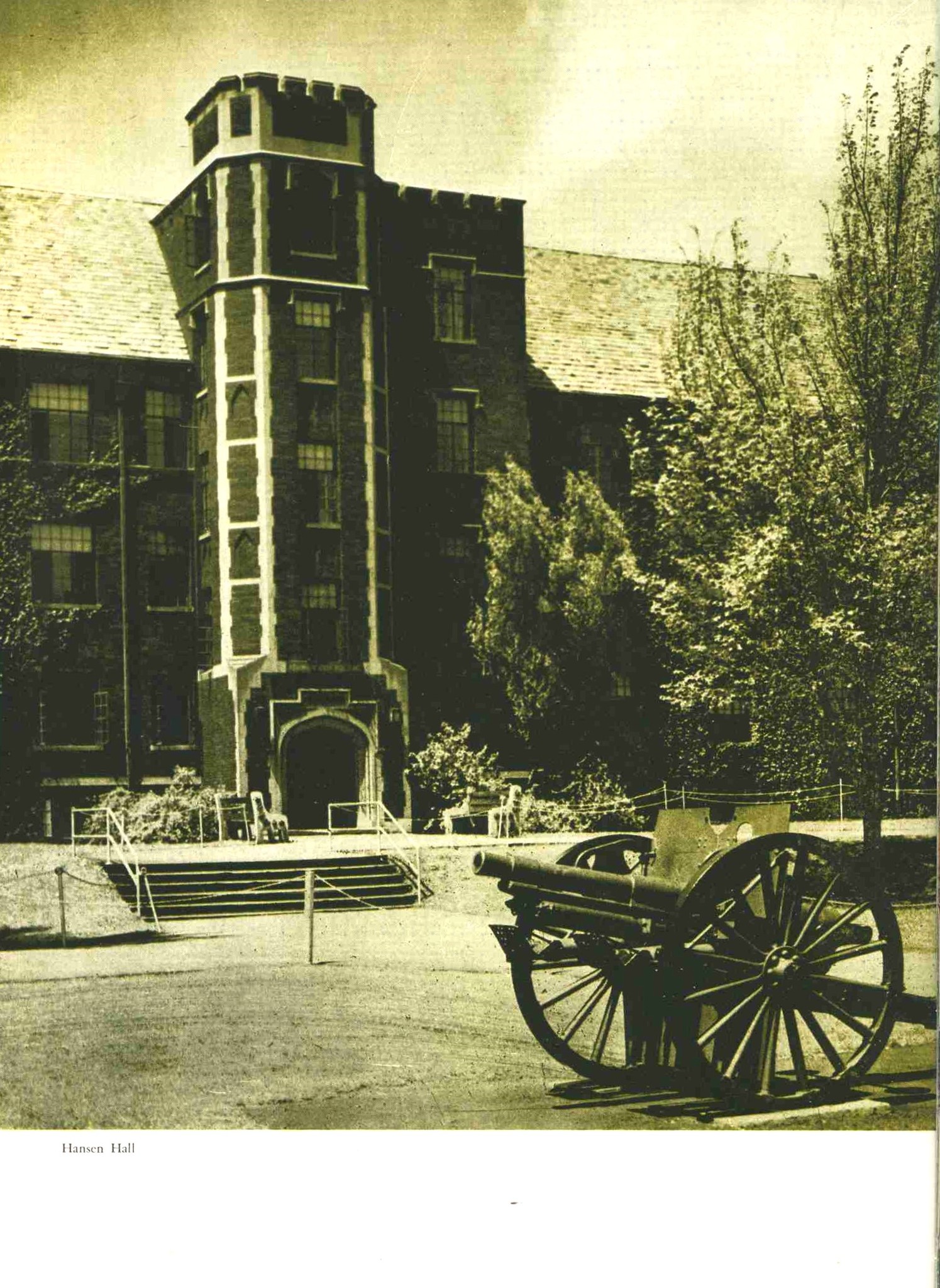
Seven MPMA graduates lost their lives during the WWI time period. In 1920, the pictures of these “gold star men” were framed and placed in the chapel of the school’s Blake Hall, a building demolished many years ago.
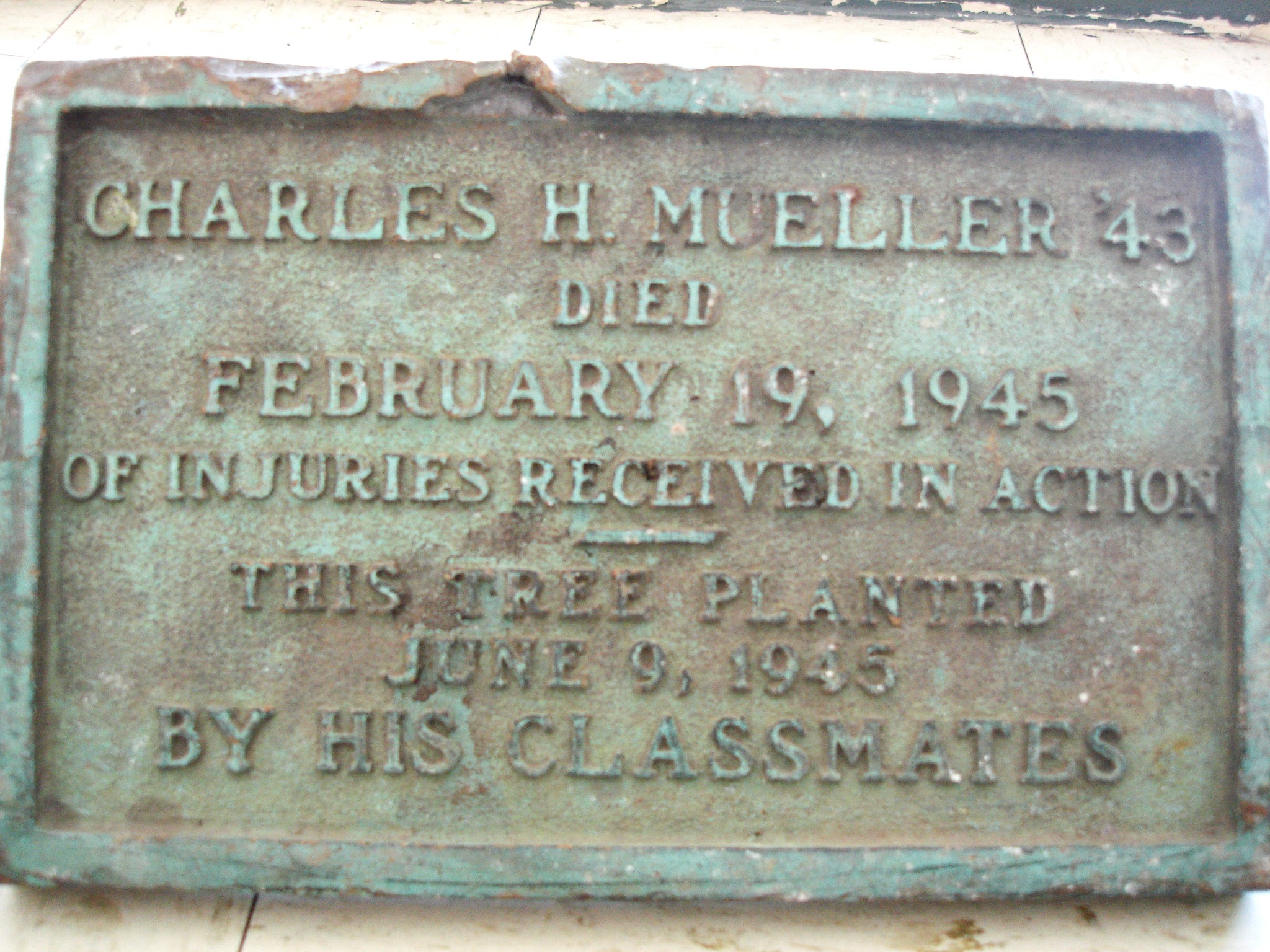
In 1921, trees were planted in their honor, and plaques were installed on the MPMA campus. This was considered a significant move by MPMA at the time, with the head of the school, Col. Harry D. Abells, stating that this established “new traditions for the guidance of our present and future cadets.”
The loss of MPMA men increased substantially with World War II. A total of forty-five cadets and two faculty members lost their lives in service at that time.
In 1943, the 70th year anniversary of MPMA, seven elm trees with plaques were planted on the campus in memorial to the seven cadets whose war-time deaths had occurred. The Tribune ran this poem at the time (June 17, 1943):
Seven honored decades,
Thru years of peace or dread,
Her sons have served our banner
With seven stripes of red.
Seven stars, new golden,
Shine on her roll today
For seven heroes fallen
In conflict far away.
Seven elms, new planted,
Pay tribute to each name,
And in our arch of triumph
Shall hold their endless fame.
Those first seven deaths were just the beginning. In the next few years, forty more U.S. servicemen connected to MPMA died.
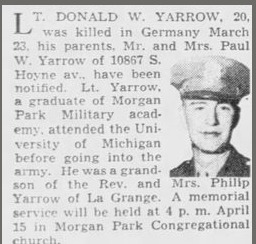
Many of them also had connections to the local community. One case study, that of Lt. Donald W. Yarrow, puts a real face on what would otherwise just be a statistic.
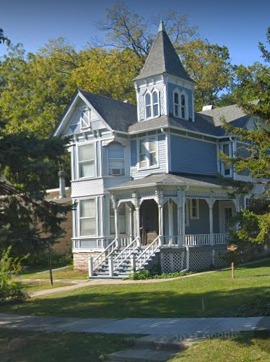
RHS research shows that Donald W. Yarrow was born on December 2, 1924, to Paul and Edna Brown Yarrow. He was the grandson of a well-known minister in the community, Rev. Dr. Phillip Walter Yarrow. The Rev. Yarrow family lived at 11156 S. Longwood Drive, in one of the most picturesque Queen Anne houses in Morgan Park.
Rev. Yarrow was from London, educated at Princeton and Harvard, and the pastor of the Morgan Park Congregational Church. He was described as a “militant anti-vice crusader” who ran the Illinois Vigilance Association for twenty years. He staged hundreds of raids on speakeasies and brothels. He was fearless against Al Capone as well as corrupt government officials. Rev. Yarrow was a trustee of MPMA.
Paul Yarrow was a stockbroker, and Edna Yarrow was an active clubwoman and volunteer. During WWII, she was chair of the Morgan Park Red Cross Unit. She served as chair of the Morgan Park Woman’s Club American Home Committee.
At the age of 18, Donald Yarrow was a lieutenant in the U.S. Army. He graduated from MPMA in 1942, where he had been on the honor roll and had received promotions. He attended the University of Michigan, but one month after his eighteenth birthday, he entered the U.S. Army, and became the second youngest officer to complete the officer program at Fort Benning, Georgia.
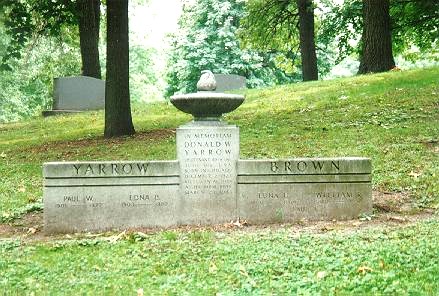
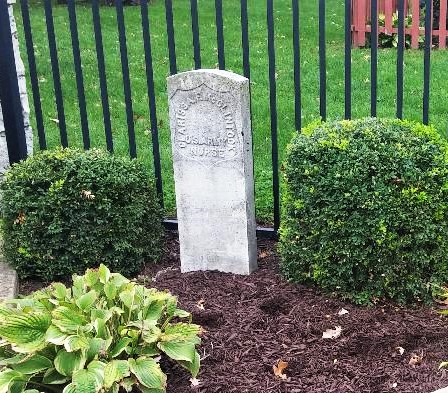
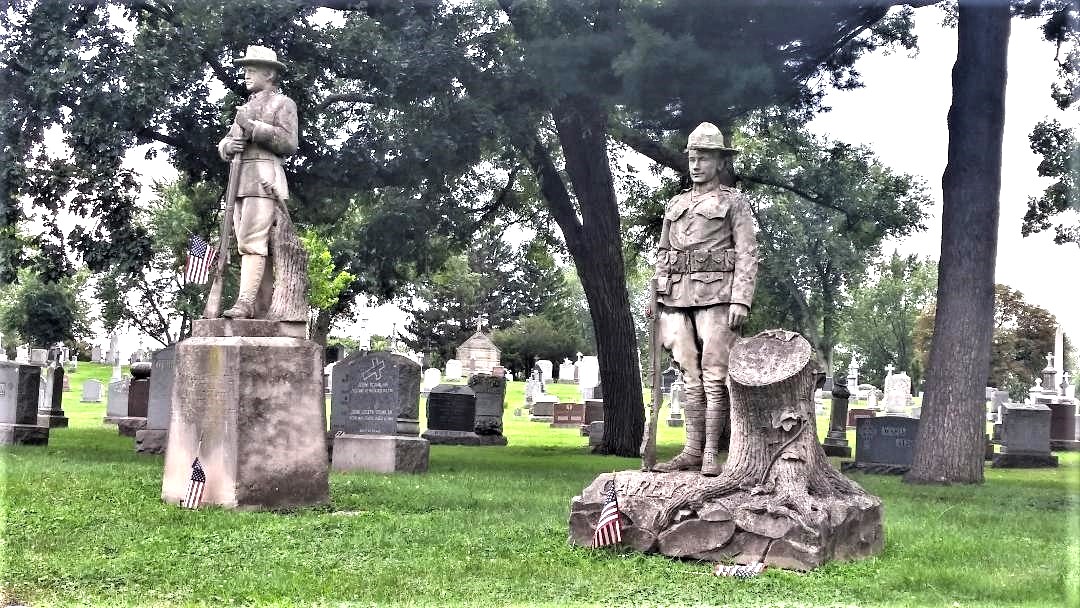
According to Kritzberg’s research, Donald was wounded in 1944, returned to combat, and then was killed on March 23, 1945, when crossing the Rhine for “the great drive deep into Germany.” He was twenty years old. His funeral service was held at his grandfather’s church at 112th and Hoyne Avenue and he was buried in Mount Hope Cemetery, where his grave is prominently marked (see images).
In October of 1945, Paul and Edna Yarrow received a bronze star medal awarded posthumously to Donald. The ceremony took place at MPMA. According to the Chicago Tribune, he won the medal for heroic action on February 23 of that year in Germany, a month before he was killed. In establishing an observation post, he and two comrades had to move through heavy enemy fire, and they captured sixteen German soldiers, four mortars, and ammunition.
Also according to Kritzberg, more information on that event had been included in his obituary in the Chicago American newspaper on March 31, 1945. They captured the German soldiers without firing a shot. Donald, however, could not have fired a shot anyway because he was out of ammunition. It was only after taking the prisoners to the stockade that he realized that he had no bullets in his carbine.
Forty-seven elm trees were planted on the MPMA campus during those years in the 1940s. Unfortunately, Dutch elm disease, which ravaged Chicago in the 1960s, destroyed these memorial trees.
MPA records, according to Kritzberg, also list twelve MPMA alumni who were killed in Korea and Viet Nam.
However, it seems that not all MPA graduates who were killed during active service are on the MPMA lists, only those killed during “war years.” One man who is missing from the list, for example, is Grant Fenn, whose family owned the Graver-Driscoll House that is RHS Headquarters, from 1940 to 1946.
Grant Fenn graduated from MPMA in June 1942. The day after he received his diploma, he was appointed second lieutenant, infantry, U.S. Army, and started active duty. He graduated from the United States Military Academy, West Point, New York, in 1945 and was commissioned in the U.S. Air Force.
Fenn served in Italy, and for two years as an assistant attaché in Athens, Greece. He was killed in 1951 when the B-36 bomber he and twenty-two others were flying in crashed in New Mexico. He was 26 years old. He was buried in Mount Greenwood Cemetery.
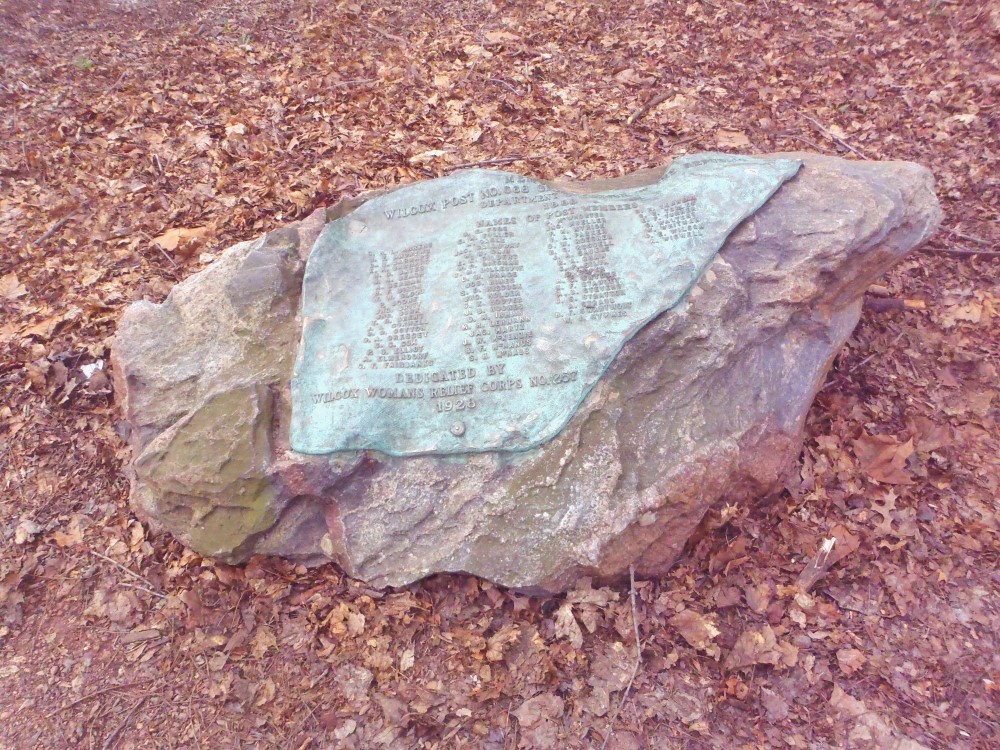
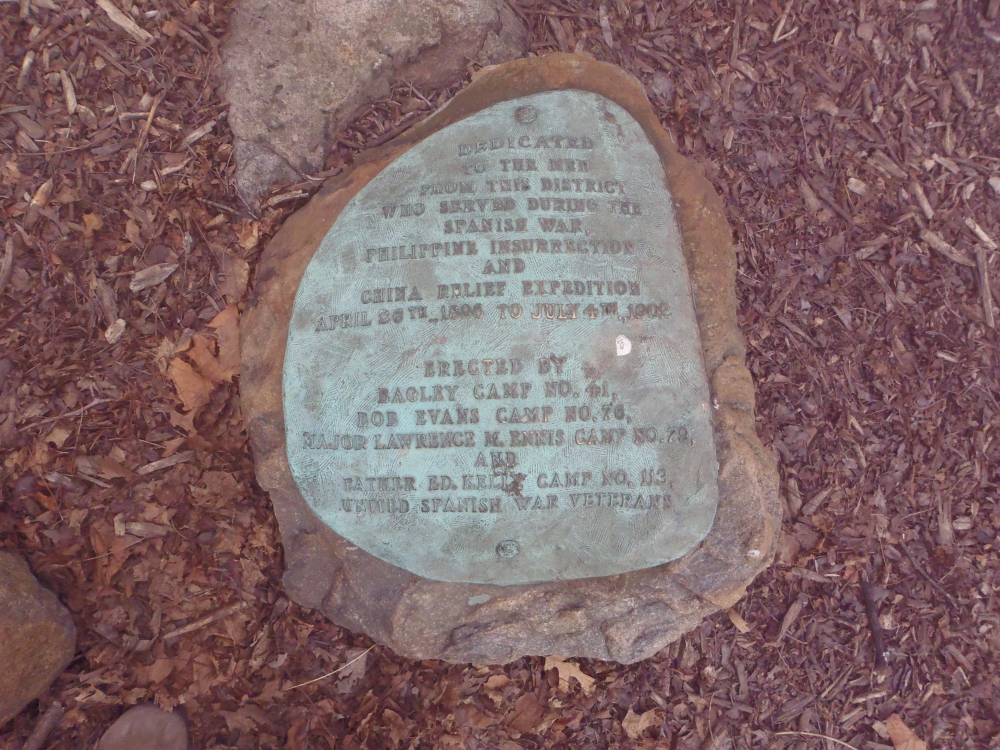
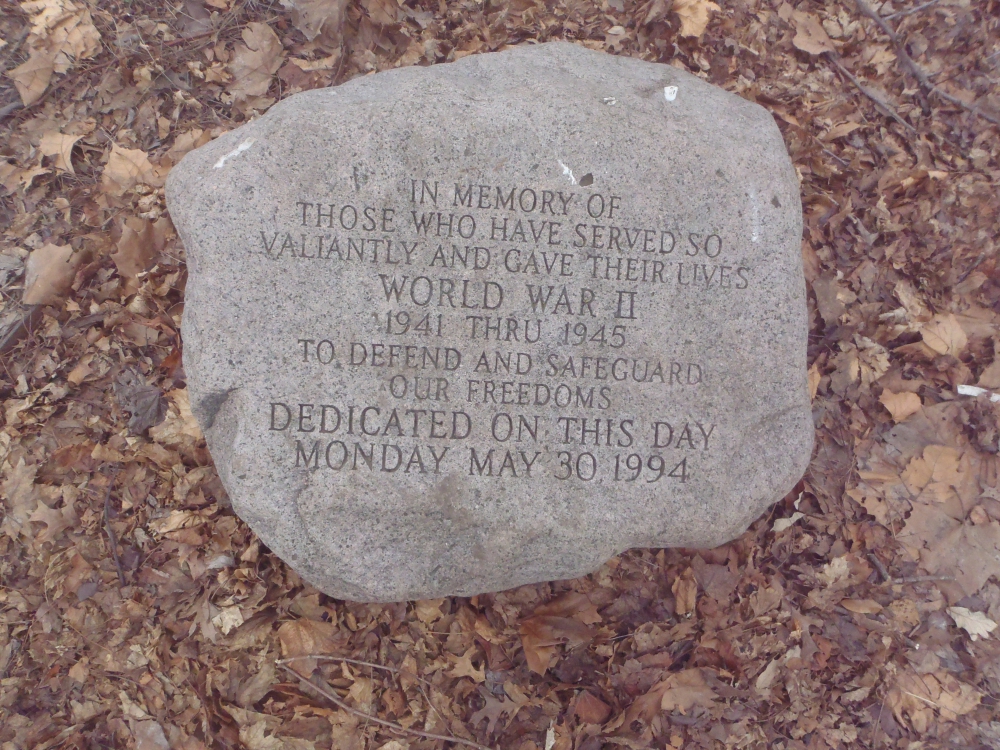
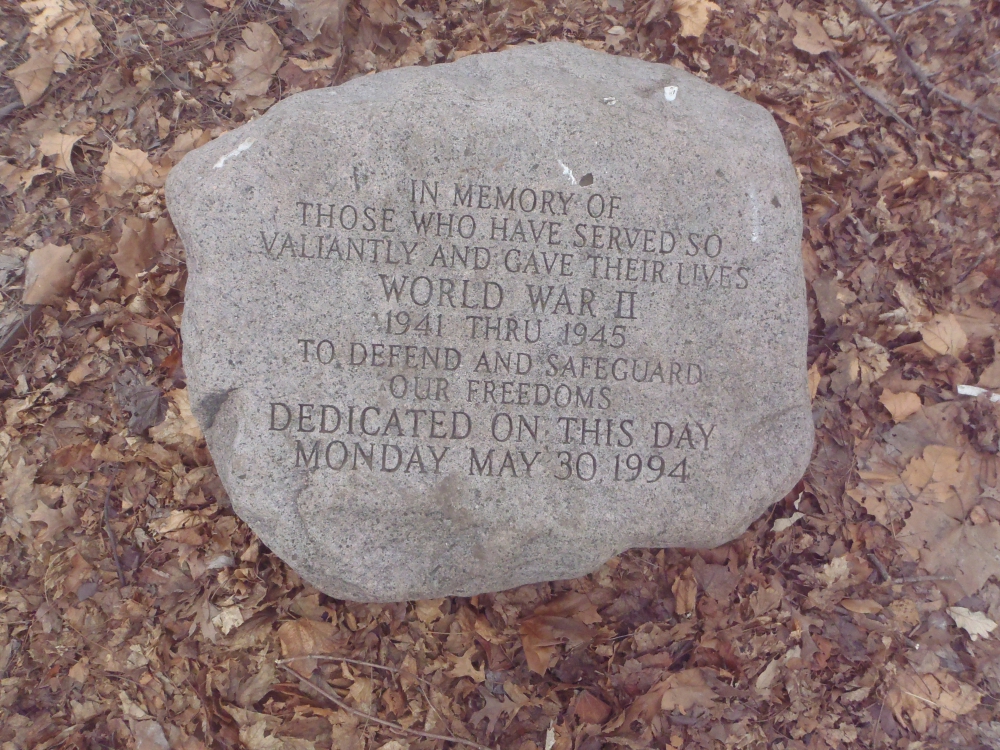
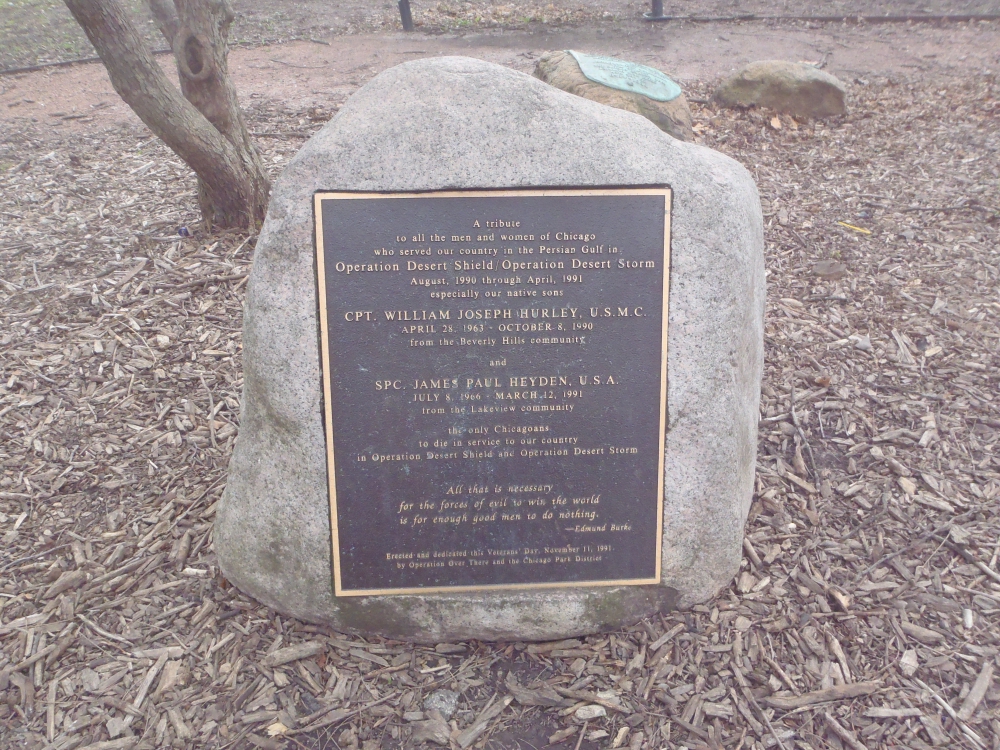
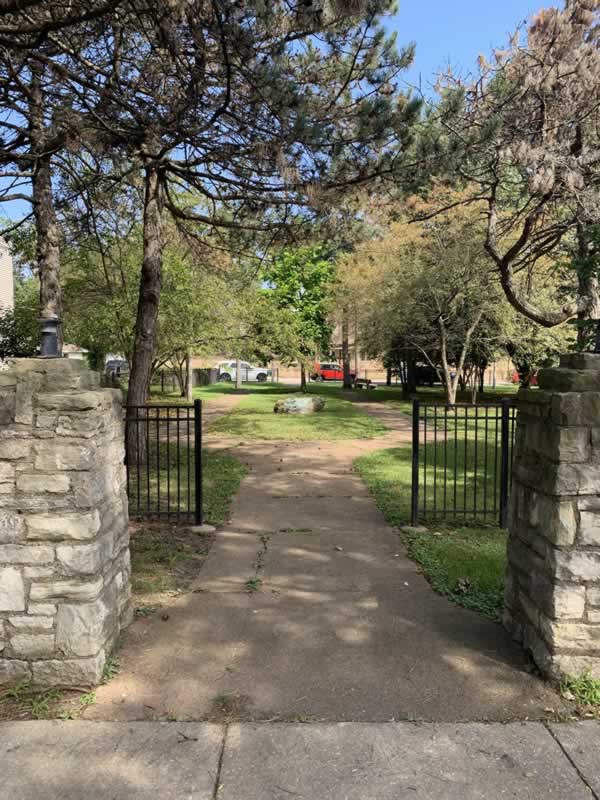
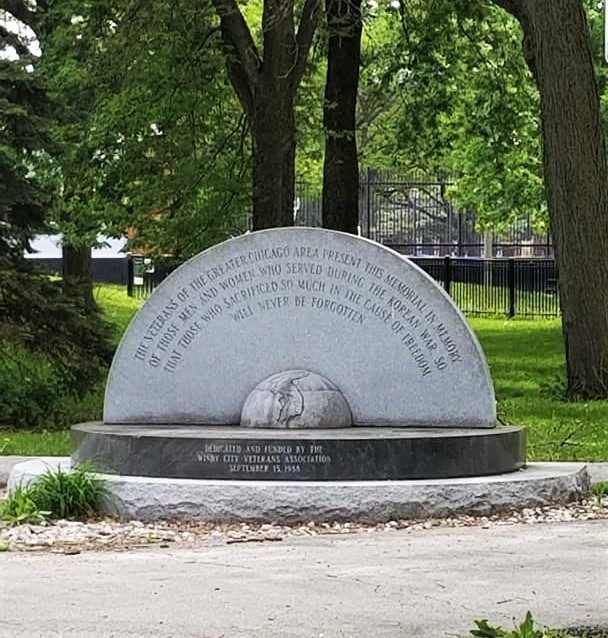
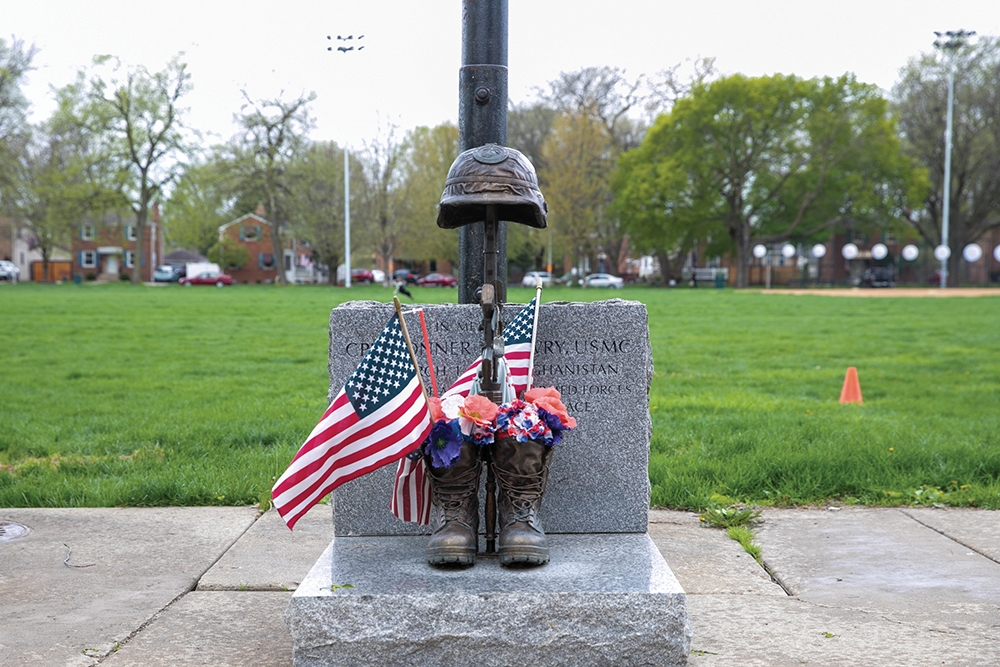
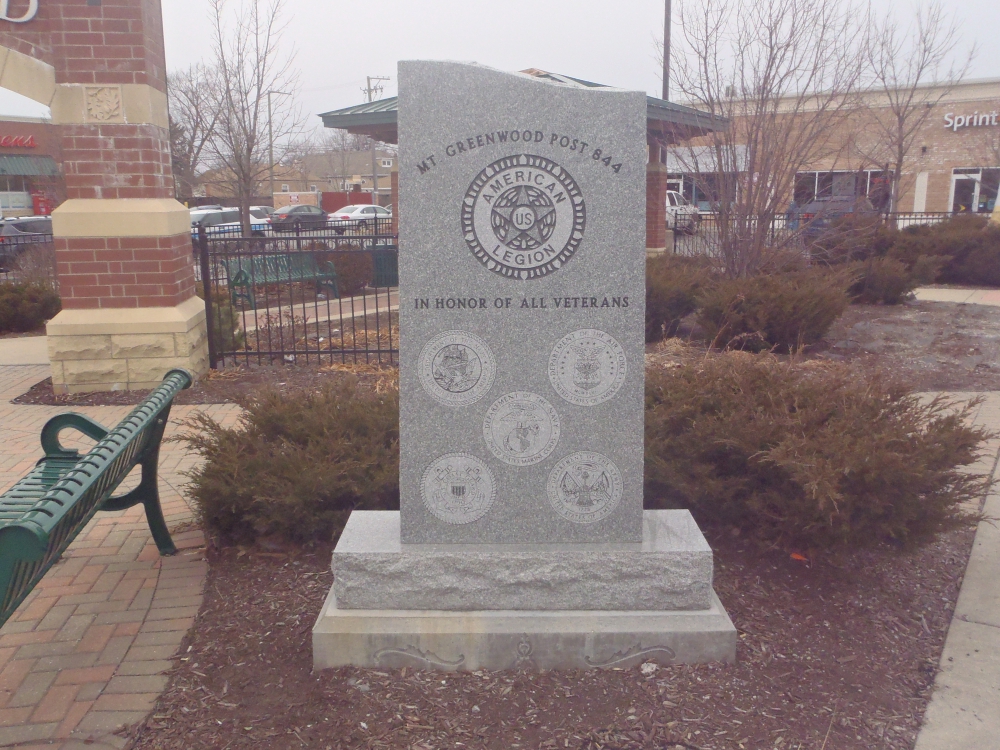
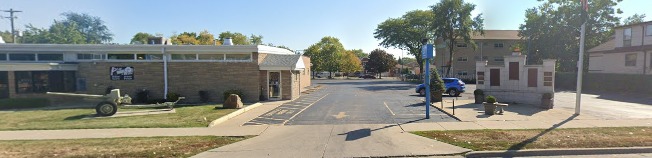
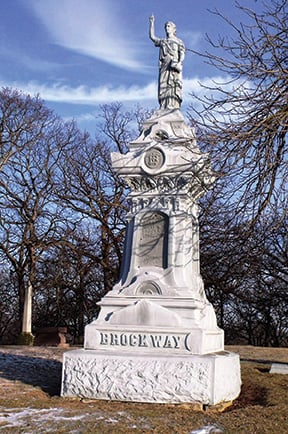
There were other memorials at MPMA that were identified by Kritzberg and several are shared in the attached images.
Sharing this video from another post – Chicago, 1914, taken from a blimp.

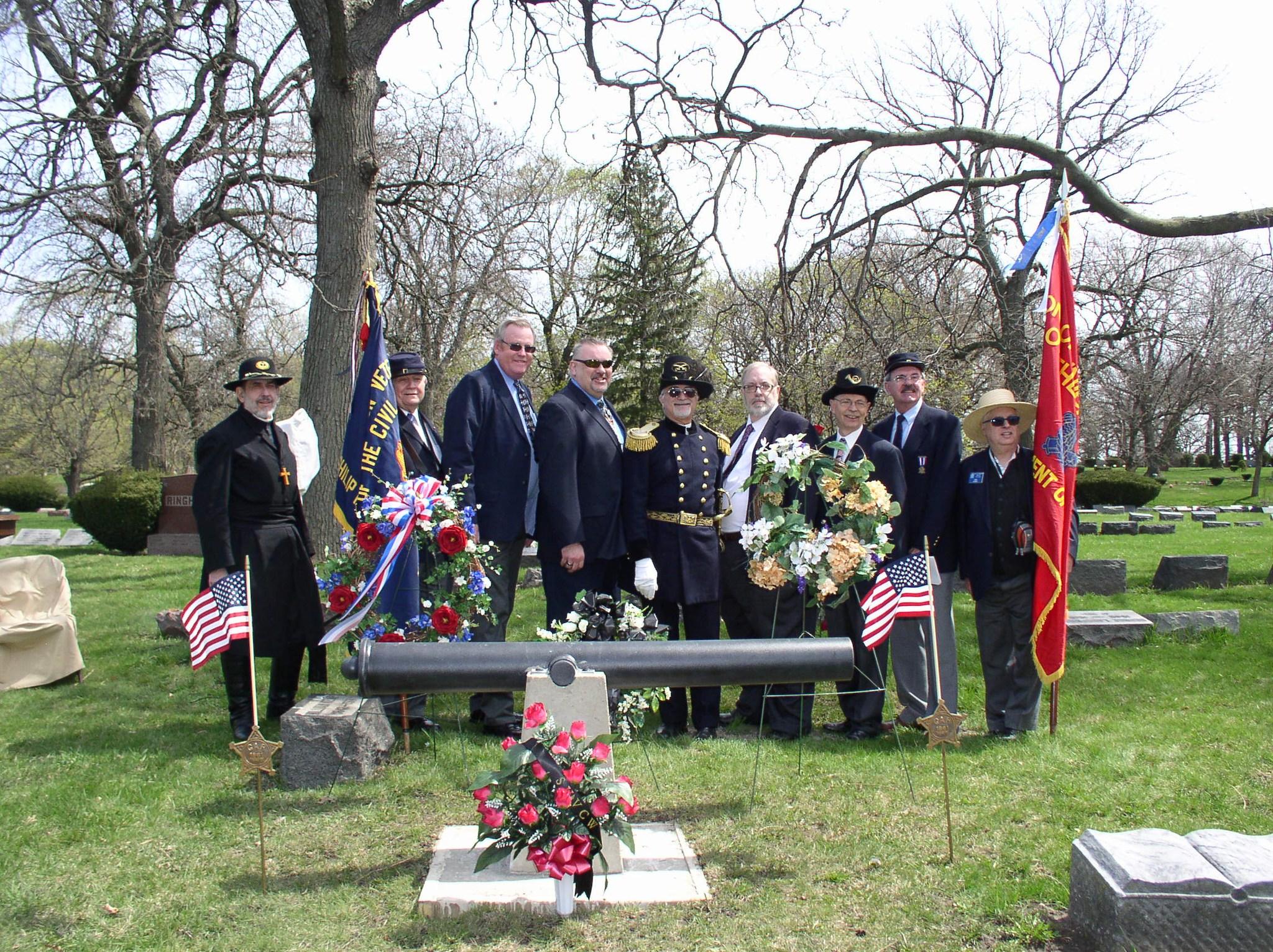
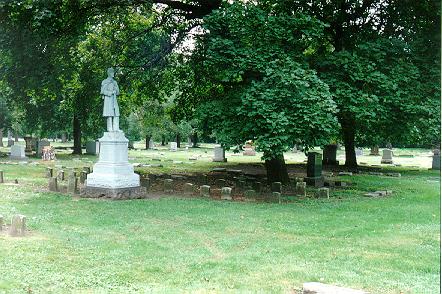
The Ridge Historical Society
Memorial Day 2023 – Part 1
By Carol Flynn
The purpose of Memorial Day is to remember the people who died while in military service to our country, the United States of America.
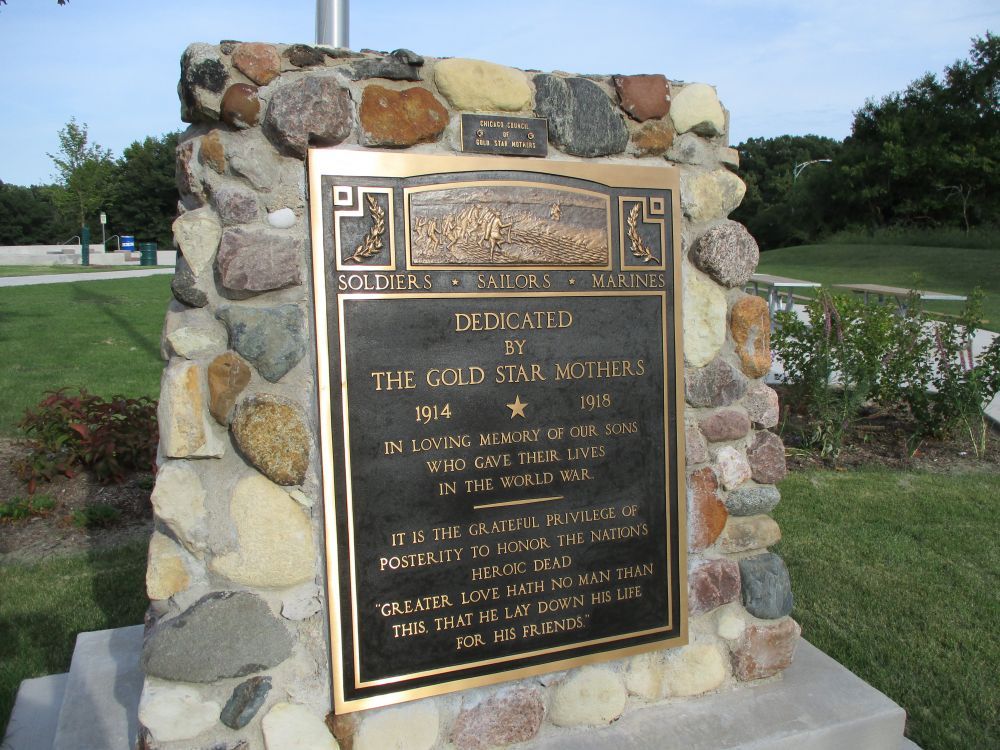
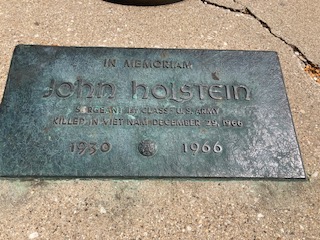
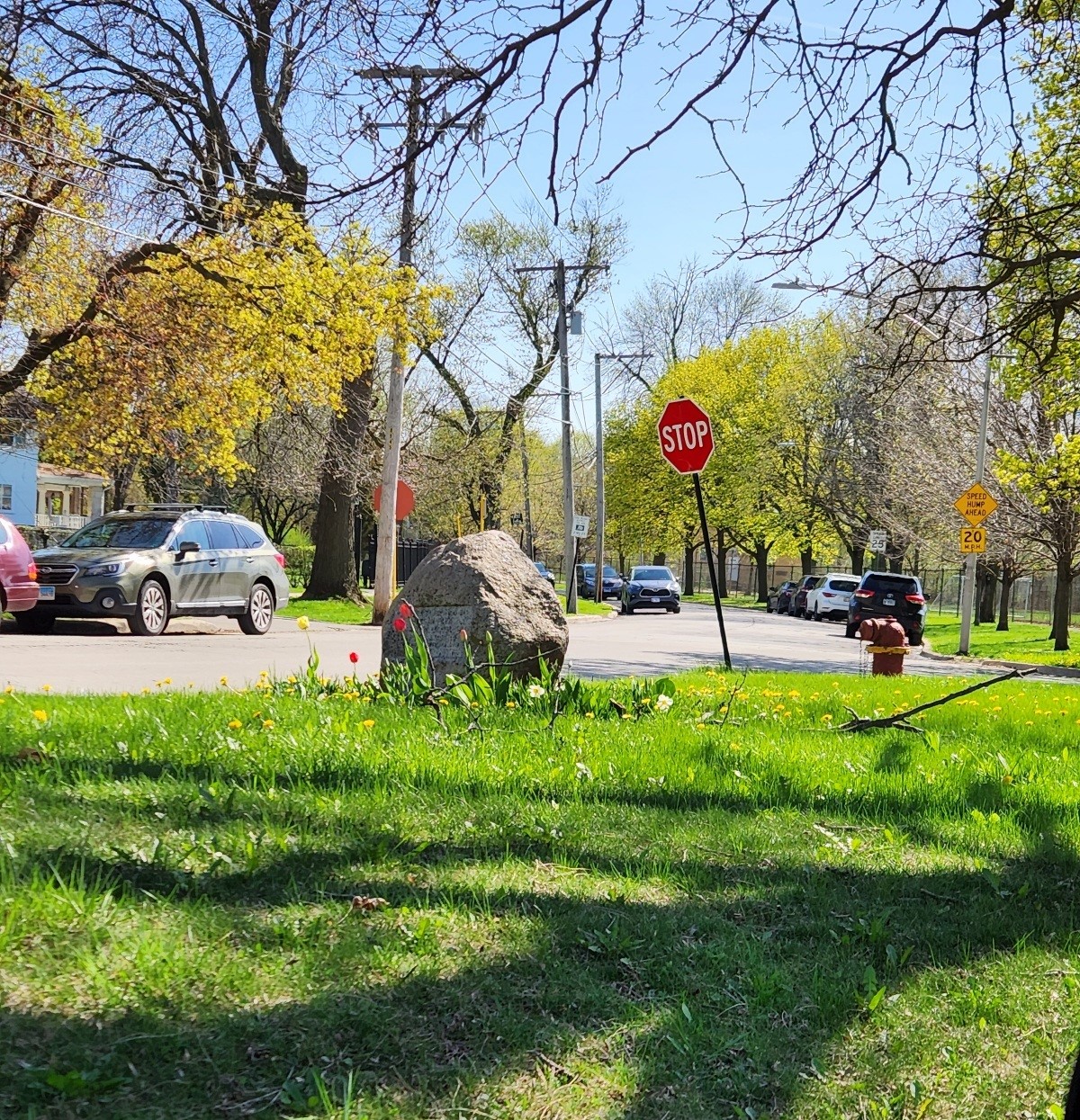
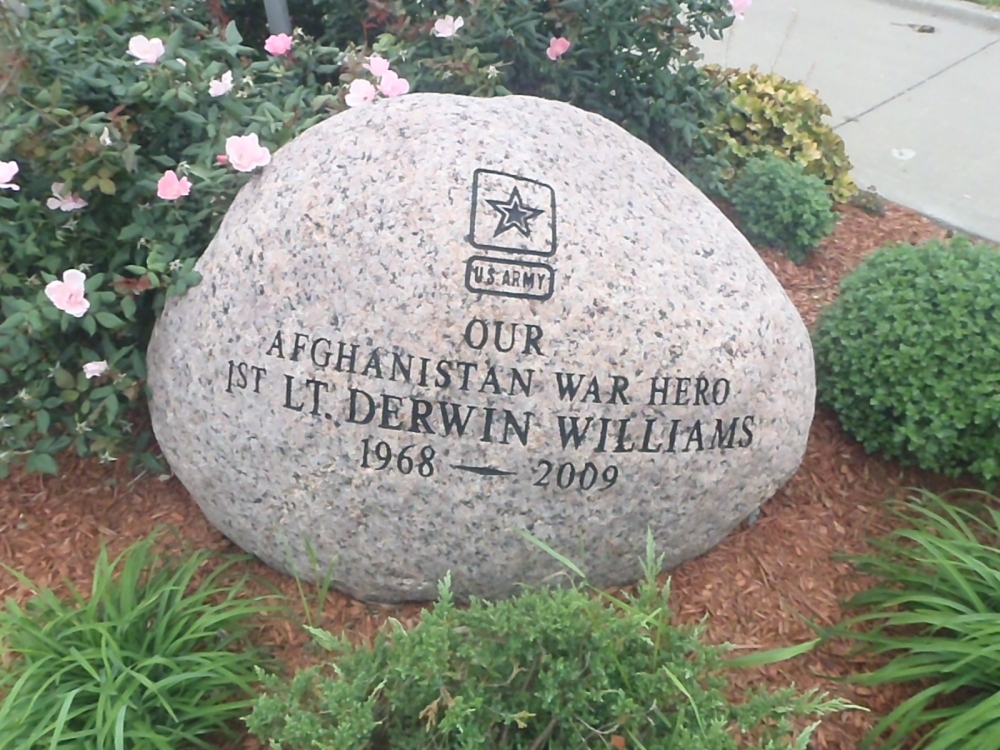
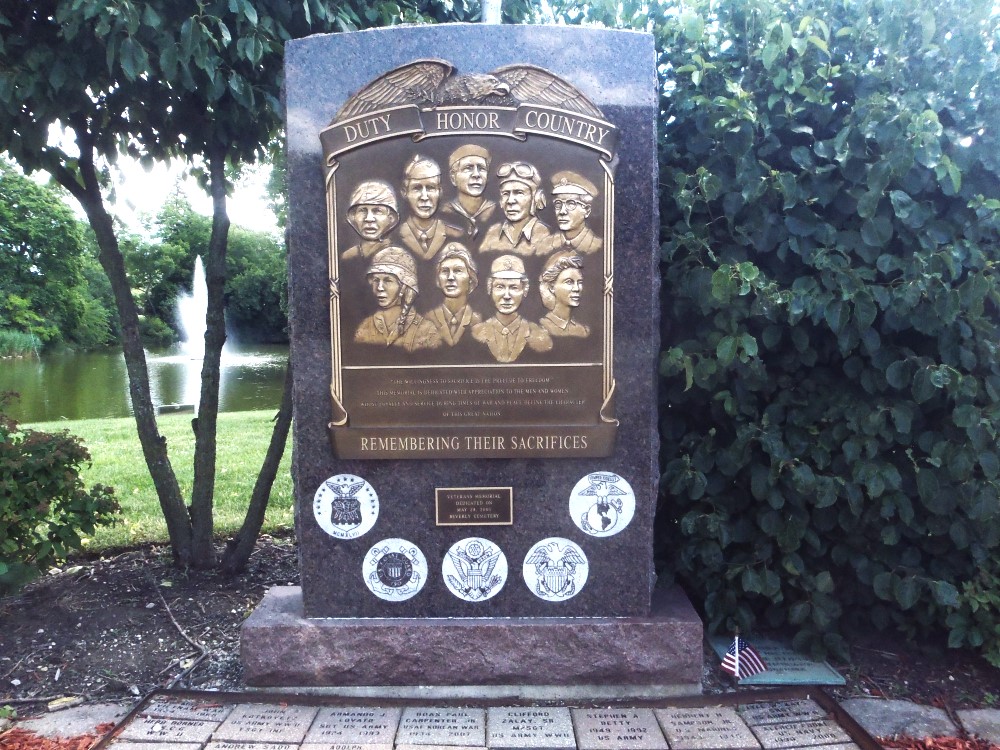
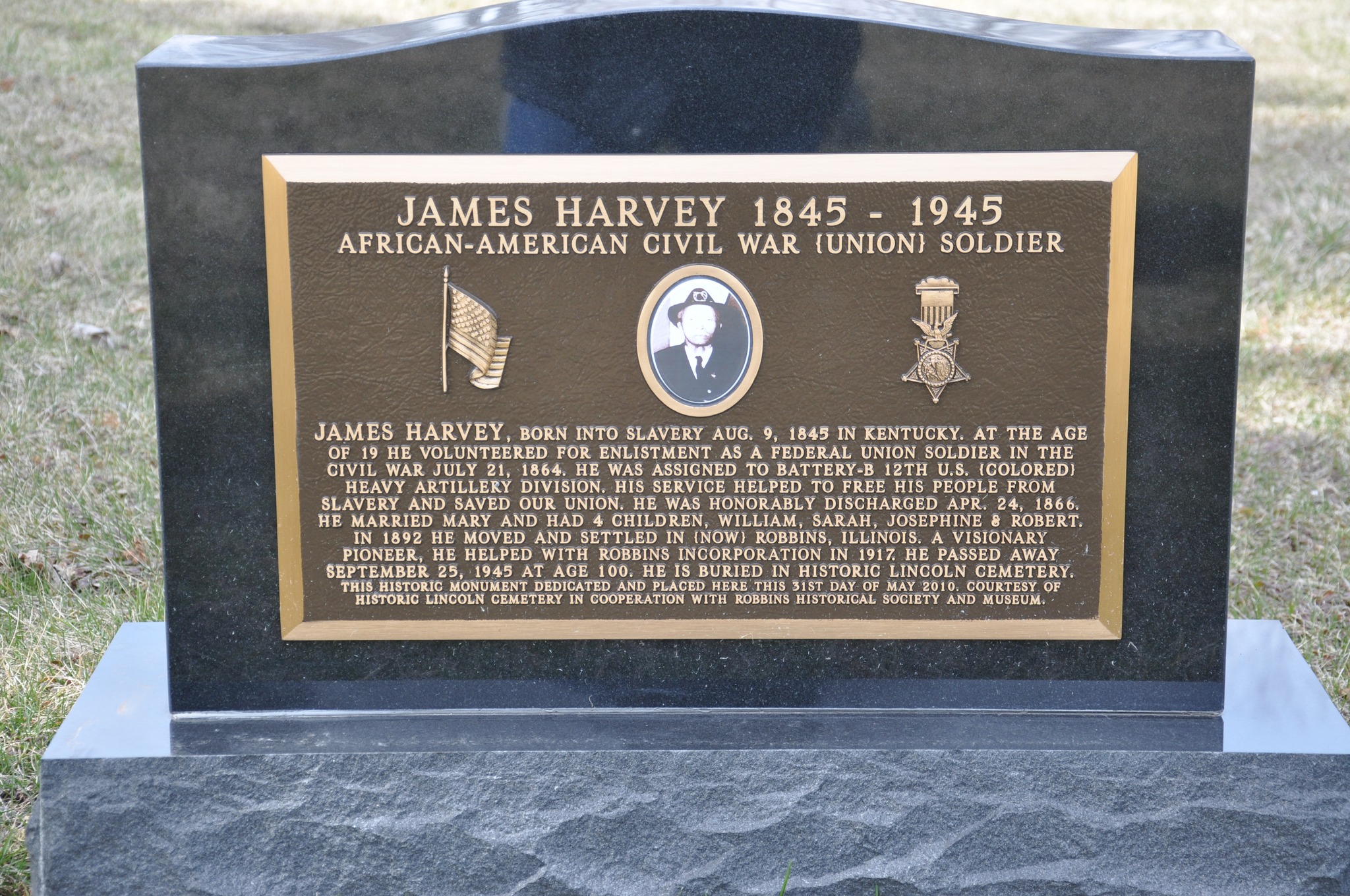
In the Ridge communities, there are many markers and memorials to U.S. service personnel. Here is a list and some pictures of these memorials.
If you know of others in the Ridge area to add to the list, please comment on this post with the locations.
In the next post, we’ll look at the history of military memorials connected to Morgan Park Academy, which started as the Mount Vernon Military Academy in the 1870s. The history was prepared by Barry Kritzberg.
Ridge Park – Six memorial stones, including one of the oldest on the Ridge, installed in 1926.
Graver Park – World War I
Kennedy Park – Korean War
Beverly Park – Connor T. Lowry, Afghanistan
Dan Ryan Woods – Gold Star Mothers
Morgan Park High School flagpole
112th Street and Lothair Ave. – Memorial Triangle
98th Place and Throop Street – Derwin Williams, Afghanistan
111th Street and Kedzie Avenue – American Legion
Memorial Park in Blue Island – Gravestones, memorials, artillery
97th Street and Kedzie Avenue – American Legion Post artillery and eternal flame
Mount Greenwood Cemetery – Civil War veterans’ graves and cannon replica
Mount Hope Cemetery – Civil War veterans section
Beverly Cemetery – Veterans monument
Lincoln Cemetery – James Harvey, U.S. Colored Troops
Mount Olivet Cemetery – “Doughboy” grave statues
It was a great night.
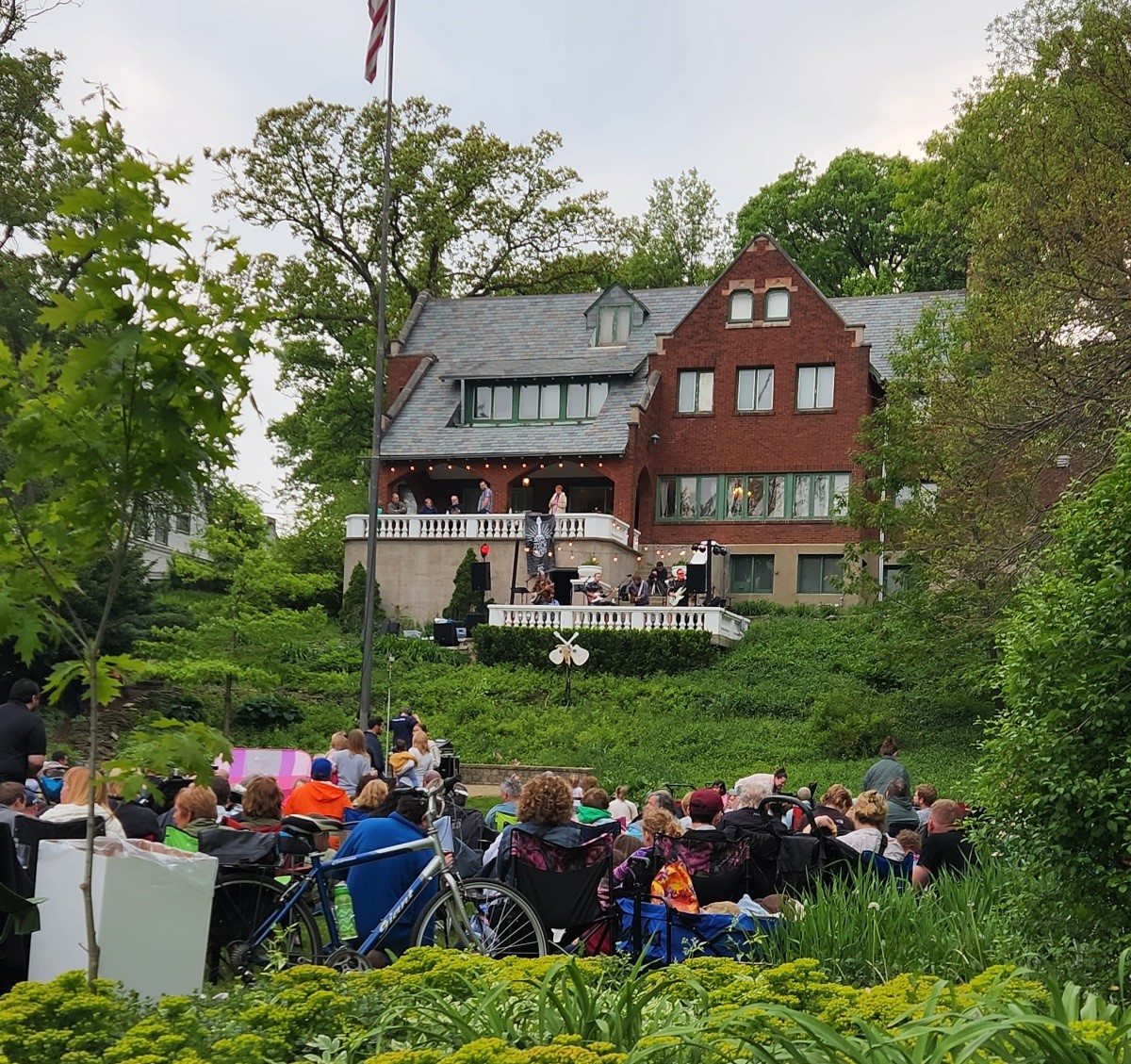
The first Porch Concert of the year, put on by the Beverly Area Planning Association (BAPA), was held at the Ridge Historical Society, and featured the band Beverly Country Club.
The front lawn was packed with people just having a good time.
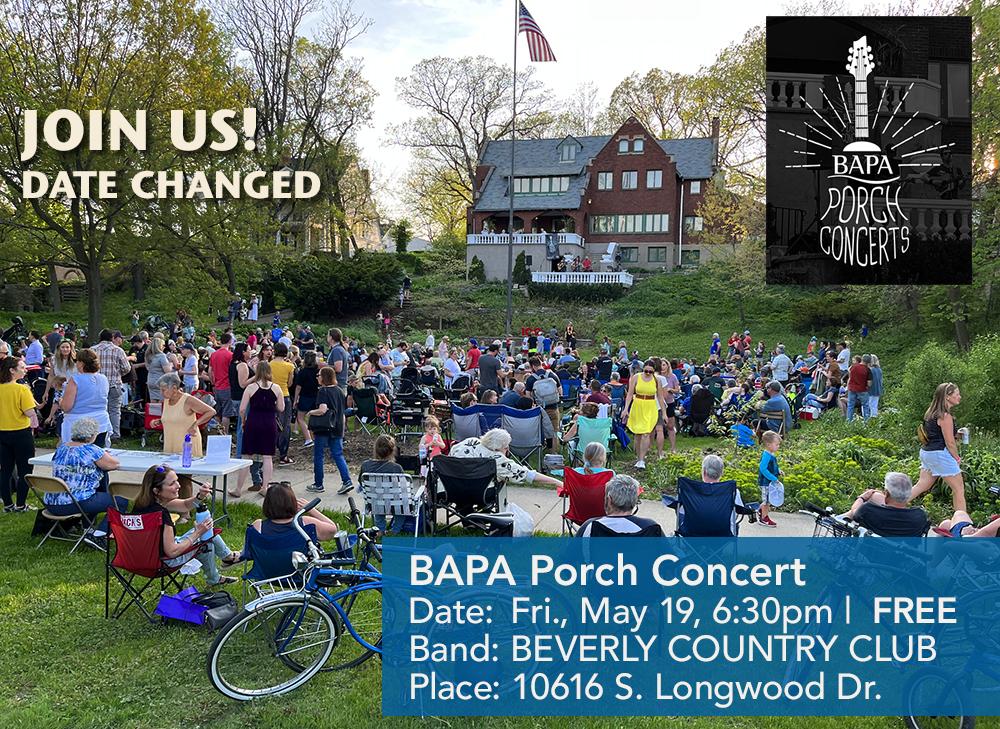
The rain's holding off, so the Porch Concert should go on tonight at the Ridge Historical Society! See you there!
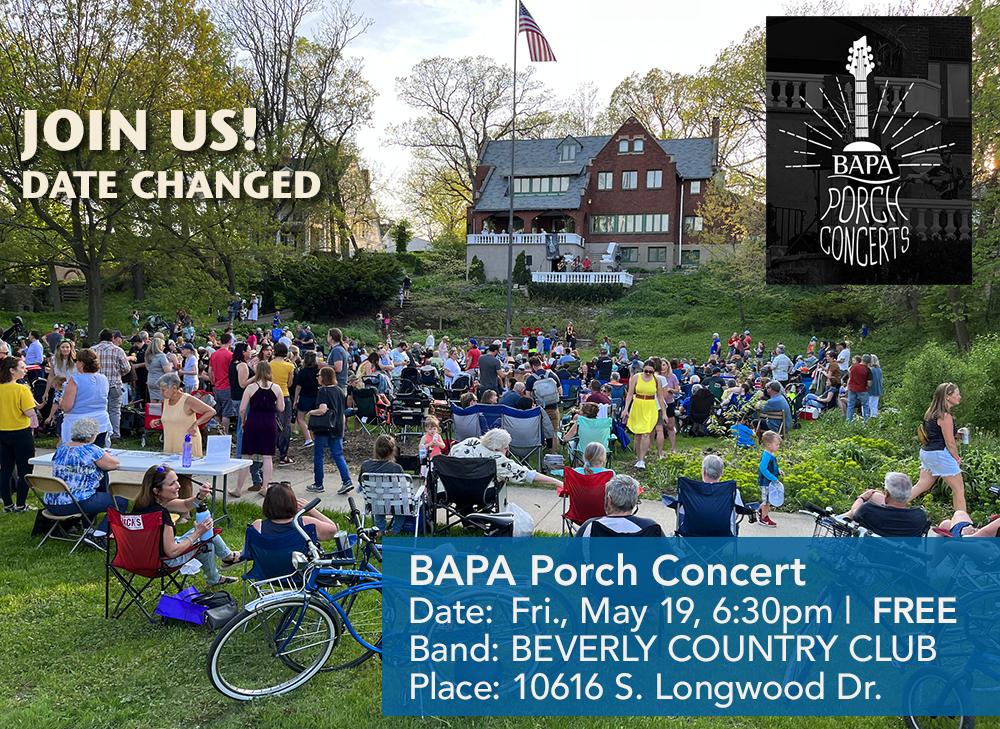
Well, we're going to go ahead and promote this and keep our fingers crossed. The first BAPA porch concert, rescheduled due to rain, will be held this Friday, May 19, at RHS, on the Longwood Drive lawn – 10616 S. Longwood Drive. The concert starts at 6:30 p.m.
Rain is forecasted for that day, so we'll see – watch this page for updates.
The Ridge Historical Society
Mother’s Day – Part 7 on the Hofer Sisters – the League of American Mothers
By Carol Flynn
Today is Mother’s Day, the perfect day to continue the series on Andrea Hofer Proudfoot, the fourth of the five Hofer sisters, who started the League of American Mothers.
In November of 1893, Andrea, 27, married Frederick William Proudfoot, an attorney from Englewood whose practice included legal work with the Chicago Board of Trade.
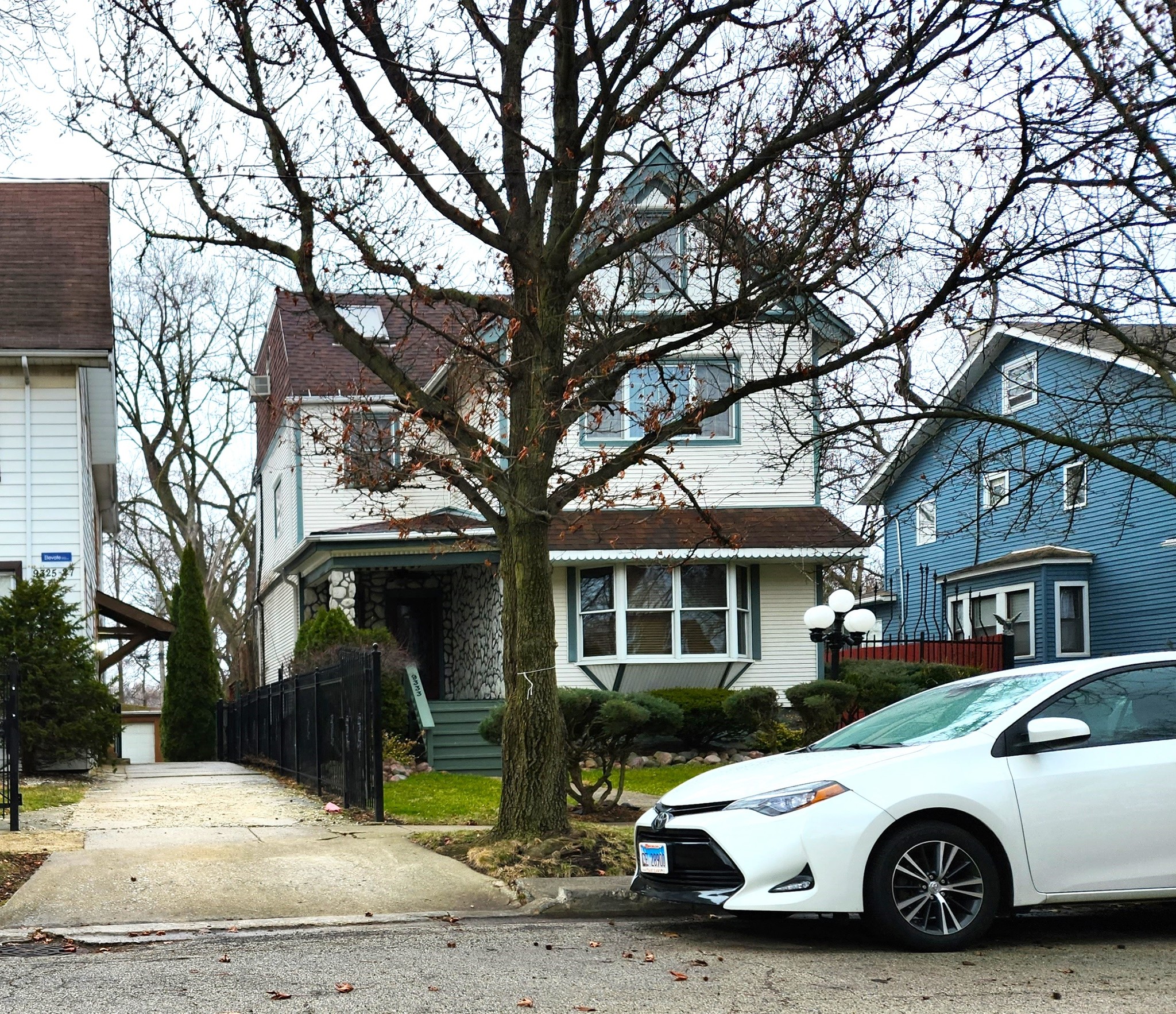
One of Proudfoot’s wedding gifts to Andrea was an estate in North Beverly known as “Oakhurst” located at today’s address of 9333 S. Vanderpoel Avenue. The street was previously known as Prospect and then Howard Court. Andrea and Frederick moved into the house and started a family; six children were born to them between 1894 and 1907.
Around 1895, Andrea and her younger sister Elizabeth (Elsa) Hofer Schreiber started a school in the Proudfoot home they called the Froebellian School for Young Women. This school trained women to be kindergarten teachers, based on the principles of Friedrich Froebel, a Prussian educator who founded kindergartens in Germany in the 1830s. He based his schools and training programs on the principles originally developed in the 1700s by Swiss educator Johan Heinrich Pestalozzi.
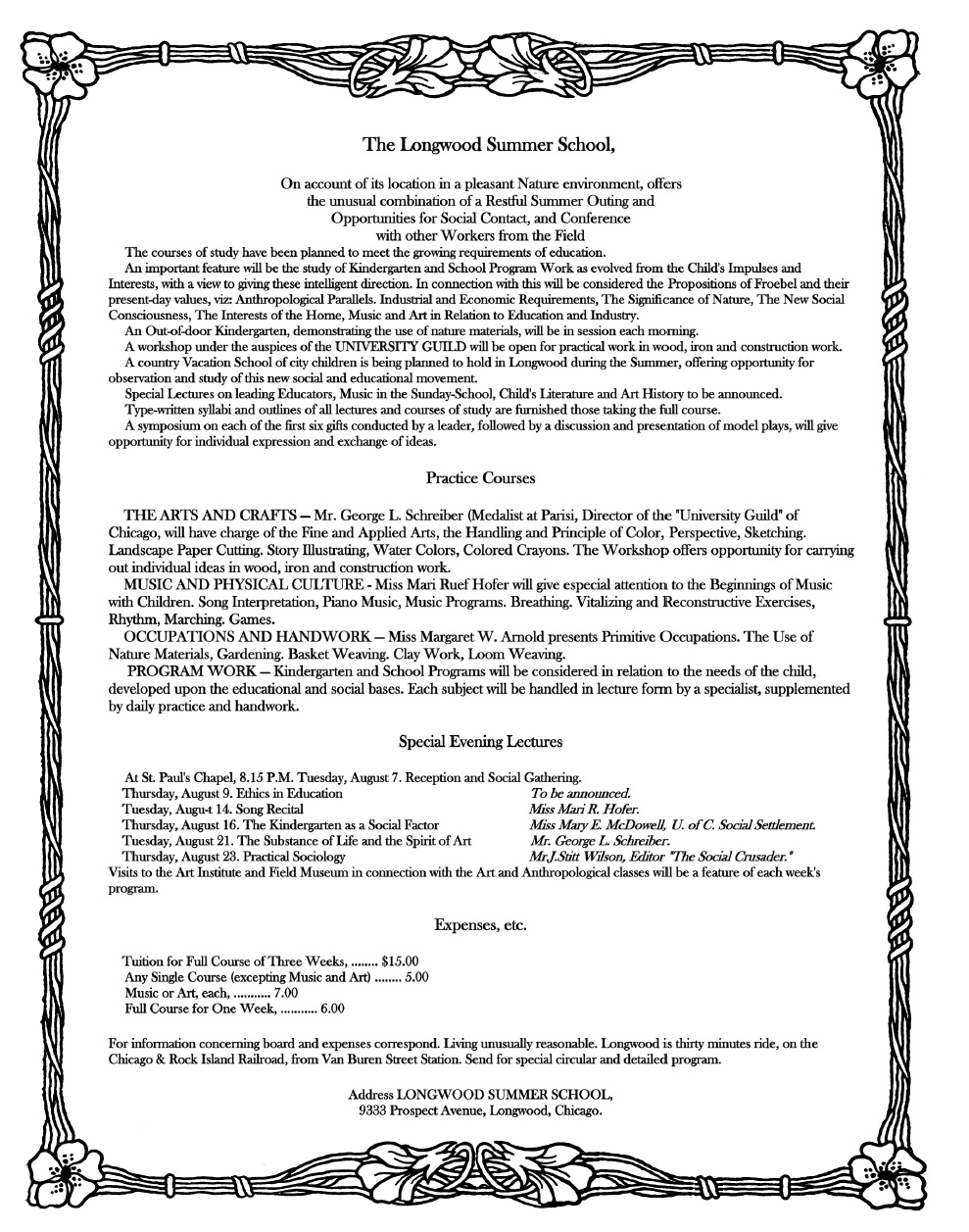
The school incorporated much more than classroom work, giving the women who trained there a variety of hands-on experiences. By 1900, the facilities included: the kindergarten teacher training program; a kindergarten for young children; boys’ and girls’ clubs; a grade school that continued the kindergarten principles and included industrial training in onsite workshops; high school level classes for girls; a playground open to all children; and a summer school program (then called vacation schools) for disadvantaged inner-city children. During the summers, the school also ran professional-level programs for educators as the Longwood Summer School.
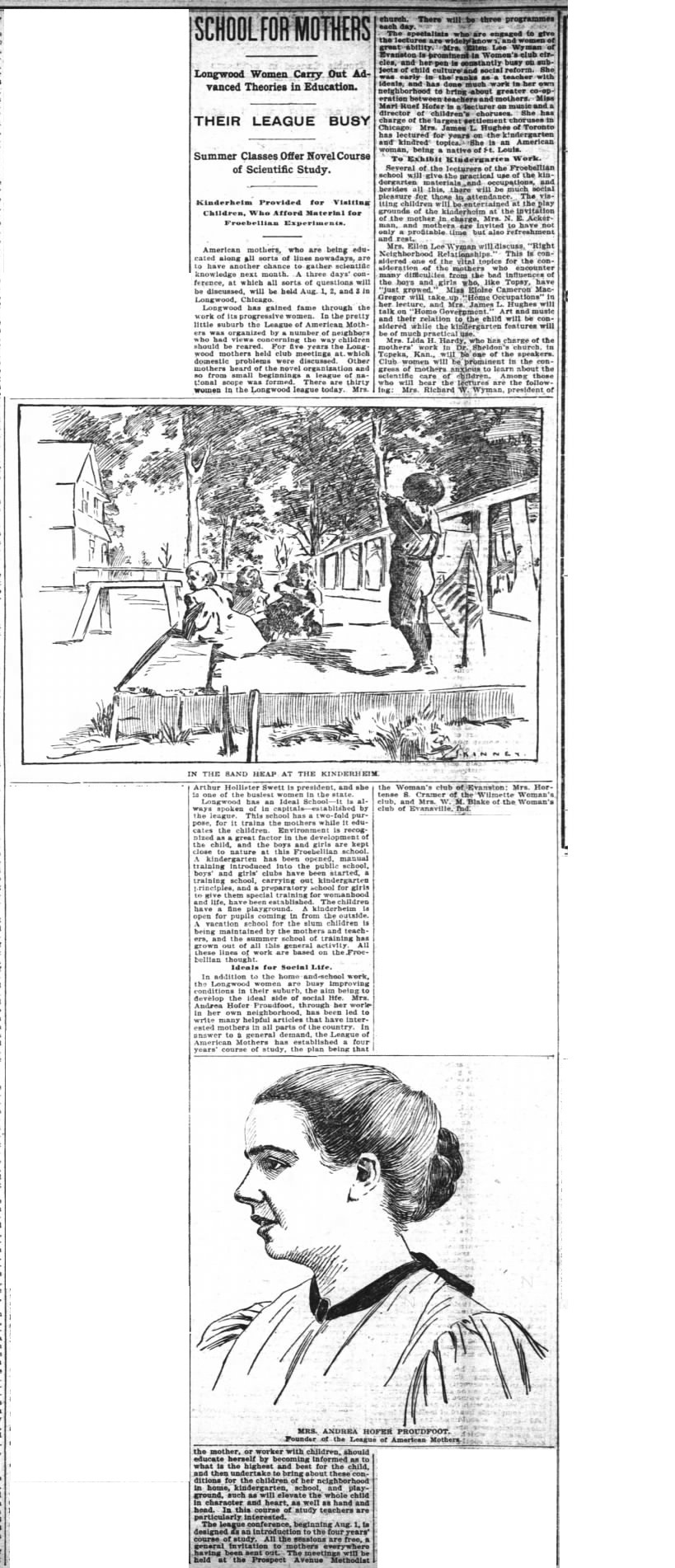
Central to this operation were also education and support programs for mothers. In 1895, Andrea formed the League of American Mothers that rose to national prominence. Local Leagues were set up all around the country. Any mother or teacher could join, there were no dues; the League was largely operated and funded personally by Andrea. Groups of mothers met frequently at the Proudfoot home and were involved in all of the school programs.
A multi-year course of self-study for mothers was developed through the League, using materials written by Andrea. The books included “A Mother’s Ideals: A Kindergarten Mother’s Conception of Family Life” for the first year of study, published in 1897; and “A Year with the Mother-Play,” for the second year, published in 1902. For mothers who could not afford to purchase the books, thousands of “travelling libraries” were set up around the country.
Andrea dedicated the first book, “A Mother’s Ideals,” to her own mother, Mari Ruef Hofer. Andrea wrote: “To My Mother – Who has been preserved to the simplicities of life through having child companions; whose duty toward the home has kept her from pursuing schoolishness; who has studied more deeply into the affections than into psychology; and who loves humanity because it has been given an impulse onward through her as a channel, and an impulse upward through her spiritual striving for her children.”
Teachers-in-training boarded at the school. All of this went on in the Proudfoot home. It can only be imagined what a busy place this property in North Beverly must have been.
Related to all of this, Andrea started a new magazine, Child-Garden of Story, Song and Play. This magazine was published from their house in North Beverly, and the subscription price was $1.00 for twelve issues.
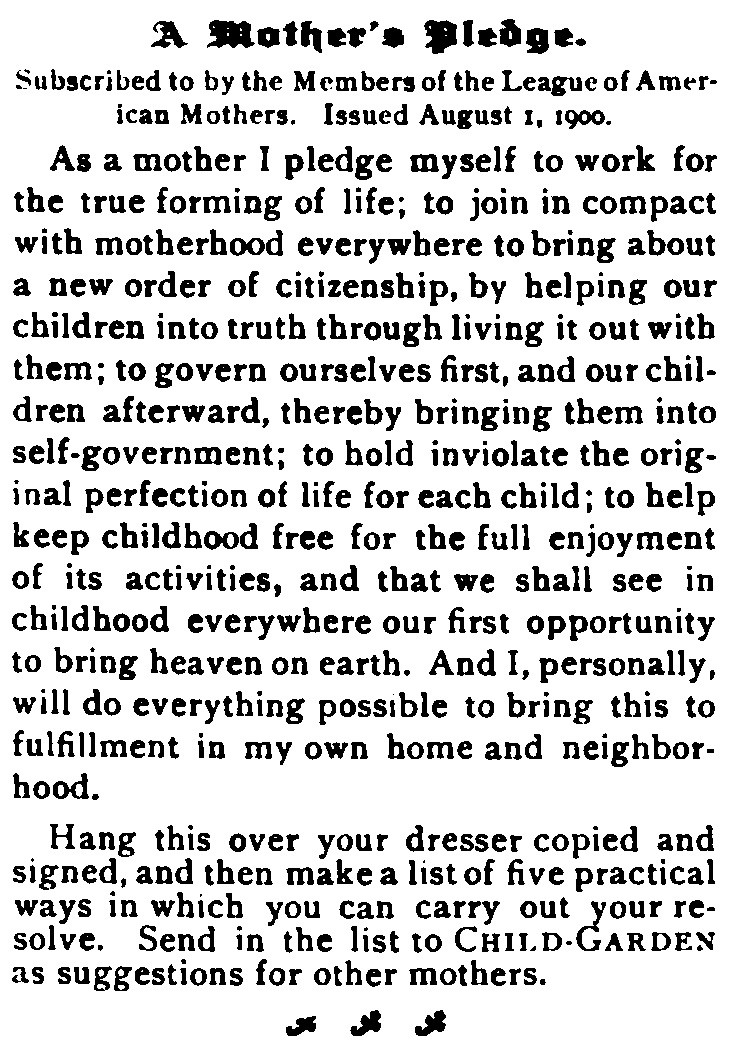
Child-Garden was described by Andrea as “the national organ of the League of American Mothers.” Each issue included poetry and stories for and by children, ideas for kindergarten teachers, and a section related to the League with subject matter for mothers’ programs, advice and discussion. Mothers were invited to correspond directly with Andrea at her Beverly address, and many did. Some of their letters were included in the magazine.
Andrea offered educated and practical advice to mothers. In the December 1900 edition of Child-Garden, for example, Andrea advised mothers to ignore advertisements and articles about diseases and “quackery patent medicine concerns” and to get advice from trusted medical professionals when needed. Child-Garden refused to carry such questionable medical content even though it cost them advertising revenue.
Child-Garden offered advice like “we expect too much from punishment – it will not take the place of firm, kind, loving, intelligent watchfulness.” Another piece of advice was that no two people were alike and children should not be forced to conform too much one way or another; they should be allowed to work things out.
Mothers wrote heart-felt letters to Andrea with statements like, "I feel as if you were my friend."
Leading up to a national congress on motherhood in 1900, in which Andrea and the League were expected to play a major role, one newspaper wrote, “Mrs. Proudfoot is a pioneer in the mothers’ work of this country. She is urging the mothers of this land into a higher respect for their calling and demands that they shall put it upon a professional basis through study and demonstration.”
The school in North Beverly ran for about nine years. In December of 1914, there was a curious article in the Chicago Tribune that a fire had occurred in the now-empty building – at the time, Andrea was spending a lot of time in Vienna, Austria, with her children who were there for educational reasons. A neighbor all but accused Andrea of arson, and the article wondered if charges would be forth coming. No more was found on this and within a few months Andrea was back to being prominently mentioned in the paper for heading a Republican women’s group, so apparently the charges were baseless.
This brings us to one more topic related to Andrea and her Hofer sisters – their involvement in politics and the international peace and amnesty movement, which will be covered in the next post.
In Memory of Marie Sandstrom
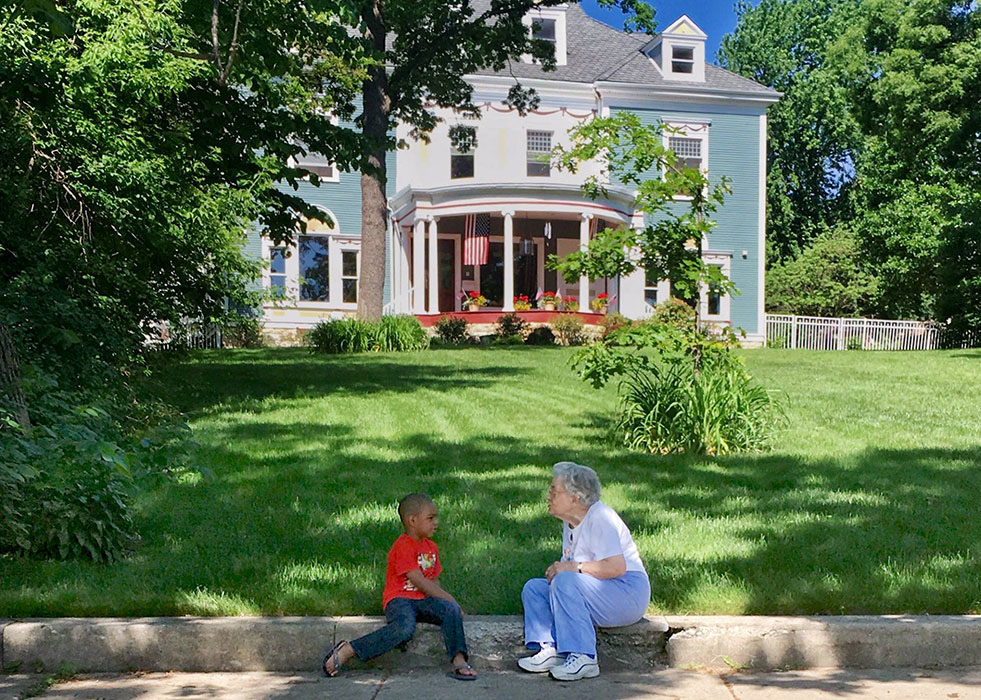
There’s a photo on the Beverly Area Planning Association website from the 2016 Memorial Day Parade that shows an older white woman talking with a young Black boy, while they sit together on the curb in front of the Horton House on Longwood Drive.
That woman was Marie Sandstrom, and that was the kind of thing that Marie did – reach out to people and engage with them in a kind, genuine, straight-forward way.
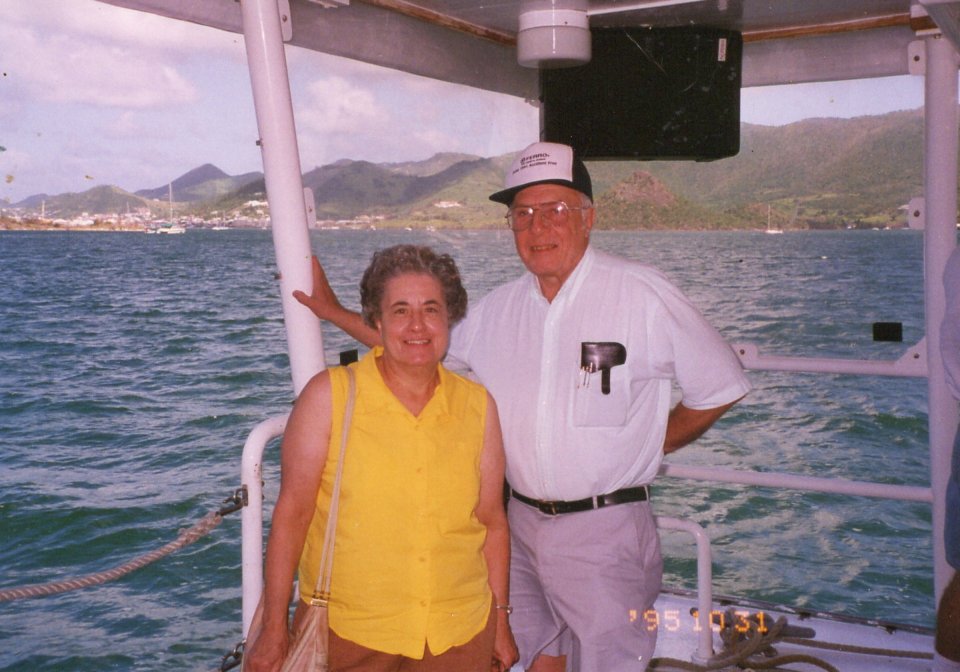
The Ridge Historical Society was saddened to learn that Marie passed away on April 23, 2023, at 94 years of age.
Marie and her husband, Bill Sandstrom, were a major presence at RHS for many years. Bill passed away in 2019, after serving as RHS president and treasurer.
Marie was part of the Social Committee at RHS; in fact, for some time she was the entire Social Committee. Marie could always be counted on to help at an event, setting up the buffet table, making the coffee, greeting and serving people, cleaning up. If attendees were lucky, Marie made her famous lemon bars to be served that day.
As part of her self-assigned duties, Marie took care of household tasks around the Graver-Driscoll House, things that many people just took for granted – buying paper towels and toilet paper and coffee; arranging for the place to be cleaned; laundering the curtains.
A physically small woman, Marie’s head barely cleared the steering wheel of her car. To the unpracticed eye, it would look like a driverless car had just pulled into the parking area.
However, although she was small, she was mighty. Marie was no push-over; she held her ground for what she thought was right.
The Sandstroms were dedicated members of Bethany Union Church, where Marie was usually in charge of the kitchen. The church’s annual spaghetti dinners under the direction of “Mama Marie” were unforgettable, drawing in large crowds for Marie’s homemade spaghetti sauce.
They were also active members of the Kiwanis and the Chicago Art Deco Society.
The real passion that Marie and Bill shared, though, was dancing. Bill took dancing lessons as a young World War II veteran so he could meet girls at dances. One young lady he asked to dance was Marie Bianchi. They got married in 1952. They had two children and the family moved to Beverly in 1965.
Marie and Bill became members of the Cotillion Club in Beverly, which had formed in 1939. “Cotillions” are formal balls, and the club held regular formal dances at local country clubs and other venues. As late as 2018, the Sandstroms, both in their 90s, were on the Club’s Dance Committee. Some of the dances at cotillions have specific moves and steps that the dancers need to be proficient in, and the Sandstroms shared the floor with the best.
At Bill’s memorial service, one of their grandsons related a favorite family story about the couple’s dancing. While in Pasadena for that grandson’s graduation, the family was out for an evening of entertainment. Bill requested a song from the jazz piano player and singer, and he and Marie began to dance. Other patrons came over to watch this elderly, accomplished couple perform, and began depositing money in an empty water glass in the center of the table. At the end of the dance, the singer came over to tell them she had never seen anything like this in all her years; their dancing together was beautiful. Noticing the monetary donations, she laughed and told them, “You two should come back every night – you could really make a living at this!”
Bill was eulogized for his loyalty, kindness, and service, but it’s more accurate to say that like dancing, it was a team effort, made possible by Marie and Bill working together.
There is a saying that “service is the rent we pay for being.” Marie and Bill surely paid enough rent through their service to others to now be dancing together forever in the finest heavenly mansion.
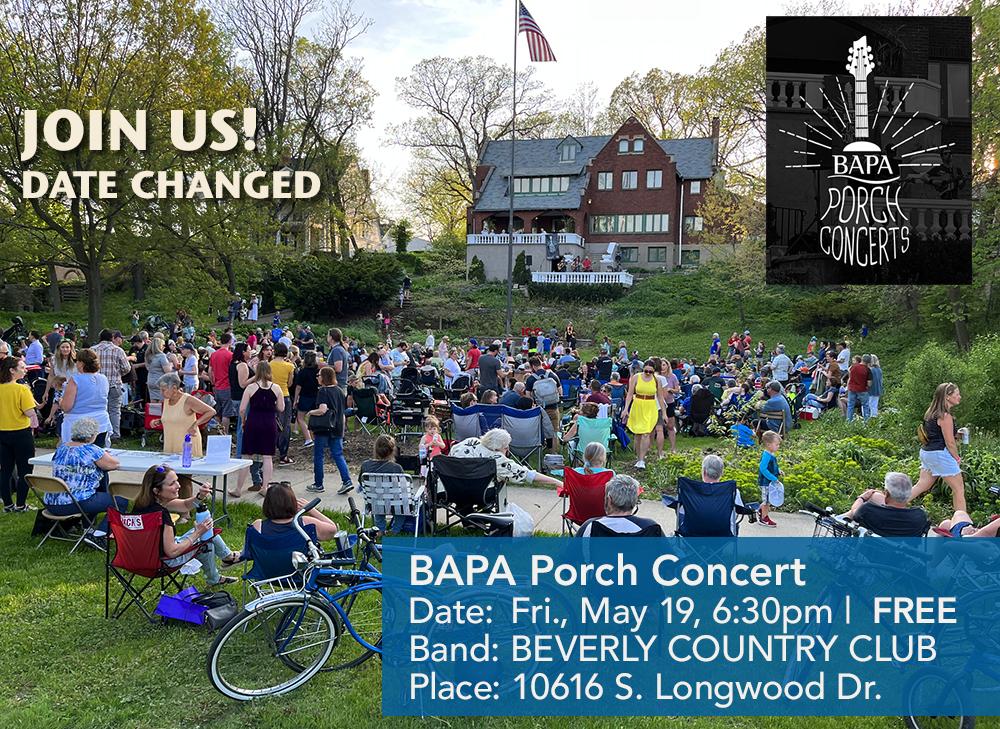
The BAPA porch concerts are about to begin another season! And the first one will be held at RHS.
The Beverly Country Club band will play at RHS, 10616 Longwood Drive, on Friday evening, May 19 (rescheduled from May 12), starting at 6:30 p.m. The event is free, just bring your own lawn chairs to sit in.
RHS requests that people approach the building from the Longwood Drive side. The Seeley Avenue entrance and driveway may be blocked by equipment trucks.
Ridge Historical Society
National Teacher Appreciation Week – Catherine A. Burke
By Carol Flynn; research collaboration by Tim Blackburn
May 7 to 13 is National Teacher Appreciation Week. An official event since 1984, the week reminds us that educators deserve our support, respect, and gratitude for all they contribute to society.
Many educators have called the Ridge home, and the city and the local community have recognized some of the trailblazers who lived here. Alice Barnard, Bessie Sutherland, and Kate Starr Kellogg have schools named for them. John H. Vanderpoel has a street and a school named for him, plus a memorial association, founded in his name, to collect art.
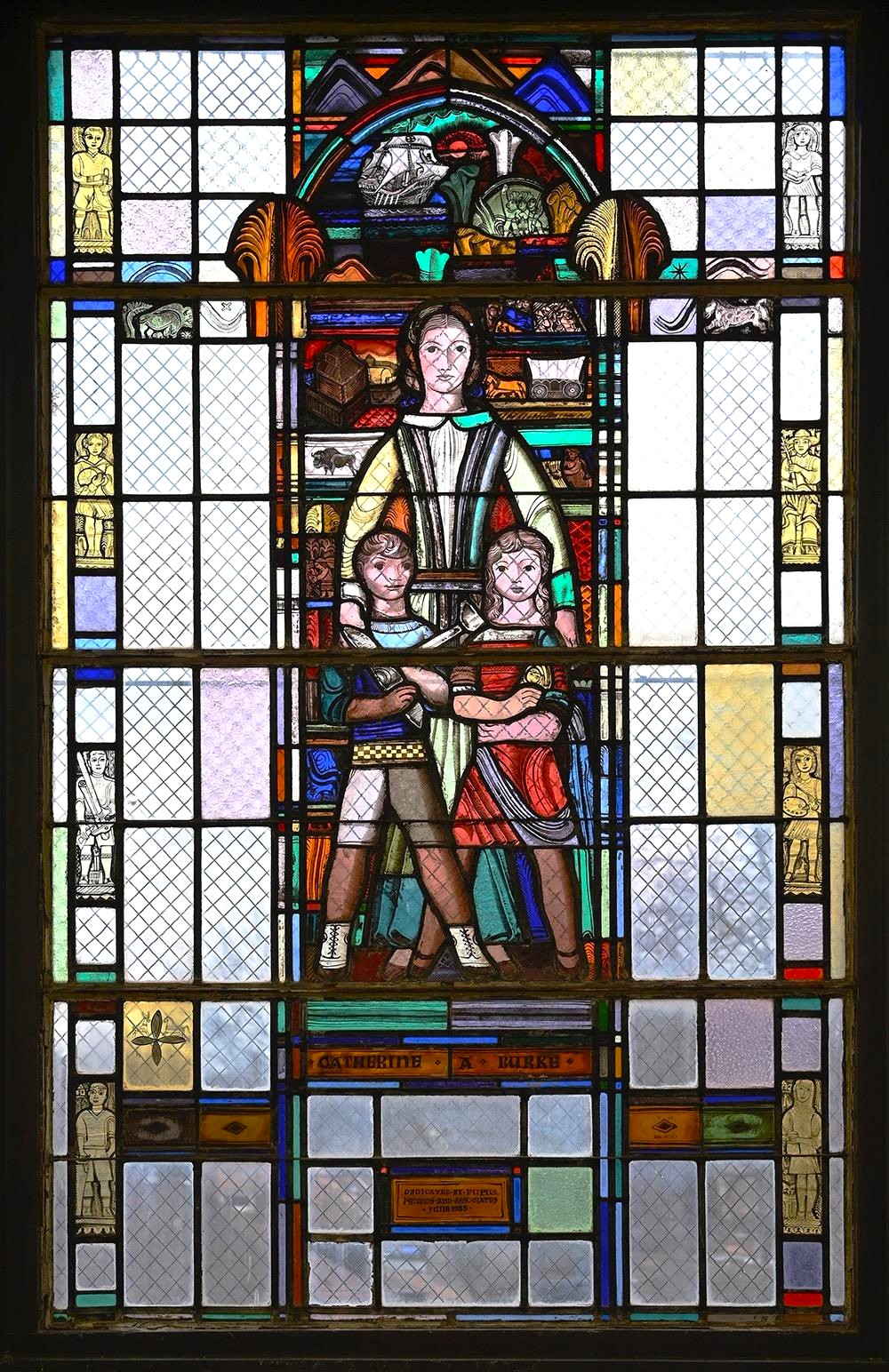
Many other remembrances have been lost to time. Recently, one was rediscovered and brought to RHS’s attention. This is the stained-glass window at the John H. Vanderpoel Humanities Academy at 9510 S. Prospect Avenue that is dedicated to Catherine A. Burke.
The window was rediscovered by Katharine Konopasek, a Beverly resident who is a retired Chicago Public School (CPS) principal who continues to help by substitute teaching. Katharine was subbing at Vanderpoel when she saw “rainbow colors” coming from behind a shade covering a window on the third floor of the school. Pulling aside the shade, she found the window, which is inscribed “Catherine A. Burke,” and “Dedicated by pupils, friends and associates – June 1935.”
Curious about the history of the window, Katherine tried to find information through CPS and the school. When no information was available in those files, she contacted the Vanderpoel Art Association, which started its collection in that school. The Vanderpoel volunteers didn’t know about the window, but they arranged to have it photographed.
Katherine then reached out to RHS, and we started researching it. This is the story we’ve uncovered so far.
Catherine A. Burke was the first principal of the Vanderpoel School, serving from 1912 to 1929.
Catherine was born in Joliet, Illinois, on June 7, 1862. Her parents were Patrick and Elizabeth Burke, both from Ireland. When Patrick died in 1905, the Joliet Evening Herald newspaper described him as “one of the best known of the Joliet pioneers.” He worked for a railroad and then for a company in the Joliet limestone industry. He was best known for being a leader in the temperance movement. He was also described as a “lover of good literature” who enjoyed discussing books and authors.
There were at least six Burke children, and Catherine and her older sister Mary became teachers. They graduated from the Joliet high school. Many high schools in those days prepared girls for careers as grade school teachers. Later, Catherine and Mary both studied at the University of Chicago.
Both women earned good reputations as instructors at the Eastern Avenue school in Joliet. By 1900, the parents and these two daughters had moved to Chicago so that Mary and Catherine could take “a high place as teachers in the public schools.” They rented a house at 3800 S. Indiana Avenue. After the father died, the mother and daughters moved to 453 Oakwood Boulevard, where they rented an apartment in a two-flat.
Catherine was employed as a teacher in the CPS schools. A 1906 Chicago Tribune article reported that the school board approved a salary promotion for Catherine because she held a principal’s certificate. This meant she had taken coursework and passed an exam, which qualified her for promotion within the school system. Her promotion had been recommended by Ella Flagg Young, who had been a District Superintendent of CPS and would become the first woman superintendent of CPS, and the first woman superintendent of any large school system in the country, in 1909.
Young advocated for employment rights for female teachers, addressing issues like employing married women as teachers, advancement opportunities for women in the Chicago schools, and pay equity between female and male teachers. Other Progressive women were also involved in the school system by then – famous social worker and reformer Jane Addams of Hull House was a member of the school board.
In 1912, Young appointed Catherine as the first principal of a new school opening in Beverly at 95th Street and Prospect Avenue. At the time, Catherine was reported as a teacher at the Willard School. She had held previous positions at the Park Manor School and the Brenan School.
The original name of the new school in Beverly was the John Farson School, named for a well-known Chicago banker, lay religious leader, and philanthropist, whose sister Elizabeth Farson was a CPS principal. Farson had no connection to Beverly; his name had been chosen by the president of the school board.
The Beverly community wanted the school named for John H. Vanderpoel, the artist who had been head instructor at the School of the Art Institute of Chicago. Vanderpoel, who had lived in North Beverly, had died in 1911. The school board president said it was too late to change the name of the school because Farson’s name already had been, literally, carved in stone on the front of the school.
However, in 1913, with the support of Farson’s widow, the name of the school was changed to Vanderpoel’s name.
In 1914, the Vanderpoel Memorial Association (today’s Vanderpoel Art Association) was founded by the artist’s friends and fans. They started an art collection which was installed in the school. The first piece obtained for the collection was “The Buttermakers” by Vanderpoel. Artists and collectors donated hundreds of pieces of artwork for the collection.
Displaying artwork in schools was the usual practice back then. The collections were often managed by the local women’s clubs. When the current Morgan Park High School was established in 1914 – 1916, prominent clubwoman Gertrude Blackwelder oversaw the acquisition of artwork for the school, with the assistance of the Morgan Park Woman’s Club. The situation at Vanderpoel was unique, with the emphasis on the collection as a memorial to the late artist/educator.
Catherine Burke served as a vice president of the Vanderpoel Memorial Association. The art collection was a very important part of the school.
Next post: Catherine Burke’s years as a school principal in Beverly, and the stained-glass window.